AI Training for Employees: Teach the Clarifying Question
AI training for employees should teach one consequential clarifying question before prompt writing, so the task, evidence and approval boundary are clear.
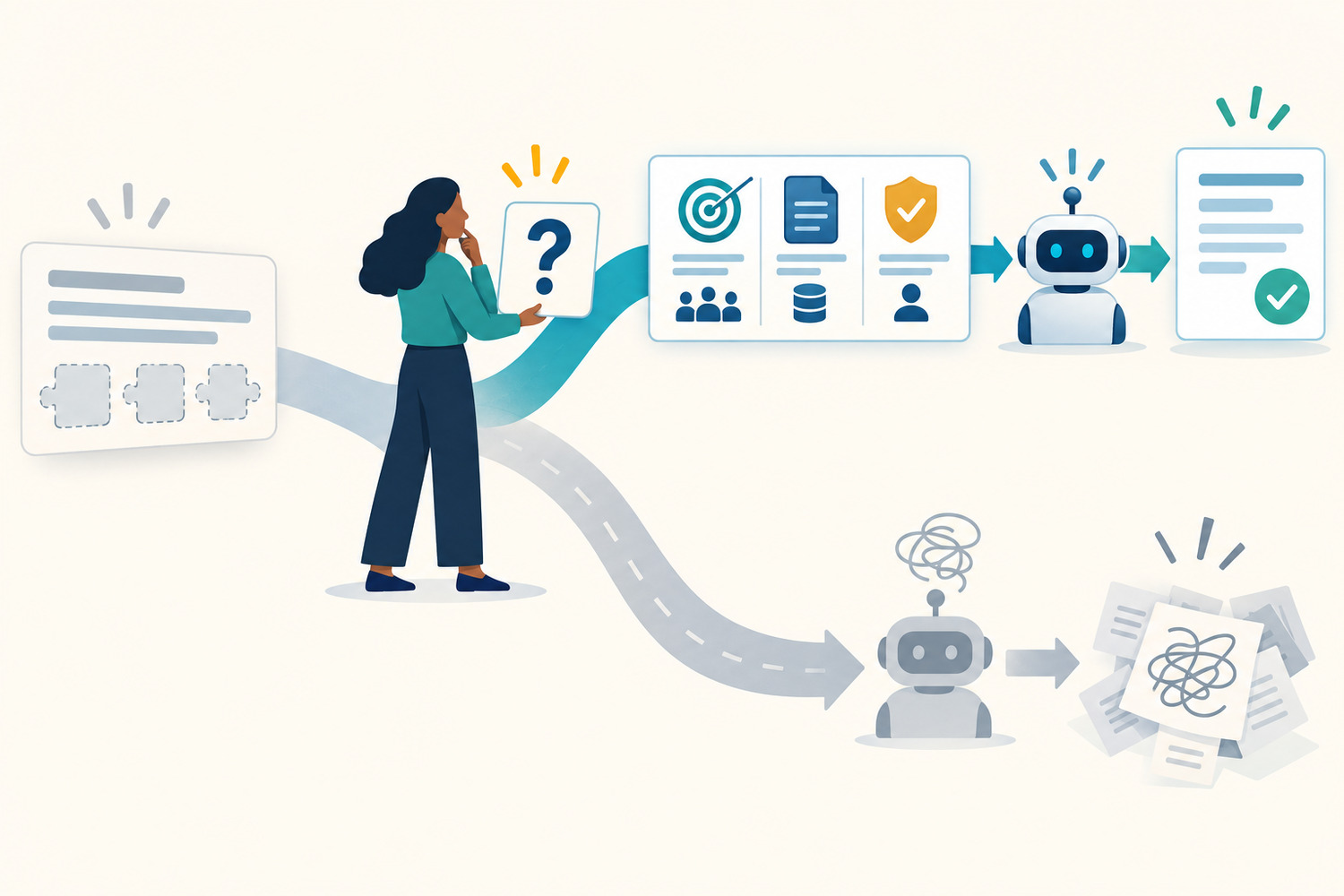
AI training for employees often gives people a complete brief and teaches them to write a better prompt. Real work is less tidy. A manager may ask for “a short client update” without naming the audience, approved facts, decision owner or deadline. If training always fills those gaps, employees can learn to produce fluent answers before they understand the task.
Teach one small skill before prompt writing: ask the clarifying question that changes the work. The goal is not a long interview or another template. It is a deliberate pause to identify the missing detail that would most affect the output, the evidence needed or the person who must approve it.
Why AI training for employees needs incomplete briefs
The European Commission’s current AI-literacy guidance says organisations should adapt learning to staff knowledge, the system, its risks and the context and purpose of use. The UK Government AI Playbook likewise recommends defining a clear goal, choosing use cases that meet a real need and building in human review where impact warrants it. A learner cannot apply those principles if the exercise hides every uncertainty.
The US Office of Personnel Management starts training needs assessment with performance requirements, desired outcomes and critical behaviours. For many AI-assisted tasks, one critical behaviour happens before the tool opens: noticing that the request is incomplete and asking for what is missing.
Ask for the detail that changes the task
Outcome and audience
What decision, action or reader must the output support? A format request is not the same as a work outcome.
Evidence and source
Which facts are approved, where do they come from and what must be checked before use?
Boundary and owner
What may the AI prepare, what must a person decide and who approves the final use?
Choose one question, not every question
Good judgement includes deciding which uncertainty matters most. If the audience is unknown, tone and detail may both be wrong. If the evidence is missing, the answer may invent or overstate. If the approval boundary is unclear, the learner may turn a draft into an unauthorised commitment. Ask first about the gap with the largest effect on correctness or consequence.
This differs from task decomposition. Decomposition divides known work into inspectable stages. Clarification establishes what the work is before those stages begin. Use both: first resolve the decisive gap, then apply Bokili’s task-decomposition method to the clarified brief.
Reading is a start. Practice makes it stick.
Start learningWorked example: the delayed delivery update
A manager says: “Use AI to write a short email about the delivery delay.” The learner could start prompting, but three facts are missing: which customers are affected, what date is confirmed and whether any remedy has been approved. A useful clarifying question is: “Which customers and delivery date are confirmed, what remedy may we mention, and who approves the email before it is sent?”
The answer may reveal that only one region is affected, the date is still provisional and no compensation is approved. The task changes from “write an apology” to “prepare an internal draft that states the confirmed scope, marks the date as provisional and leaves the remedy for approval.” The AI output is now easier to review because the boundary is explicit.
Build the clarifying-question practice
- 1
1. Remove one decisive detail
Give the learner a realistic request with one important gap in outcome, evidence or authority.
- 2
2. Require a pause
Do not let the exercise advance until the learner writes one clarifying question.
- 3
3. Reveal the answer
Provide a short response that materially changes the brief.
- 4
4. Run the AI task
The learner prompts only after the missing detail is supplied.
- 5
5. Score the question
Check whether it reduced the largest risk or ambiguity, not whether it used special wording.
- 6
6. Carry the context forward
Use a short handoff note so the answer, source and approval boundary remain attached to the draft.
Score the pause, not just the prompt
A weak course may praise the final email and miss that the learner guessed the date. A stronger assessment gives credit for identifying the missing information, asking a relevant question and preserving the answer in the working brief. The final draft still matters, but it no longer hides the judgement that made it possible.
For programme design, pair this skill with the practice-brief method and the AI handoff card. The Bokili programme for HR and L&D supports short, role-based practice around realistic tasks and feedback.
- Choose a repeated request from a low-risk workflow.
- Remove one detail about outcome, evidence or approval.
- Write the single question that would best recover that detail.
- Prepare a two-sentence answer that changes the task.
- Define what the learner must carry into the AI prompt.
- Score whether the question reduced ambiguity before scoring the output.
The first useful prompt may be a question to a person
Employees do not need to interrogate every request. They do need permission and practice to pause when the missing detail would change the result. AI training for employees becomes more realistic when a learner can recognise an incomplete brief, ask one consequential question and then use AI with the right outcome, evidence and approval boundary in view.
Sources
- AI Literacy — Questions & Answers — European Commission
- Artificial Intelligence Playbook for the UK Government — GOV.UK
- Planning & Evaluating Training — U.S. Office of Personnel Management
- Bokili for HR and L&D — Bokili
Reading is a start. Practice makes it stick.
Bokili turns skills like this into ten-minute missions for your whole team, with instant feedback and progress you can see.
Start learningKeep reading
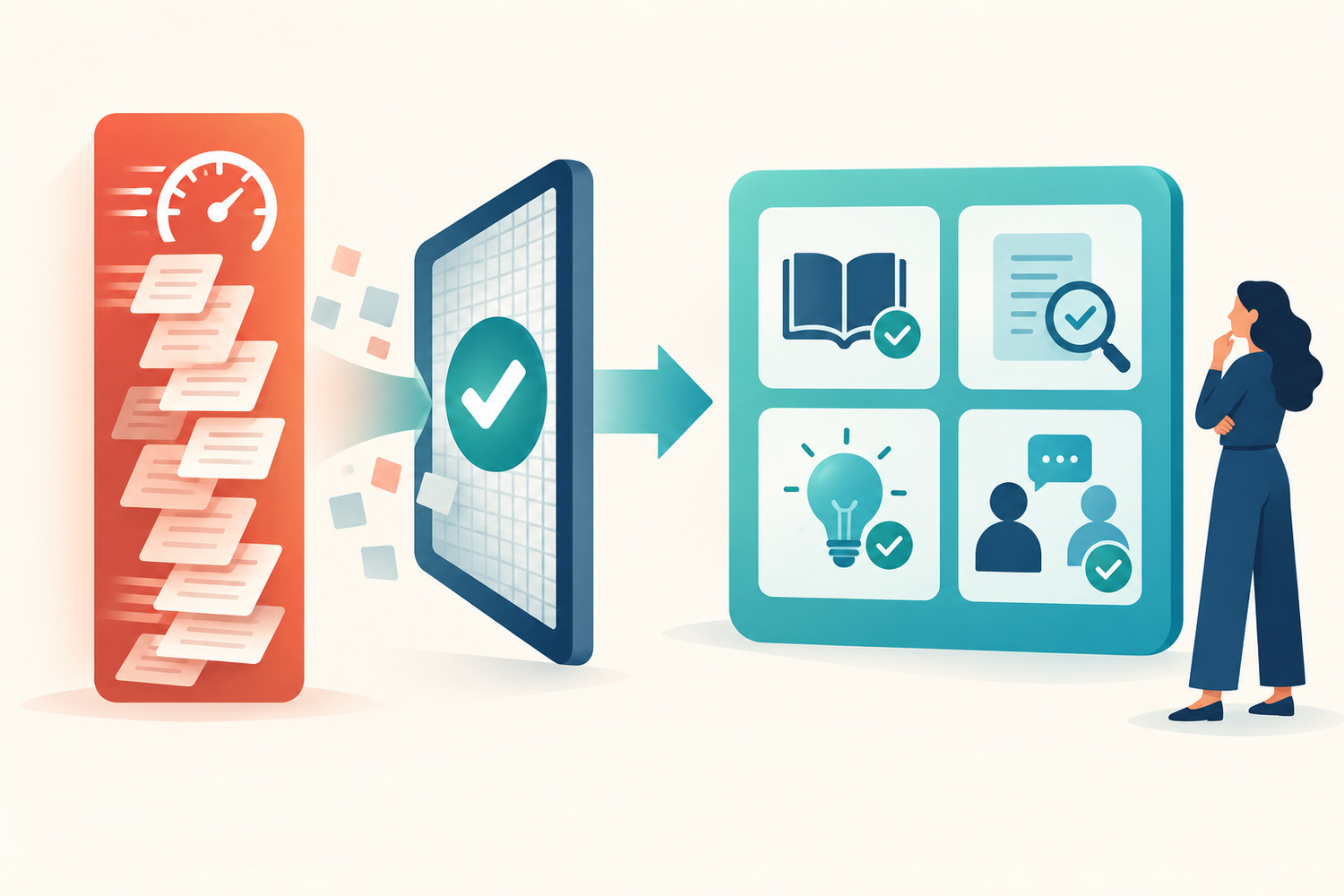
An AI Training Leaderboard Should Reward Verification, Not Speed
A learning leaderboard is useful only when its points make careful practice, evidence checks, correction and peer help more visible than raw output volume.

AI Training for HR: Audit the Job Description Before You Publish
AI training for HR should teach teams to trace every job requirement to real work before a polished draft becomes a hiring filter.
Separate the AI Draft From Its Acceptance Test
When one AI produces both the recommendation and the test used to approve it, shared blind spots survive. Fix human-owned criteria first.