
AI Training for Employees: Teach Task Decomposition
Teach employees to split complex work into small AI-assisted passes with explicit human checks before recombining the final output.
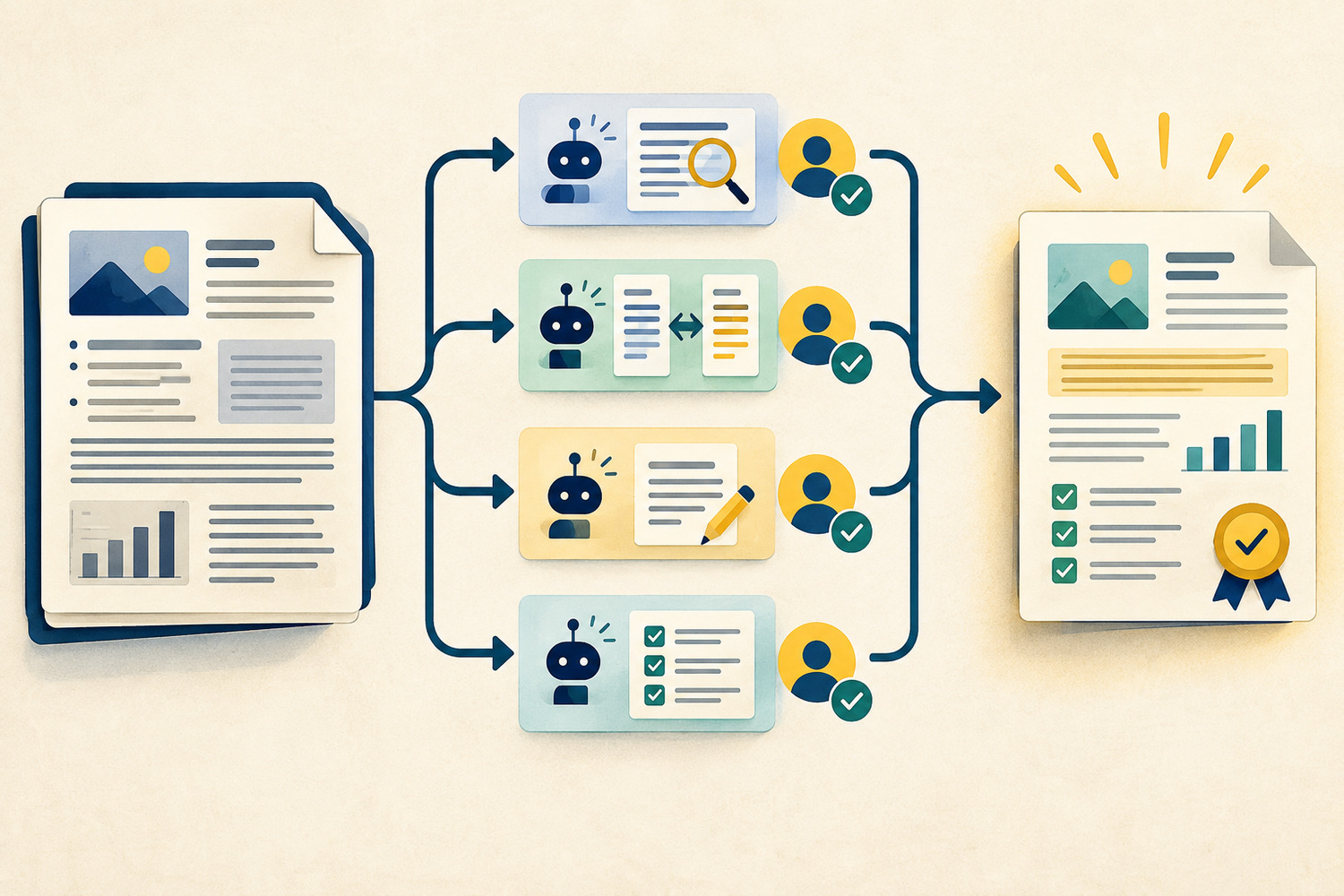
AI training for employees often starts with prompt tips and stops just as the work becomes difficult. A learner can improve one request yet still struggle with a task that involves several documents, decisions and quality checks. The missing skill is task decomposition: breaking one outcome into small AI-assisted passes that a person can inspect before the work is recombined.
This article is for L&D and enablement leaders designing practical workplace training. Its thesis is that decomposition should be taught before advanced prompting. A well-mapped task gives each AI step a narrow purpose, a safe input, an observable output and a human check. That makes errors easier to find and the final work easier to own.
Why AI training for employees should start with the whole task
NIST’s AI Use Taxonomy starts from human goals and outcomes. It treats a task as a combination of AI-use activities rather than defining work by one model or product. NIST’s human-centred AI programme also says the taxonomy can support task analysis for specific use cases and keep attention on overall tasks and human goals.
The US Office of Personnel Management makes a parallel training point: define the performance requirement, the critical behaviours and the gap before choosing training. It also warns that training is rarely the only solution. Applied to AI, that means a weak workflow may need clearer ownership, better source material or a review gate—not another prompt lesson.
MAP a complex task before anyone prompts
M — Mark the outcome
Write the final work product, its user, deadline and acceptance checks. If “done” is vague, every later prompt inherits the ambiguity.
A — Arrange the passes
Split the work into small transformations such as extract, classify, compare, draft and verify. Give each pass one job and one output.
P — Place the checks
Decide where a person must inspect sources, apply judgement, approve a choice or stop the workflow. Put checks before errors become expensive.
Worked example: turn a policy update into a manager briefing
Consider a fictional HR team with a revised twelve-page hybrid-working policy, the previous version and a set of employee questions. The desired output is a two-page briefing for managers. It must state what changed, what did not change, which questions the policy answers and which questions require HR review.
A one-shot prompt asks an AI tool to read everything and draft the briefing. That is fast, but a reviewer must now inspect extraction, comparison, interpretation and writing at once. When a sentence is wrong, it is hard to see whether the model missed a clause, compared the wrong versions or made an unsupported inference.
The mapped four-pass workflow
- 1
1. Extract
List obligations, permissions, dates and exceptions from the new policy. Require a section or page reference beside every item.
- 2
2. Compare
Compare the extracted items with the previous version. Label each as new, changed, unchanged or removed. A policy owner checks the high-impact changes.
- 3
3. Draft
Write the manager briefing only from the checked comparison. Separate firm guidance from questions that still need HR judgement.
- 4
4. Verify
Check every material statement against the new policy, confirm unanswered questions remain explicit, and review tone before release.
Reading is a start. Practice makes it stick.
Start learning| One-shot task | MAPped task | |
|---|---|---|
| Prompt goal | Produce the whole briefing | Produce one inspectable intermediate output |
| Error location | Hidden inside the final draft | Attached to the pass where it arose |
| Human role | Review everything at the end | Check sources and judgement at named gates |
| Training evidence | A polished document | A sequence of observable behaviours |
Design practice around the passes, not the interface
The exercise should survive a tool change. Give learners a fictional or approved source pack, the same desired outcome and the same acceptance checks. Let them use an approved AI tool, but score the decomposition: Did they define done? Did each pass have one purpose? Were inputs permitted? Did the reviewer see the evidence at the right moment? Did the final output preserve unresolved questions?
Task-decomposition practice brief
- Name one recurring work outcome, one real user and one quality standard.
- Provide fictional, public or approved materials that match the task.
- Limit each AI-assisted pass to one transformation.
- Require a visible source check before interpretation or drafting.
- Put a human decision gate wherever policy, risk or professional judgement matters.
- Ask learners to keep one intermediate output so feedback can target the process.
- Run a second attempt after feedback and compare the changed behaviour.
Decomposition is not more prompting
The purpose is not to turn one task into a long chain of chat messages. Use only the passes that make an important error easier to detect, correct or contain.
- Choose a recurring task that currently takes 30 to 90 minutes.
- Write the final user, output and three acceptance checks.
- List the transformations inside the task using verbs.
- Circle the two or three transformations where AI could help.
- Place one human check after each risky or irreversible pass.
- Remove any pass that adds work without making quality easier to inspect.
Measure whether people can map a fresh task
Do not grade the learner only on the final document. On a new but comparable task, look for four behaviours: a clear outcome, sensible passes, explicit checks and a controlled recombination. Those behaviours show whether the learner can design the work, not merely repeat a saved prompt.
Use Define Done before AI delegation to sharpen the outcome, the prompt experiment template to change one variable at a time, the assumption log for judgement-heavy passes and the AI workflow hand-off when work crosses roles. Bokili’s HR and L&D approach supports short, role-aware practice built around real work.
Good AI training for employees does not teach people to hand over larger tasks. It teaches them to shape the work so that each contribution—human or AI—can be checked. Mark the outcome, arrange the passes and place the checks. Then practise the map on a fresh task.
Sources
- AI Use Taxonomy: A Human-Centered Approach — NIST
- Human-Centered AI — NIST
- Planning & Evaluating — Training Needs Assessment — U.S. Office of Personnel Management
- AI Literacy — Questions & Answers — European Commission
- Features — AI training for teams — Bokili
Reading is a start. Practice makes it stick.
Bokili turns skills like this into ten-minute missions for your whole team, with instant feedback and progress you can see.
Start learningKeep reading
Use Claude Research to Build a Contradiction Map
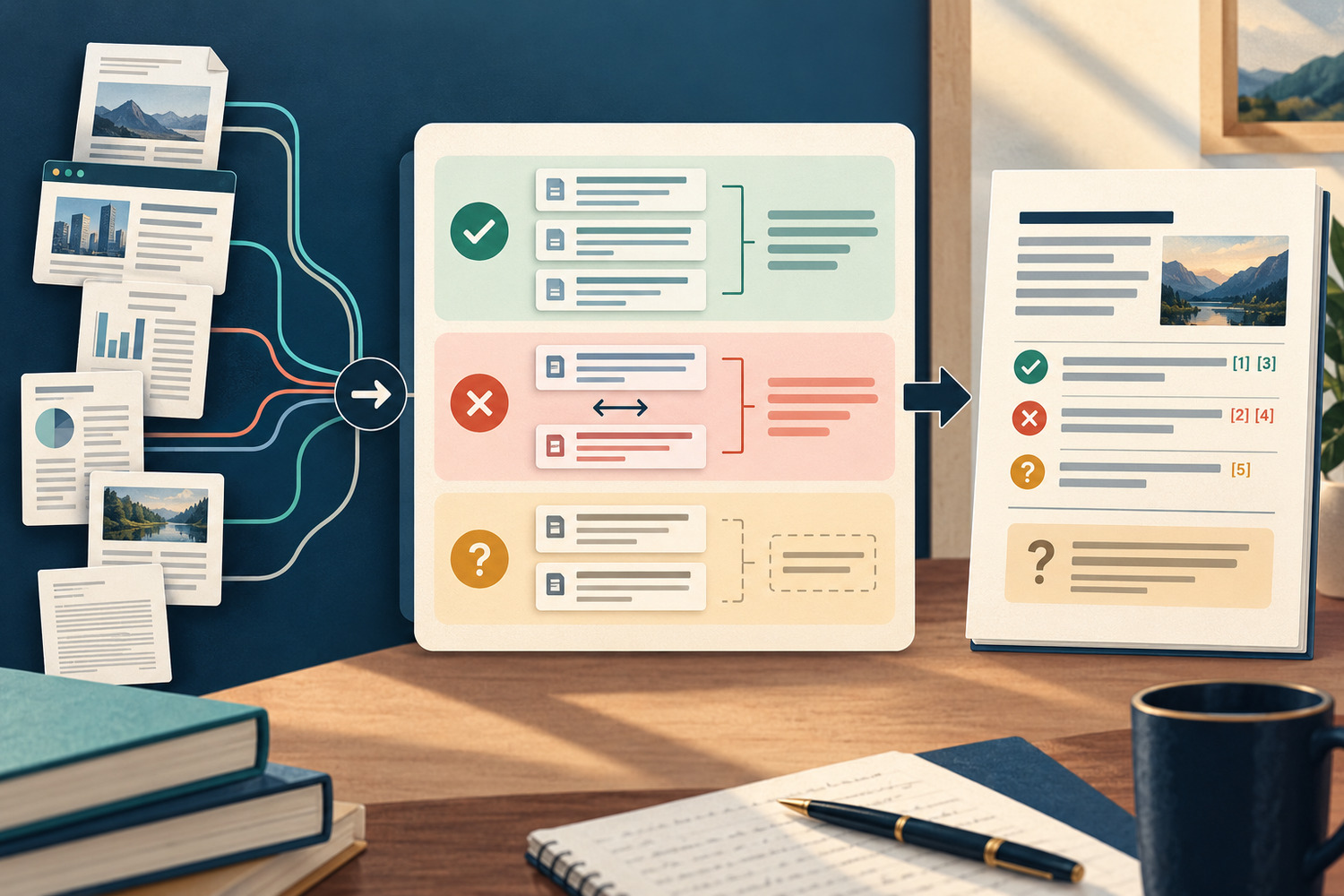
Turn Claude Research into a decision aid by separating source agreement, disagreement and open questions before you write a recommendation.
AI Skills for Employees: Budget the Review Work
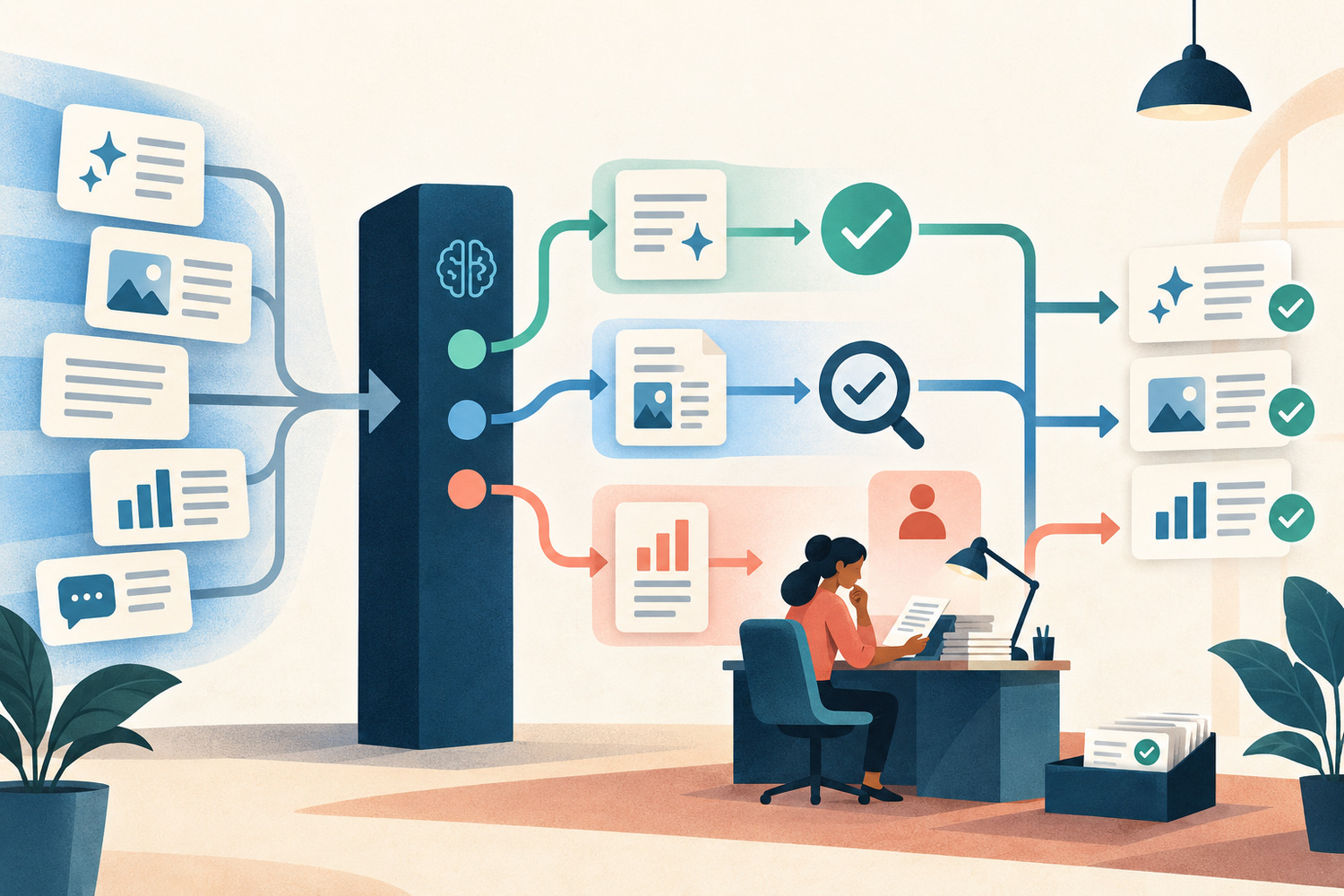
AI skills for employees should include the work that happens after generation: choosing the right review path, attaching evidence and knowing when specialist approval is required.
A Ten-Minute AI Mission Should Leave a Reusable Work Artefact
Short AI practice becomes more useful when the learner leaves with a checked prompt pattern, workflow card or decision aid that can support the next real task.