AI Meeting Notes Need a Commitment Check
AI-generated action items are drafts. Use four commitment states to stop suggestions, assignments and dates becoming promises nobody made.
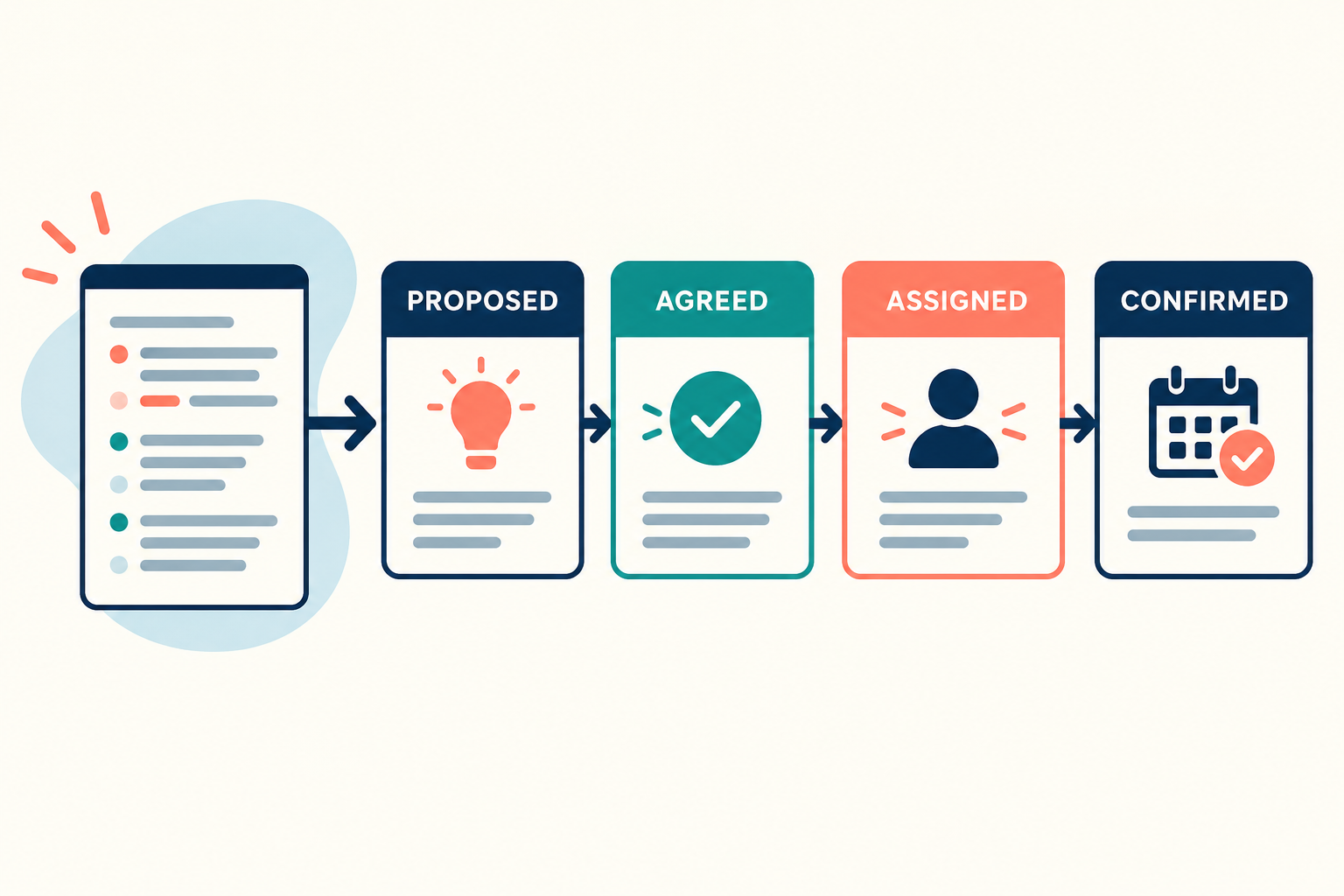
AI meeting notes can save useful time, but an action item is not the same thing as a commitment. A summary may turn “we could ask Maya” into “Maya will deliver”, or attach a date that was only discussed as an option. Microsoft’s own guidance tells users to verify AI-generated meeting notes because the content can be incorrect. The practical risk is not just a wrong sentence. It is work beginning from an agreement that nobody actually made.
The responsible habit is simple: treat every AI-generated action as a candidate until a named person confirms the work, the deadline and the evidence of completion. This is a commitment check, not a second meeting. It keeps the speed of automated notes while returning authority to the people who must do the work.
A fluent action list can hide uncertain authority
AI can organise the transcript. It cannot consent on behalf of the person whose name appears beside a task.
Why ordinary proofreading is not enough
Most reviews ask whether the summary sounds accurate. A commitment check asks a narrower question: what was the status of each statement when it was spoken? Generative AI is good at compressing discussion, but compression can erase the difference between a proposal, an agreement and an assignment. The UK Government AI Playbook therefore stresses accuracy checks, meaningful human control and clear review processes. Those controls matter even in low-stakes work because meeting notes quickly become inputs to project plans, customer messages and performance conversations.
| What the transcript may contain | What the action list must record | |
|---|---|---|
| Suggestion | “Perhaps Leo could draft it.” | Proposed — no owner yet |
| Group agreement | “Yes, let’s do that.” | Agreed — owner still required |
| Assignment | “Leo, please draft it by Tuesday.” | Assigned — awaiting Leo’s confirmation |
| Commitment | “Yes, I’ll send it by Tuesday at 15:00.” | Confirmed — owner and date recorded |
Use four states, not one checkbox
The commitment ladder
Proposed
The task was suggested. Nobody has accepted ownership.
Agreed
The group accepted the need for the task, but the owner or timing may still be open.
Assigned
A person was named. That is a request, not proof that they accepted it.
Confirmed
The named owner explicitly accepted the deliverable and date. Only this state belongs in the committed plan.
This ladder is intentionally conservative. It prevents a confident summary from silently upgrading weak language. It also makes uncertainty useful: proposed and assigned items do not disappear; they enter a short confirmation queue. A team can then resolve them without rereading the whole transcript.
Reading is a start. Practice makes it stick.
Start learningWorked example: the launch review
Imagine a 30-minute launch meeting. The transcript contains: “We should get legal eyes on the new claim. Priya might have time on Thursday.” An AI note says: “Priya to approve the claim by Thursday.” Three changes have occurred. “Might” became ownership. “Legal eyes” became approval authority. Thursday became a deadline. The sentence is tidy, but it overstates the evidence.
Repair the note before it becomes work
- 1
Return to the evidence
Find the exact transcript passage and keep the wording beside the draft action.
- 2
Label the state
Mark this item Proposed because no owner accepted it.
- 3
Ask one closed confirmation
“Priya, can you review this claim, not approve it, by Thursday 15:00?”
- 4
Record the response
Only after Priya accepts should the item move to Confirmed; otherwise change the owner, scope or date.
Notice that the correction does not ask AI for a better guess. It changes the workflow. The transcript remains the evidence, the model provides a draft, and the owner supplies consent. That division matches the broader NIST approach of treating generative AI as something organisations must manage and evaluate, not merely trust because its output is polished.
Make confirmation visible
A useful action register needs five fields: task, state, owner, due date and evidence of completion. Add the transcript timestamp when the commitment is consequential. The evidence field should describe what “done” means: a signed decision, an updated file, a sent message or a reviewed draft. This prevents a second failure mode in which the action is accepted but completion remains subjective.
This behaviour complements Bokili’s practical guidance on clarifying the task, separating an AI draft from its acceptance test, and carrying context into human review. The common principle is that human review needs an explicit object: here, the object is the commitment state.
- Take five AI-generated action items from a recent meeting and locate the supporting transcript line for each.
- Label every item Proposed, Agreed, Assigned or Confirmed.
- For anything short of Confirmed, write one closed question that names the deliverable and date.
- Add an evidence-of-completion field to the confirmed items.
- Share only the confirmed list as the active plan; keep the rest in a confirmation queue.
The practical measure
Do not measure success by how quickly notes were sent. Measure the percentage of published action items with explicit owner confirmation, a due date and a completion test. If people routinely correct names, scope or dates after circulation, the commitment check is finding real risk. AI should reduce the effort of capturing a meeting, not invent authority that the meeting never granted.
Sources
- Generate meeting notes — Microsoft Support
- Artificial Intelligence Playbook for the UK Government — UK Government
- Artificial Intelligence Risk Management Framework: Generative Artificial Intelligence Profile — NIST
Reading is a start. Practice makes it stick.
Bokili turns skills like this into ten-minute missions for your whole team, with instant feedback and progress you can see.
Start learningKeep reading
AI Upskilling for Teams: Build Two-Person Skill Coverage
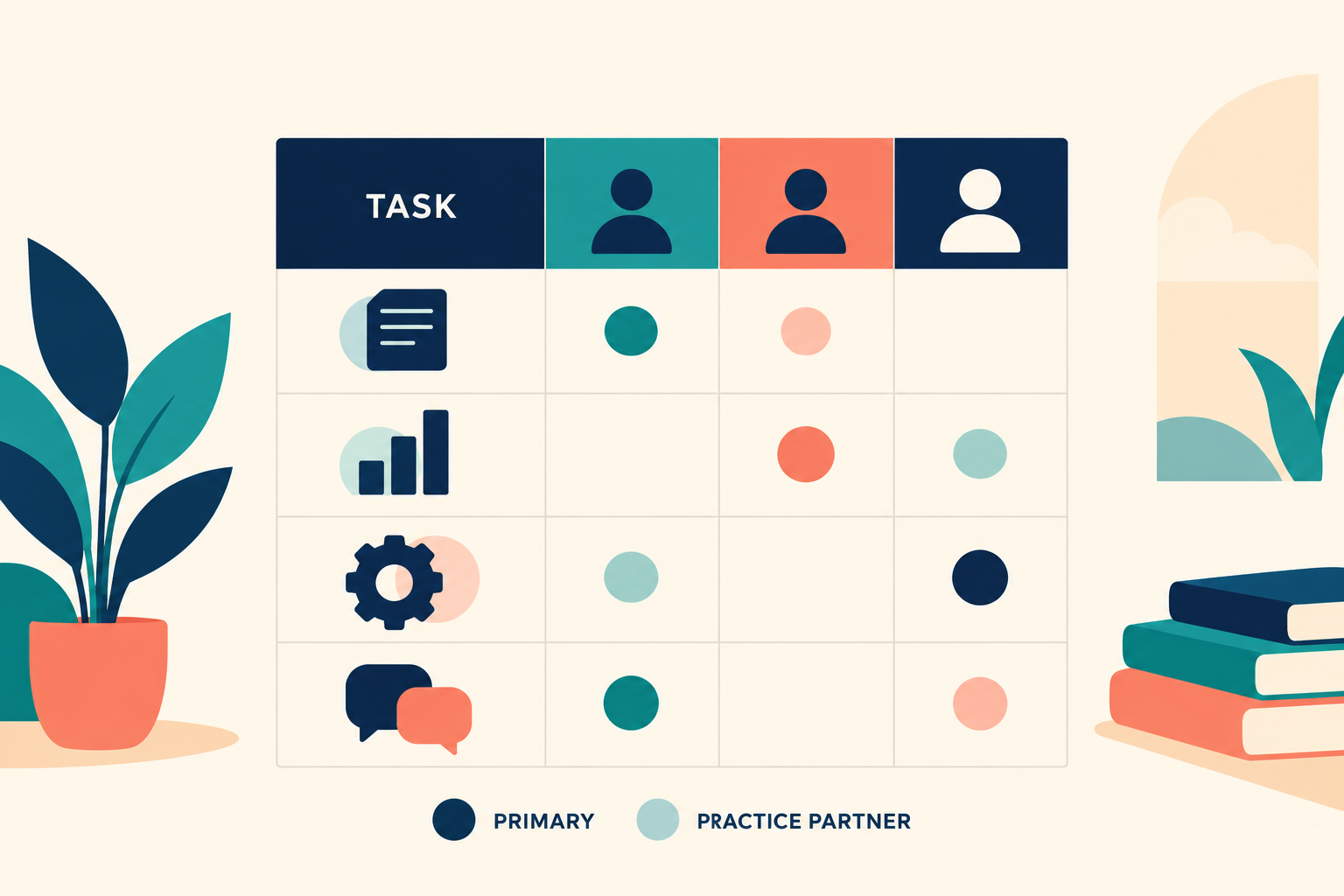
AI upskilling for teams becomes resilient when every priority work task has a primary practitioner, a practice partner and shared evidence.
AI Training Platform for Companies: Run an Exit Drill Before You Buy
Before buying an AI training platform for companies, test usable exports, access removal, data handling and learning continuity—not just onboarding.
Before You Accept an AI Conclusion, Write Its Reversal Test
A persuasive AI answer can trap reviewers in confirmation. Use the TURN card to name the evidence that would change the conclusion before you accept it.