
Separate the AI Draft From Its Acceptance Test
When one AI produces both the recommendation and the test used to approve it, shared blind spots survive. Fix human-owned criteria first.
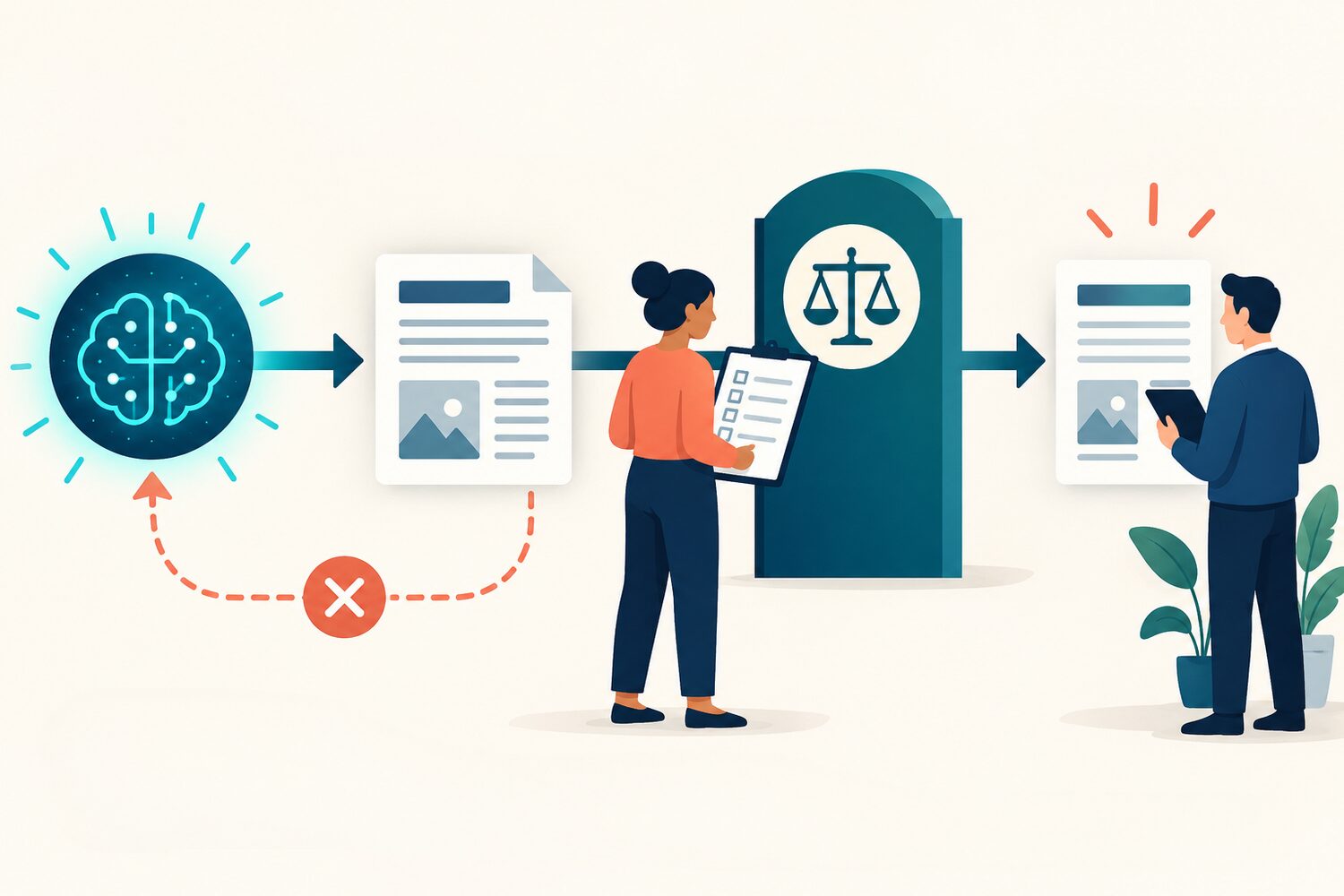
An AI system can draft a recommendation, then produce a convincing checklist that says the recommendation is good. That is not independent evaluation. The same missing context, mistaken assumption or preferred framing can shape both the answer and the test used to approve it.
For consequential work, separate production from acceptance. A person who owns the outcome should define what evidence, limits and stop conditions matter before generation begins. Then a reviewer should test the draft against those criteria, not ask the model to reassure itself.
A second prompt is not a second opinion
The distinction is easy to miss. A team asks an AI tool to compare suppliers. It then asks the same system, in the same context, to score its comparison for completeness and risk. The second response may look more cautious, yet it is still built from the model’s interpretation of the same brief. It has not created an independent source of evidence.
NIST’s AI Risk Management Framework treats risk management as a continuous practice and calls for diverse perspectives to surface assumptions. Its Measure Playbook goes further: organisations should involve internal experts who are not the front-line developers, or independent assessors, and document validity, limitations and human-review responsibilities. The UK Government AI Playbook likewise says teams should test outputs, maintain meaningful human control and validate high-risk decisions with people.
None of that means every low-stakes draft needs a committee. Independence should match consequence. A meeting agenda may need a quick owner check. A supplier recommendation, hiring criterion or customer remedy needs a stronger boundary between the system producing the proposal and the people deciding whether it is acceptable.
The CLEAR acceptance test
C — Criteria fixed first
Write the conditions for an acceptable result before the draft appears. This reduces the temptation to move the bar around a persuasive answer.
L — Limits declared
Name excluded data, known gaps, scope boundaries and decisions the AI is not authorised to make.
E — Evidence traceable
Require every material claim to point to an approved source, record or calculation that a reviewer can inspect.
A — Authority assigned
Name who may approve, return, escalate or stop the work. Human review is a responsibility, not a decorative step.
R — Reviewer separated
For meaningful consequences, use a person or team with enough distance to challenge the framing as well as the details.
Separate generation from evaluation
| Self-check loop | Independent acceptance test | |
|---|---|---|
| Timing | Criteria are invented after the answer appears. | Criteria are fixed before generation. |
| Evidence | The model judges plausibility from its own response. | The reviewer traces claims to approved sources. |
| Blind spots | The same framing shapes draft and critique. | A reviewer can challenge the brief and missing context. |
| Authority | A quality score feels like approval. | A named person approves, returns or stops the work. |
| Record | The chat ends with a reassuring verdict. | The team keeps criteria, evidence, exceptions and decision. |
Reading is a start. Practice makes it stick.
Start learningThe acceptance test is not a longer prompt. It is a small control owned by the work. It should remain usable if the team changes models, tools or vendors. That makes it a durable part of the workflow rather than a feature of one chat.
Worked example: an AI-assisted supplier recommendation
Imagine an operations team comparing three suppliers for a service renewal. Before anyone uses AI, the decision owner writes five acceptance conditions: all prices must come from current quotes; mandatory security evidence must be present; unresolved contractual exceptions must be visible; no criterion may be silently reweighted; and the recommendation must show what evidence would change the result.
Run the review in two lanes
- 1
1. Build the acceptance card
The decision owner records the outcome, five criteria, approved sources, exclusions, stop conditions and final approver.
- 2
2. Produce the draft
The analyst uses the approved AI tool to organise quotes and draft a comparison. The prompt may reference the card but may not change it.
- 3
3. Trace the claims
A reviewer checks every material statement against the quotes and security records. Unsupported claims are removed, not softened.
- 4
4. Challenge the frame
The reviewer asks what the draft omitted, whether any criterion was reinterpreted and which uncertainty could reverse the recommendation.
- 5
5. Record the decision
The approver accepts, returns or stops the work, with the reason and any follow-up evidence required.
Suppose the draft ranks Supplier A first because it describes the service as the lowest cost. The reviewer finds that the model compared the monthly fee but ignored a migration charge in the quote. Because the acceptance card required current total price and prohibited silent reweighting, the issue is easy to identify. The process does not need the AI to confess a mistake; it needs a human-owned test that exposes it.
Use independence where it changes the decision
Start with the smallest separation that is credible. For routine work, the requester can own the checklist and review the output. For higher stakes, split requester, drafter and approver. Where specialist evidence matters, add someone who understands the domain and was not rewarded for shipping the system quickly.
This complements an assumption log: assumptions reveal what might be wrong, while an acceptance test defines what must be true before action. A reviewer track builds the skill to apply that test. The AI handoff card carries the evidence and limits into review. For organisation-wide practice, Bokili’s leader learning path connects these controls to real work.
- Choose one AI-assisted decision that someone will act on this month.
- Write the outcome and three conditions an acceptable answer must meet.
- Name the approved evidence for each condition.
- Add one limit, one stop condition and the person with final authority.
- Decide whether the current reviewer is independent enough for the consequence.
- Run the card against one recent draft and record the first mismatch.
A fluent draft can make its own test feel unnecessary. That is exactly when separation matters. Let AI help produce options, summaries and recommendations. Keep the standard of acceptance outside the draft, owned by people who can inspect the evidence and carry the consequence.
Sources
- AI Risk Management Framework: Core — NIST
- AI RMF Playbook: Measure — NIST
- Artificial Intelligence Playbook for the UK Government — UK Government
Reading is a start. Practice makes it stick.
Bokili turns skills like this into ten-minute missions for your whole team, with instant feedback and progress you can see.
Start learningKeep reading

AI Training for HR: Audit the Job Description Before You Publish
AI training for HR should teach teams to trace every job requirement to real work before a polished draft becomes a hiring filter.
Learn to Use AI by Correcting One Mistake at a Time
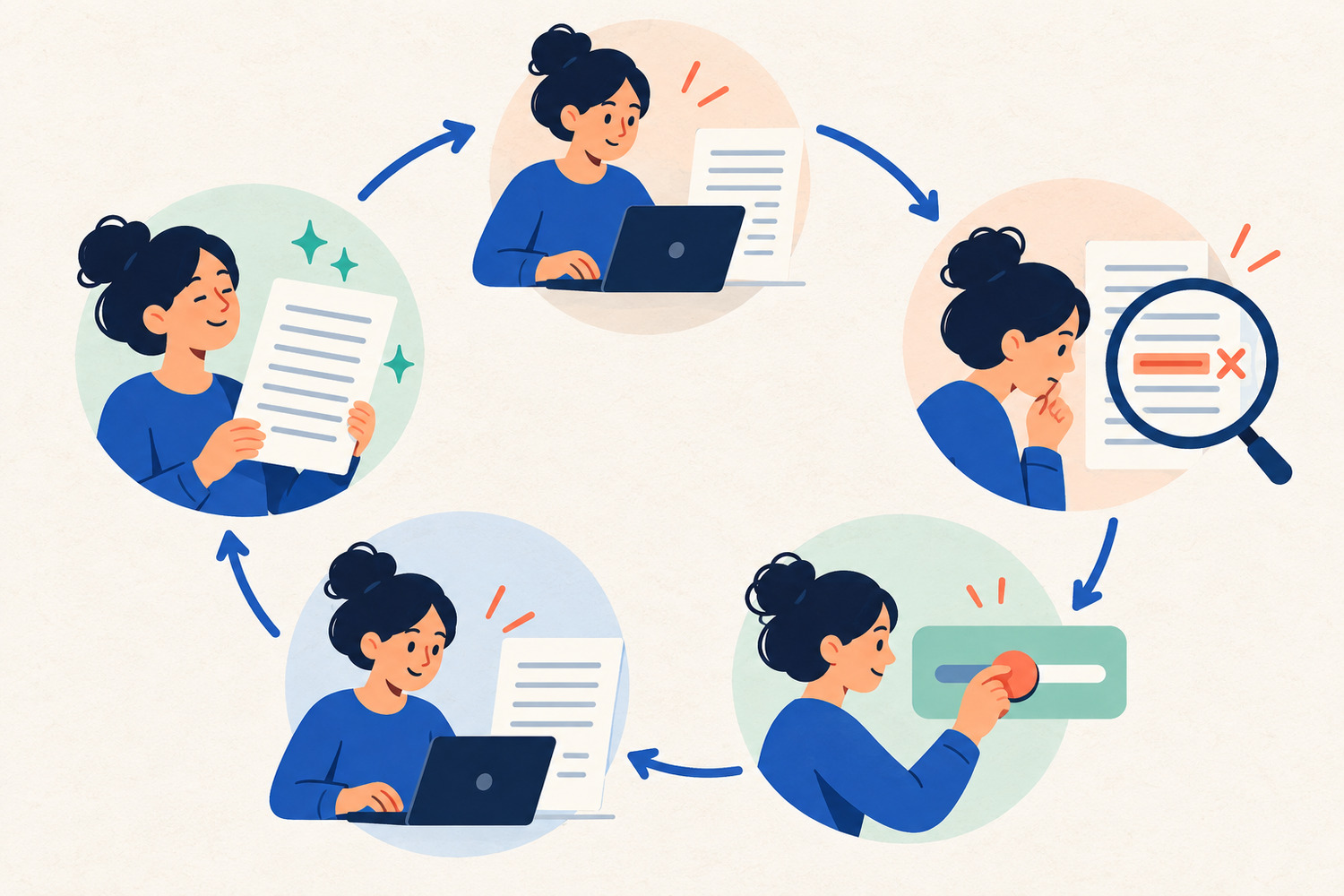
Learn to use AI at work with a four-step correction loop that turns one disappointing output into a reusable skill.

The AI Handoff Card: Carry Context Into Human Review
Use a five-field handoff card to carry sources, AI contribution, human changes and open questions into the next review.