

Turn AI Ideas Into a Governed Use-Case Queue
Use the QUEUE method to compare AI ideas by work need, simpler alternatives, consequence, evidence and accountable ownership before a pilot starts.
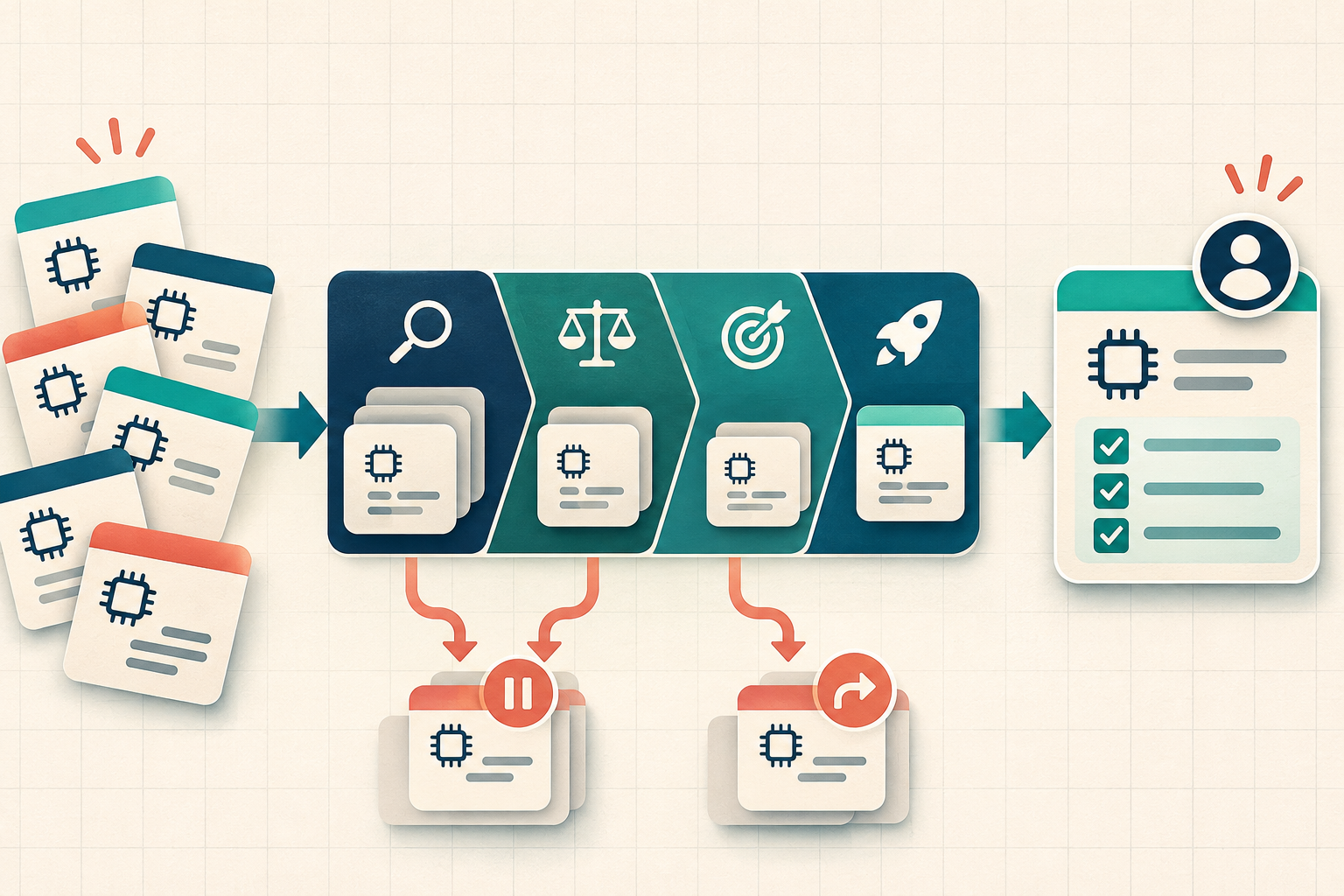
AI ideas arrive in different shapes: a manager wants faster reporting, a team wants a chatbot, and a supplier promises automation. If each idea starts its own pilot, the organisation does not have an AI portfolio. It has a race for attention.
A governed use-case queue gives every idea the same short test before money, data or staff time are committed. It does not turn early exploration into a heavy approval process. It makes the problem, alternative solutions, likely consequences, evidence and ownership visible enough to compare.
Start with the work problem, not the AI feature
The UK Government AI Playbook says use cases should be led by business and user needs, pain points and inefficiencies rather than by what the technology can do. It also recommends a use-case register and a method for prioritising opportunities by feasibility and business value.
Australia’s National AI Centre adds two useful questions: how well does the opportunity suit AI, and what happens if the outcome is wrong? It also recommends considering a simpler process change, template, rule-based automation or training when that can solve the problem with less cost and complexity.
Use the QUEUE intake
QUEUE: five fields for comparable AI ideas
Qualify the problem
Name the user, recurring work problem and current cost or delay. Do not start with a model or vendor.
Use the simplest fit
Compare AI with a template, process repair, rule-based automation, integration or training.
Examine consequence
State who is affected, what could go wrong and how difficult the outcome would be to reverse.
Queue by evidence
Record the data, examples, baseline and acceptance test available for a contained trial.
Establish ownership
Name the person who can approve scope, provide evidence, stop the test and review the result.
The queue is an intake, not a promise. An idea may move to a pilot, return for evidence, switch to a simpler fix or stop. The same fields let leaders compare unlike proposals without pretending that every benefit and risk can be reduced to one score.
Worked example: three finance-team ideas
Imagine a finance team submits three ideas. First, draft monthly variance commentary from an approved table. Second, suggest employee performance ratings from manager notes. Third, chase missing invoices by email. The ideas all contain “AI”, but they should not receive the same next step.
Reading is a start. Practice makes it stick.
Start learning| Idea | Queue decision | |
|---|---|---|
| Variance commentary | Recurring draft work with a stable input and human approval. | Run a contained pilot with evidence tags and a fixed acceptance test. |
| Performance ratings | High impact on people, difficult to undo and dependent on sensitive evidence. | Pause and escalate for legal, HR and governance review before any trial. |
| Invoice chasing | Predictable reminders driven by known dates and statuses. | Test rule-based automation or a workflow repair before adding generative AI. |
This is not a verdict on the ideas’ ultimate value. It is a decision about the next responsible unit of work. The queue prevents a persuasive demo from skipping the questions that less exciting proposals had to answer.
Keep the queue light but accountable
A 30-minute weekly triage
- 1
Read new cards
Reject feature-led requests that cannot yet name a work problem.
- 2
Compare alternatives
Ask what a process change or conventional automation would achieve.
- 3
Screen consequence
Identify affected people, sensitive data, hard-to-reverse outcomes and required controls.
- 4
Choose one next step
Pilot, gather evidence, redirect to a simpler fix, escalate or stop.
- 5
Set a review date
Name the owner and the evidence required for the idea to move again.
The Data and AI Ethics Framework says accountable projects need clear roles, including a senior responsible owner who ensures a real business need is being addressed and the work remains viable. The owner needs authority to change or stop the work, not merely a name in a spreadsheet.
Minimum fields before an idea leaves intake
Use-case queue card
- One user and one recurring work problem are named.
- A non-AI or simpler option has been considered.
- The intended use and out-of-scope use are explicit.
- Affected people and hard-to-reverse consequences are visible.
- A baseline, evidence set and acceptance test are available or assigned.
- A responsible owner can approve, pause and stop the work.
- The next action and review date are recorded.
Build the first queue in ten minutes
- Write the idea as a work problem without naming an AI tool.
- List one simpler way to reduce the problem.
- Name who would be affected if the output were wrong.
- Choose one piece of evidence for a small test.
- Name the person who can stop the work.
- Record one next step: pilot, evidence, redirect, escalate or stop.
Make selection part of adoption
An AI roadmap becomes more credible when people can see how ideas enter, move and stop. Use QUEUE before a pilot, then connect it to Bokili’s guides on writing pilot exit rules, building a stop-doing list and setting an error-cost threshold. Bokili can then help teams practise the behaviours that the selected use cases actually require.
Sources
- Artificial Intelligence Playbook for the UK Government — Government Digital Service
- Identify opportunities — Australian Government — National AI Centre
- AI screening questions — Australian Government — National AI Centre
- Data and AI Ethics Framework — UK Government
- Features — AI training for teams — Bokili
Reading is a start. Practice makes it stick.
Bokili turns skills like this into ten-minute missions for your whole team, with instant feedback and progress you can see.
Start learningKeep reading
AI Learning and Development: Run a Delayed Transfer Check
Use the TRACE method to check whether an AI skill reached real work, what evidence exists and which barrier or next practice needs attention.
AI Skills for Employees: Turn Rough Notes Into a Testable SOP
AI skills for employees should include the PATH method: structure rough process notes, dry-run the normal path and expose exceptions before release.

Use ChatGPT for Word to Revise One Section Without Losing the Facts
Use the LOCK method to change one selected passage while protecting the facts, figures, defined terms and recommendations that must stay fixed.