

AI Skills for Employees: Turn Rough Notes Into a Testable SOP
AI skills for employees should include the PATH method: structure rough process notes, dry-run the normal path and expose exceptions before release.
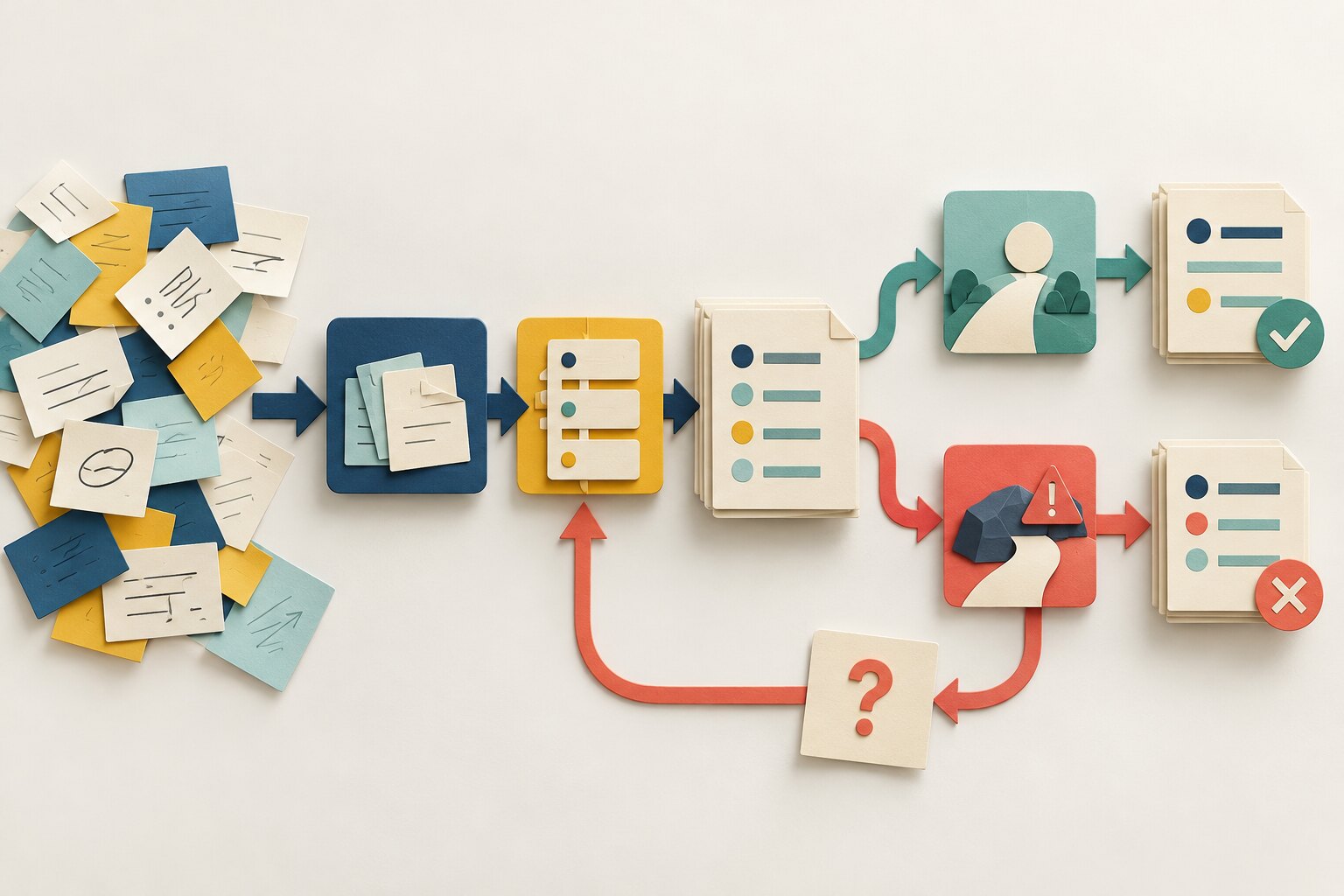
AI skills for employees should include more than turning rough notes into polished instructions. A standard operating procedure is useful only when another person can follow it, recognise an exception and know where an unanswered question must go. Fluent prose is not the test. A dry run is.
This matters because process notes are rarely complete. They contain shortcuts, implied decisions and knowledge that the original author carries in their head. An AI tool can organise those notes quickly, but it can also make gaps look resolved. The safest workflow uses AI to structure the material, then asks a human to test the procedure on one normal case and one exception.
Why AI skills for employees need an SOP dry run
The UK Health and Safety Executive describes procedures as agreed ways of carrying out work and recommends task analysis, user involvement and regular review. Its walk-through guidance focuses not only on actions but also on decisions, order and the effect of a missed step. Those principles apply beyond safety-critical work: an SOP should make the real task visible, not merely make notes look tidy.
The European Commission’s AI-literacy guidance also says training should reflect people’s technical knowledge, experience and the context in which they use AI. For an employee writing a procedure, that context includes the role, inputs, tools, approval points and exceptions around the task.
Use the PATH method
PATH: from rough notes to a testable SOP
Pin
Name the trigger, end state and scope of the procedure.
Assign
Attach each action, input, decision and approval to an owner.
Test
Dry-run the draft on one normal case and one foreseeable exception.
Hand back
Return unknowns to a named human instead of letting the AI fill them.
PATH treats the generated document as a hypothesis about how work happens. The dry run tests that hypothesis. If the procedure cannot tell a new colleague what to do next, who decides or what evidence closes the task, it is not ready.
Worked example: a customer refund procedure
Suppose a service team has notes saying: “Check the order, confirm the reason, refund if eligible, ask a manager for unusual cases, tell the customer.” An AI tool can turn that into numbered steps. Yet the notes do not define eligibility, the evidence needed, the manager’s decision threshold or the system record that proves completion.
Reading is a start. Practice makes it stick.
Start learning| Polished but untested | Testable SOP | |
|---|---|---|
| Trigger | A refund is requested. | A refund request arrives with an order number. |
| Decision | Refund if eligible. | Check the named eligibility rule and record the result. |
| Exception | Ask a manager for unusual cases. | Escalate damaged-item claims above the stated threshold to the duty manager. |
| Completion | Tell the customer. | Record the decision, send the approved message and attach the case reference. |
Now run two fictional cases. In the normal case, a customer returns an unopened item within the stated period. In the exception, the order is outside the period but the item arrived damaged. The second case exposes whether the procedure contains a real escalation route or only vague language.
Draft with AI, but preserve the unknowns
A practical drafting sequence
- 1
Prepare the notes
Remove sensitive data and keep only the facts needed to describe the process.
- 2
Ask for structure
Request trigger, prerequisites, actions, decisions, exceptions, evidence and completion.
- 3
Mark uncertainty
Require the draft to label missing thresholds, owners or rules as open questions.
- 4
Walk through
Ask a colleague who performs the task to use the draft on a fictional case.
- 5
Approve and date
Name the owner, version, review date and source of each governing rule.
Never ask the model to invent a threshold or policy just to complete the format. A visible blank is safer than a confident fiction. The NIST AI RMF Playbook recommends comparing performance with real operating conditions, using human expertise for unexpected data and recording errors, exceptions and oversight. In an SOP workflow, the equivalent is an explicit question log.
Release checklist
Before the SOP is published
- The trigger and intended end state are explicit.
- Prerequisites, tools and inputs are named.
- Every decision has an owner and a referenced rule.
- Normal steps and at least one foreseeable exception were tested.
- Unknowns remain labelled and assigned to a human.
- The completion evidence is inspectable.
- The document has an owner, version and review date.
- A person who performs the task has reviewed the wording.
Try it in ten minutes
- Choose a five-step, low-risk task and write the rough notes.
- Ask an approved AI tool to organise them into trigger, actions, decisions and completion.
- Circle every threshold, owner or rule the notes did not supply.
- Run one normal fictional case through the draft.
- Run one exception case through it.
- Turn each failure into a named open question rather than invented text.
Make the procedure earn its polish
AI can shorten the distance from scattered notes to a structured draft. It cannot prove that the draft matches the work. Use PATH to keep the trigger, ownership, decisions and exceptions visible, then test the document before release. Continue with Bokili’s guides to separating an AI draft from its acceptance test, carrying context into human review and preparing a shift handover without hiding unfinished work. Bokili’s short, role-adapted missions can help teams practise the same habits on realistic work tasks.
Sources
- Procedures — UK Health and Safety Executive
- Understanding the task — UK Health and Safety Executive
- NIST AI RMF Playbook — Measure — NIST
- AI Literacy — Questions & Answers — European Commission
- AI training for HR & L&D leaders — Bokili
Reading is a start. Practice makes it stick.
Bokili turns skills like this into ten-minute missions for your whole team, with instant feedback and progress you can see.
Start learningKeep reading
Use ChatGPT for Word to Revise One Section Without Losing the Facts
Use the LOCK method to change one selected passage while protecting the facts, figures, defined terms and recommendations that must stay fixed.

AI Training for HR: Keep Minority Views in Survey Analysis
Teach HR teams to protect identity, trace themes to evidence and preserve rare or contradictory employee survey comments for human review.

A Ten-Minute AI Mission Needs a “Use It When…” Cue
Make short AI practice transfer to real work by naming the condition, useful action and evidence check the learner should retrieve later.