

Enterprise AI Training: Build a Reviewer Track
Enterprise AI training needs separate practice for the people who create AI-assisted work and the people who approve it.
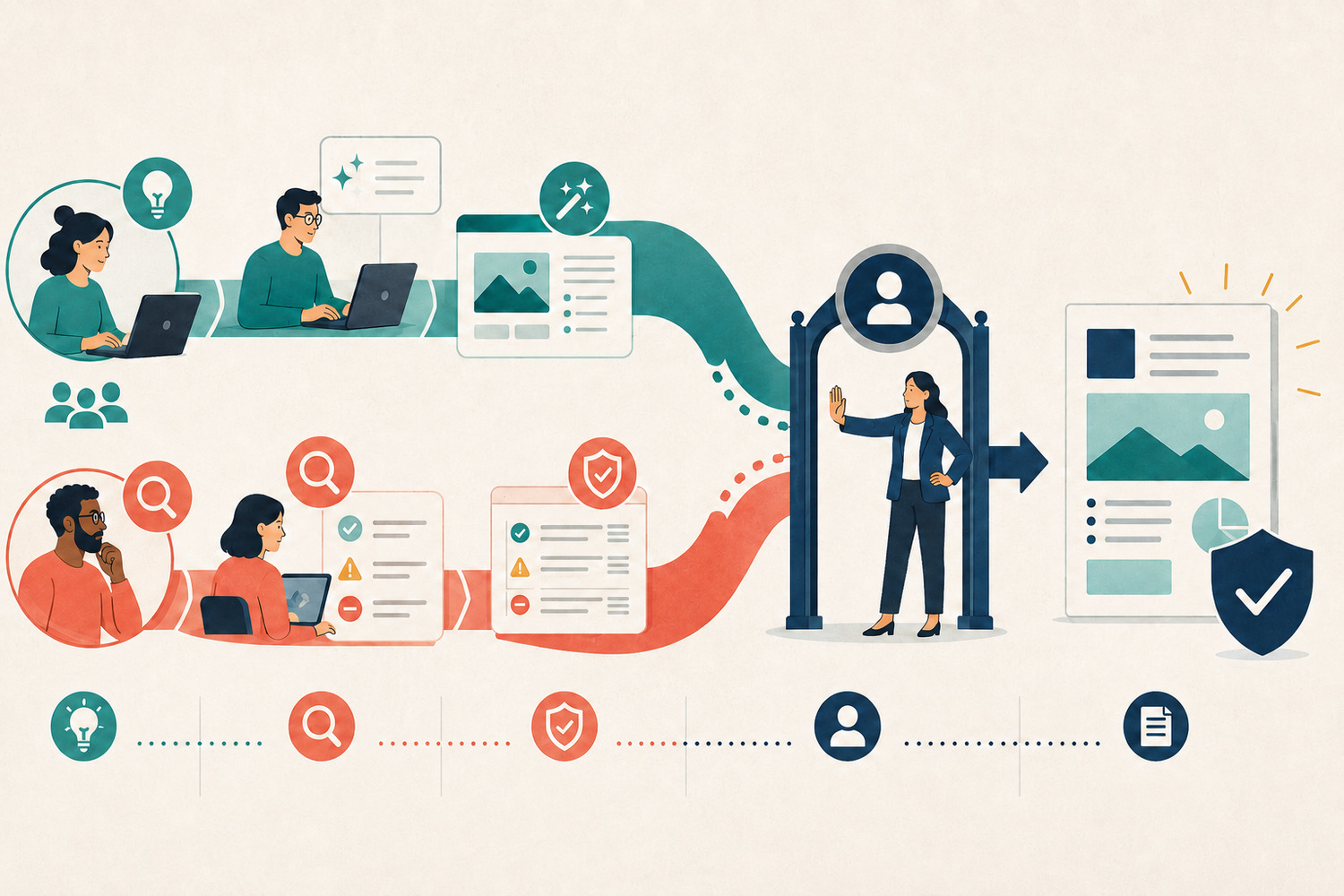
Enterprise AI training often prepares people to create with AI, then assumes an experienced colleague can review the output. That assumption is weak. Reviewing AI-assisted work is a separate skill: the reviewer must know the task standard, trace important claims, detect omissions, recognise when the evidence is insufficient and stop the work when the risk is too high.
Build a reviewer track alongside the maker track. The shared foundation can cover approved tools, data boundaries and model limits. After that, the practice should split. Makers learn to frame and improve a task. Reviewers learn to decide whether the result is acceptable for its intended use.
Why enterprise AI training needs two practice tracks
A maker can produce a fluent first draft without being the person authorised to approve it. A reviewer can understand the business standard without knowing how the prompt was written. Training both groups on the same generic module leaves a gap exactly where the organisation relies on human oversight.
| Maker track | Reviewer track | |
|---|---|---|
| Primary question | How do I produce a useful first version? | Is this safe and good enough for this use? |
| Evidence skill | Provide relevant context and sources | Trace material claims and expose missing evidence |
| Failure practice | Revise weak instructions and inputs | Reject, return or escalate a plausible but unsafe output |
| Proof of skill | A stronger second attempt | A documented acceptance decision on a fresh sample |
This split matches current guidance. NIST’s AI Risk Management Framework calls for human-oversight processes to be defined and assessed, with roles and responsibilities made clear and personnel trained for their duties. The European Commission’s AI-literacy guidance says learning should reflect people’s knowledge, the system, its risk and the context of use. It also treats the skills needed by a human-in-the-loop as distinct from the question of whether the tool itself has human review.
What enterprise AI training should teach reviewers
RACE: four reviewer decisions
R — Requirements
Restate the output’s purpose, audience, acceptance criteria and prohibited uses before reading the draft.
A — Audit trail
Trace high-impact claims to approved sources. A citation is a pointer, not proof that the source supports the sentence.
C — Counter-check
Look deliberately for omissions, exceptions, conflicts and a plausible alternative interpretation.
E — Escalation
Choose accept, return, or escalate. Record the reason, owner and next action rather than quietly rewriting everything.
RACE turns “use your judgment” into observable behaviour. It is intentionally small enough to apply to a customer summary, policy draft, supplier comparison or internal analysis. Each workflow should add its own acceptance criteria and authority limits.
Run a calibration exercise, not a quiz
Reading is a start. Practice makes it stick.
Start learningGive reviewers two versions of the same fictional work sample. Both should read well. One should contain a visible unsupported claim; the other should omit a constraint that changes the decision. Ask each reviewer to apply RACE independently before discussing the result.
A 30-minute reviewer calibration
- 1
Set the decision
Define the intended use and the person who may approve it.
- 2
Publish the standard
Provide a short rubric: required evidence, forbidden data, must-include constraints and escalation triggers.
- 3
Review alone
Each participant records accept, return or escalate, with source references and reasons.
- 4
Compare decisions
Discuss disagreements about materiality, not writing style.
- 5
Revise the rubric
Turn recurring disagreements into one clearer acceptance rule or one new practice example.
Connect the track to the rest of the programme
Start with a small set of priority workflows, as described in Bokili’s guide to an enterprise AI training workflow pilot. Use confidence labels as signals, not evidence, and practise an explicit omission check. Then measure whether the reviewer behaviour transfers to a fresh work sample, not whether people merely completed the module.
For HR and L&D teams, the relevant Bokili path is the AI training approach for HR and L&D. The programme can share foundations across roles while keeping examples, thresholds and decision rights specific to each workflow.
Measure reviewer skill without rewarding caution theatre
A reviewer who rejects everything is not necessarily safer. Measure correct identification of material issues, evidence traceability, agreement on clear cases, appropriate escalation on ambiguous cases and the quality of feedback returned to the maker. Sample accepted outputs as well as rejected ones, because false confidence can hide in both.
- Use fresh samples that were not shown during teaching.
- Include at least one fluent output with a consequential omission.
- Record the decision and reason before group discussion.
- Separate factual defects from harmless style preferences.
- Refresh the rubric when tools, policies or workflows change.
- Pick one AI-assisted output your team already reviews.
- Write three acceptance criteria and one escalation trigger.
- Give the same sample to a maker and a reviewer.
- Ask both to decide what happens next and cite their evidence.
- Use the difference to design the first reviewer practice task.
Training is incomplete until someone can say no
The maker track helps people produce better work. The reviewer track protects the moment when that work becomes a decision, message or action. Enterprise AI training needs both. Bokili supports short, role-specific practice so teams can rehearse creation, review and escalation before those behaviours carry real consequences.
Sources
- AI RMF Core — NIST AI Resource Center
- AI Literacy — Questions & Answers — European Commission
- Artificial Intelligence Risk Management Framework: Generative Artificial Intelligence Profile — NIST
- Guidelines for Human-AI Interaction — Microsoft Research
Reading is a start. Practice makes it stick.
Bokili turns skills like this into ten-minute missions for your whole team, with instant feedback and progress you can see.
Start learningKeep reading
AI Learning and Development: Turn Policy Rules Into Behaviour Pairs
AI learning and development works better when abstract policy rules become paired actions employees can recognise, practise and use at the point of work.
An AI Mission Should Change One Constraint at a Time
Keep the task, source pack and acceptance check stable. Change one condition so learners and coaches can see which AI skill improved.
AI Training for Employees: Reset Skills After a Role Change
A completed course does not prove readiness for new tasks, data or authority. Use a narrow role-change reset to collect fresh evidence without restarting every course.