Before You Accept an AI Conclusion, Write Its Reversal Test
A persuasive AI answer can trap reviewers in confirmation. Use the TURN card to name the evidence that would change the conclusion before you accept it.
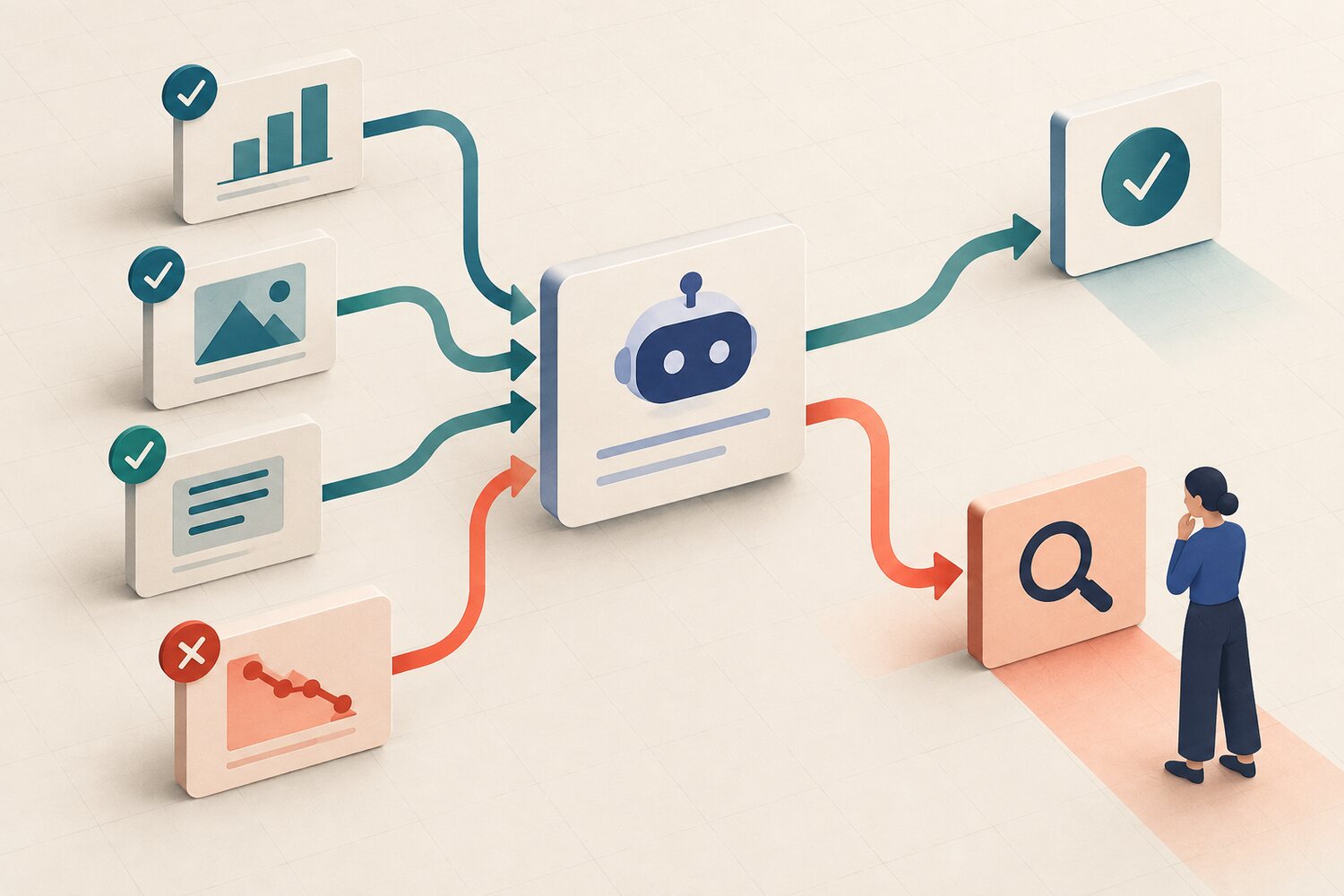
An AI-supported conclusion can sound stronger each time you ask the same system to defend it. The recommendation becomes smoother, the caveats move to the end and the reviewer starts checking whether the prose is persuasive instead of whether the decision is still open to evidence. That is confirmation, not review.
A reversal test fixes the sequence. Before you accept the conclusion, write down the specific observation, source or changed condition that would make you revise it. Then look for that evidence outside the answer. The point is not to reject every AI output. It is to keep a plausible answer falsifiable, so a named reviewer can still change course.
Do not ask the model to grade its own case
The same tool can help surface counterarguments, but an accountable person must choose the reversal condition and verify the evidence against trusted sources.
Why a reversal test improves review
NIST’s AI Risk Management Framework asks organisations to document assumptions, knowledge limits and the context in which outputs will be used. Its Measure guidance adds testing, human review, independent assessment and checks against new ground truth. The UK Government Data Quality Framework makes a related point: evidence must be fit for its intended purpose, and quality limits should be communicated to users. A reversal test turns those broad principles into one small work artefact.
The method is especially useful when an output recommends one option, summarises conflicting evidence or predicts an outcome. It is less useful for simple transformations such as changing tone or formatting a list. Match the review effort to the consequence: the harder the decision is to reverse, the clearer the reversal evidence should be.
The TURN reversal card
Thesis
Write the AI-supported conclusion in one sentence. Remove persuasive adjectives and keep the actual decision or claim.
Uncertainty
Name the assumption, missing fact or boundary most likely to make the conclusion wrong.
Reversal evidence
Define an observable signal that would change, narrow or stop the conclusion. Make it specific enough that two reviewers can recognise it.
Next check
Assign one person, source and deadline for finding that evidence. State what happens if the evidence is unavailable or contradictory.
Worked example: choosing a supplier
A procurement team asks AI to compare three training suppliers against an approved brief. The answer recommends Supplier B because its programme appears fastest to launch and covers the widest range of roles. The team could ask for a longer defence. Instead, it writes a TURN card.
Reading is a start. Practice makes it stick.
Start learningThesis: Supplier B is the strongest option for the planned launch. Uncertainty: the comparison assumes the listed role coverage includes realistic practice, not just catalogue labels. Reversal evidence: if a sample pathway for two priority roles lacks a scored workplace task and a second attempt after feedback, the recommendation must be narrowed or changed. Next check: the L&D lead requests two sample pathways by Tuesday; without them, Supplier B cannot receive the highest implementation score.
The result is not a better paragraph. It is a decision that can still move. If the samples arrive and show strong practice, the team gains evidence. If they do not, the recommendation loses weight before the contract is signed.
| Weak review | Reversal review | |
|---|---|---|
| Question | Why is this answer right? | What evidence would make us change it? |
| Evidence | More explanation from the same output | A named source, observation or test outside the answer |
| Owner | Anyone reading the draft | One accountable checker |
| Outcome | Accept or reject the prose | Keep, narrow, change or stop the conclusion |
Write reversal evidence that can actually be checked
Avoid vague conditions such as “if new information appears” or “if the model is wrong”. Useful reversal evidence has a source, a boundary and a consequence. “If the signed policy excludes contractors, remove contractors from the rollout plan” is checkable. “If stakeholders disagree, reconsider” is not.
A release gate for the reversal card
- The conclusion is one sentence and does not hide multiple decisions.
- The main uncertainty is linked to the intended use, not a generic AI caveat.
- The reversal signal is observable in a document, test, dataset or named person’s evidence.
- The checker is independent enough to challenge the draft.
- The response to confirming, contradicting or missing evidence is written in advance.
- The card and supporting evidence are saved with the final decision.
- A higher-risk decision has a human escalation route and a stop rule.
- Choose one low-risk AI-supported recommendation you are reviewing today.
- Copy its conclusion into one plain sentence.
- Write the assumption or missing fact most likely to overturn it.
- Define one piece of evidence that would change or narrow the conclusion.
- Name the person and trusted source that can check it.
- Write the action for three outcomes: confirmed, contradicted or unresolved.
Use the reversal test with other review artefacts
The reversal card complements an assumption log, an acceptance test and separate review passes. The assumption log exposes hidden claims; the acceptance test defines “done” before drafting; the reversal card keeps a recommendation open to disconfirming evidence. See https://bokili.com/en/learn/ai-recommendation-assumption-log, https://bokili.com/en/learn/separate-ai-draft-acceptance-test and https://bokili.com/en/learn/ai-employees-editors-four-review-passes.
The practical rule is simple: a conclusion that cannot describe what would change it has not finished review. Save the persuasive explanation, but also save the evidence that could make the team choose differently.
Sources
- AI Risk Management Framework Core — National Institute of Standards and Technology
- AI RMF Playbook — Measure — National Institute of Standards and Technology
- The Government Data Quality Framework — UK Government
Reading is a start. Practice makes it stick.
Bokili turns skills like this into ten-minute missions for your whole team, with instant feedback and progress you can see.
Start learningKeep reading
AI Training Platform for Companies: Run an Exit Drill Before You Buy
Before buying an AI training platform for companies, test usable exports, access removal, data handling and learning continuity—not just onboarding.

AI Skills for Employees: Audit the Input Pack First
Teach employees to test source relevance, authority, completeness, freshness and permission before an AI tool turns weak inputs into fluent output.

If AI Does the Junior Work, Protect the Learning Work
Automating entry-level tasks can save time while removing the practice that builds future expertise. Preserve the attempt, feedback and reflection deliberately.