
Turn a Contract Into an Evidence-Tagged Obligation Register With AI
A procurement workflow for extracting contract duties into traceable rows with owners, triggers, deadlines and proof—without treating AI as the source of truth.
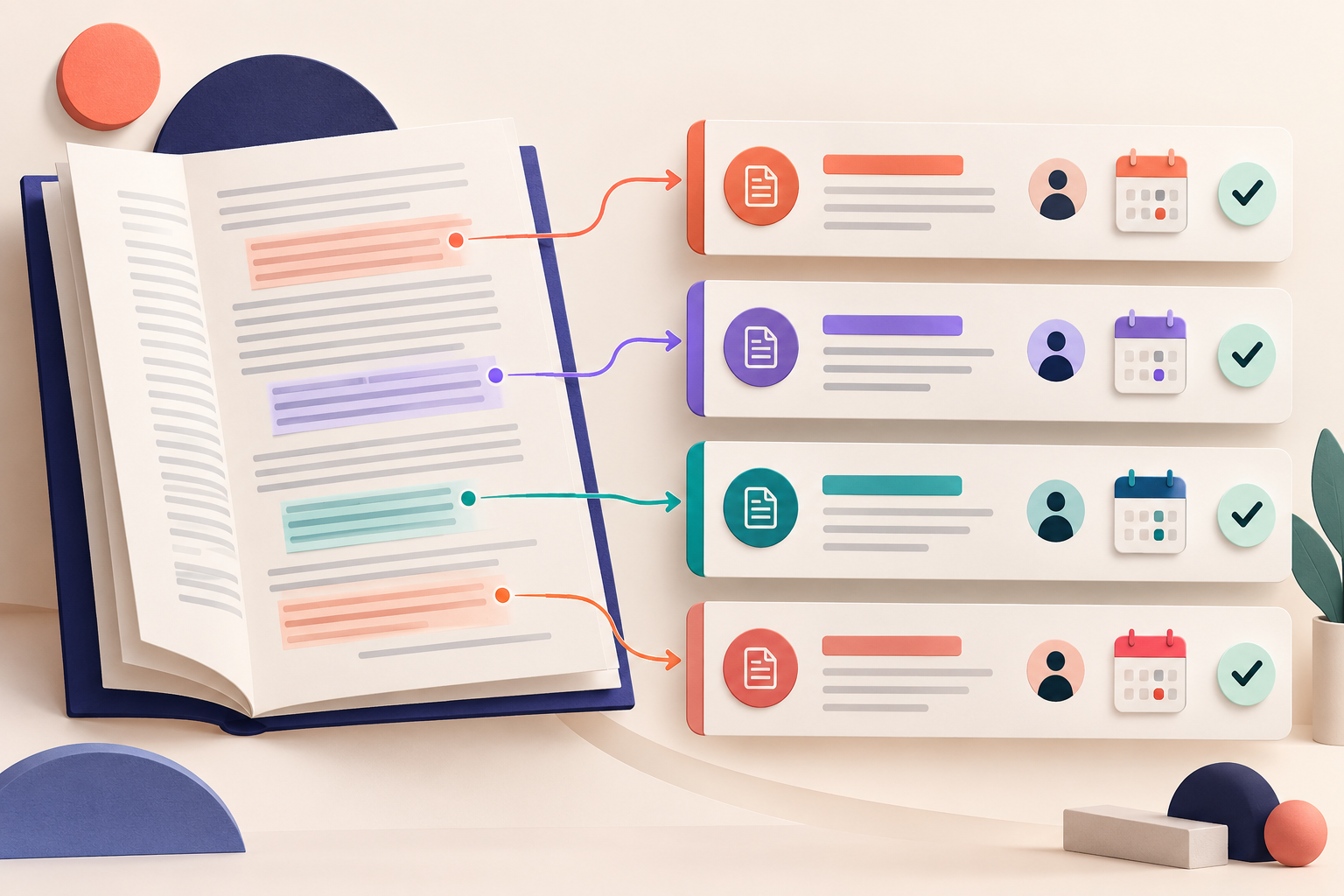
Contract managers do not need another broad summary of a supplier agreement. They need a working view of what must happen, who must act, when action is triggered and where the evidence sits. AI can accelerate the first extraction, but the useful output is not a polished synopsis. It is an evidence-tagged obligation register that a human can check against the signed contract.
That distinction matters because contract delivery is measured against obligations, KPIs, service levels and agreed outcomes. The UK Government’s 2026 Contract Management Playbook describes KPIs and SLAs as tools for tracking contractual expectations and obligations. Its guidance for new contract managers also expects reporting against a contract management plan, KPIs and an obligations matrix. AI can help build the first version of that matrix, but the contract remains the source of truth.
Do not ask AI what the contract means in general
Ask it to identify candidate obligations and point back to the exact clause. A person still decides whether each item is accurate, complete and operationally important.
Build the register around five fields
A reliable register forces every extracted item into a small structure. If a field is missing, the row is not ready for operational use.
The five-field obligation record
Clause anchor
Record the section, schedule and page so a reviewer can return to the signed text.
Required action
Write one observable action without adding interpretation that the clause does not support.
Responsible party
Name the supplier, customer, joint team or other party that must act.
Trigger and timing
Capture the event, deadline, frequency or dependency that makes the obligation due.
Proof and status
Define the document, metric, approval or record that will show completion, then track its current state.
Use AI for extraction, not legal interpretation
Work from the executed contract and its incorporated schedules, not a sales proposal or an old draft. Split a long agreement into manageable sections. Ask the AI tool to extract only explicit obligations and to quote a short source fragment with its location. Then verify every row in the original file before it enters the operational register.
This is a two-pass process. The extraction pass finds candidates. The validation pass removes duplicates, separates compound clauses, confirms the responsible party and resolves cross-references. A model may combine several duties into one neat sentence or overlook an obligation hidden in a definition or schedule. The register should make those gaps visible, not conceal them.
| Contract summary | Evidence-tagged obligation register | |
|---|---|---|
| Unit | Topics and themes | One required action per row |
| Traceability | General reference | Exact clause, schedule and page |
| Timing | Often compressed | Trigger, deadline or frequency |
| Use | Orientation | Monitoring, review and escalation |
Reading is a start. Practice makes it stick.
Start learningWorked example: a support-services agreement
Imagine a software support contract containing a response-time table, a monthly reporting duty and a requirement for the customer to provide named contacts. A generic summary might say: “The supplier provides support and monthly reporting.” That is too vague to manage.
The register creates three separate rows. The first records the supplier’s response obligation, the severity level that triggers it, the clock used and the ticket timestamp that proves performance. The second records the monthly report, its due date and the approved report file. The third records the customer’s duty to maintain named contacts and the change notice that proves an update. Separating both parties’ duties prevents the team from treating every delay as supplier failure.
Prompt for a controlled first extraction
Extract candidate obligations from this section only. For each one, return: clause anchor, required action, responsible party, trigger or timing, and expected proof. Do not infer duties that are not explicit. Mark cross-references and ambiguous wording for human review.
Do not paste confidential contracts into an unapproved tool. Follow your organisation’s data-handling rules and use only an approved environment. The UK Government AI Playbook recommends choosing appropriate use cases, maintaining human control at the right stage and validating outputs before they drive action.
Review the register like an operational control
Assign a contract owner to approve each row. Test whether a colleague can find the source clause without help. Check that every milestone has a date or trigger, every obligation has a party and every status can be supported by evidence. Re-run the review after contract variations, renewals or changes to incorporated schedules.
The result can connect naturally to an AI source-of-truth rule, an evidence-tagged incident timeline and an AI handoff card. The common principle is traceability: AI may organise the work, but people must be able to inspect the evidence.
- Choose one low-sensitivity contract section in an approved environment.
- Extract no more than five candidate obligations using the five fields.
- Open the signed source and verify every clause anchor and responsible party.
- Split any row that contains more than one required action.
- Add the proof that would demonstrate completion.
- Ask a colleague to locate each clause using only the register; fix anything they cannot trace.
A good obligation register does not pretend to replace contract expertise. It reduces the time between reading a clause and managing the work it creates. Bokili helps teams practise this kind of bounded, evidence-aware AI workflow in short missions built around real roles and decisions.
Sources
- The Contract Management Playbook — March 2026 — UK Government
- Initial guidance for new contract managers — UK Government
- Artificial Intelligence Playbook for the UK Government — UK Government
Reading is a start. Practice makes it stick.
Bokili turns skills like this into ten-minute missions for your whole team, with instant feedback and progress you can see.
Start learningKeep reading

AI Course for Beginners: Start With a Reversible Work Task
An AI course for beginners should start with a useful task that is small, safe to review and easy to undo. Use the SAFE filter to choose it.

AI Training for Employees: Teach the Escalation Sentence
AI training for employees should teach what to say when an output is uncertain: one short hand-off with the task, gap, evidence checked and decision needed.
Design the Manual Fallback Before AI Becomes Normal
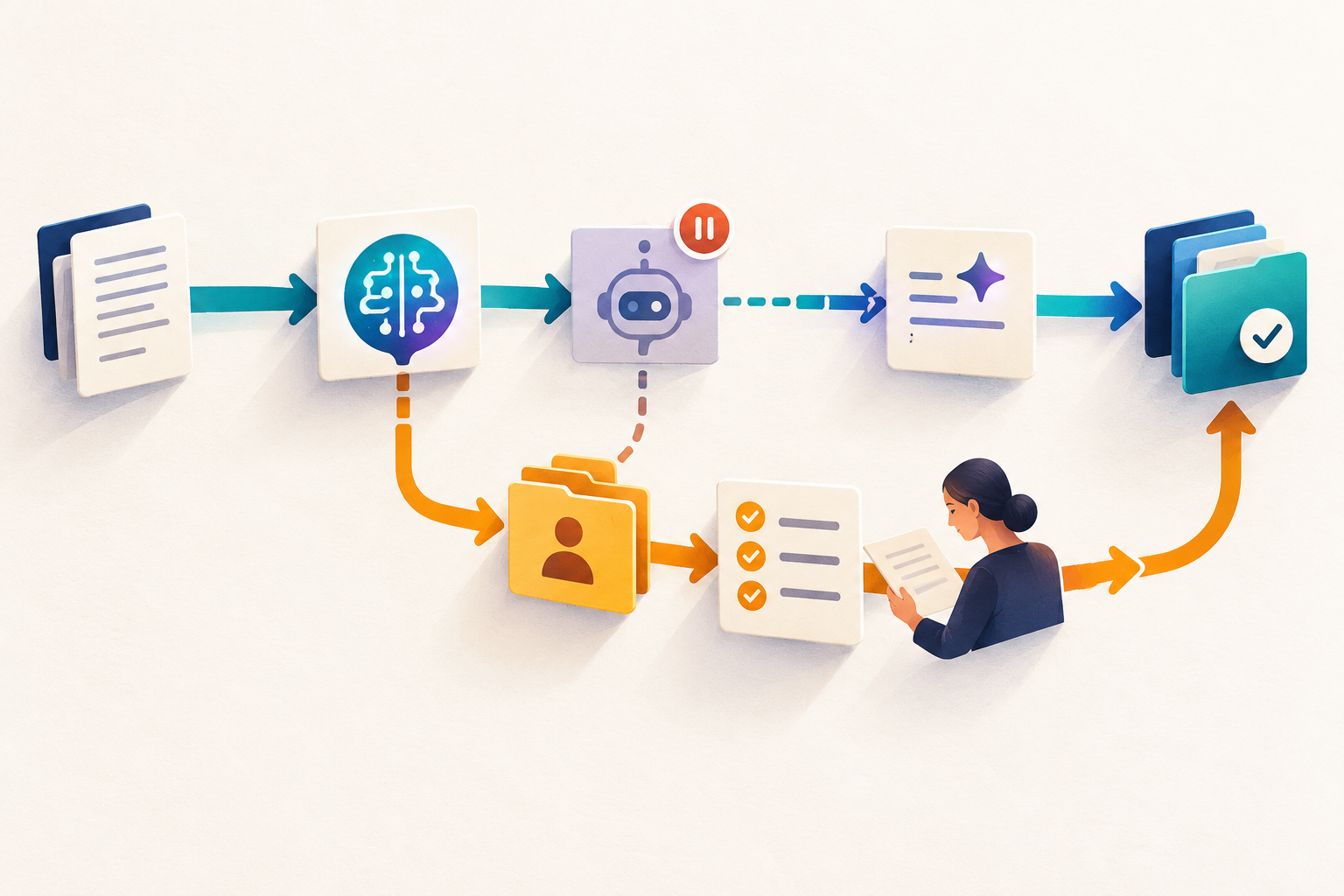
An AI workflow is not resilient because someone could take over. Build and rehearse a five-part manual fallback before the old route disappears.