
AI Training for Employees: Teach the Escalation Sentence
AI training for employees should teach what to say when an output is uncertain: one short hand-off with the task, gap, evidence checked and decision needed.

AI training for employees often teaches people to spot hallucinations, missing evidence or risky data. That is necessary, but it leaves a practical gap: what should an employee say next? Without a usable escalation sentence, uncertainty is often hidden, passed along as a vague warning or turned into a long message that gives the reviewer no clear decision to make.
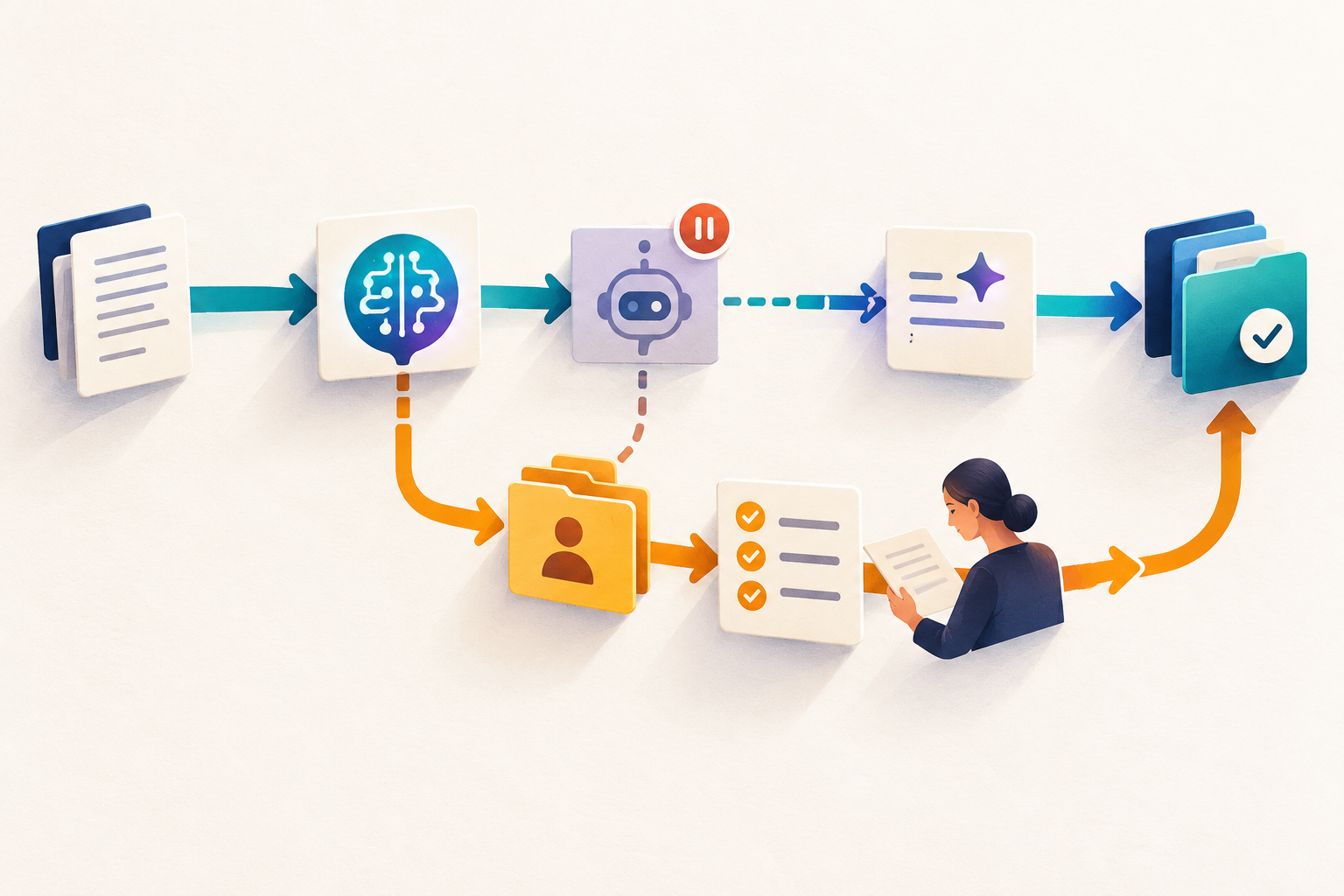
Teach one repeatable behaviour: state the task, name the uncertainty, say what was checked and ask a named person for a specific decision. This converts “I’m not sure” into a safe hand-off that work can move through.
The goal is not to escalate everything
The goal is to escalate the right uncertainty with enough context for the next person to act—without pretending the AI output is more certain than it is.
Why good judgement can still produce a bad hand-off
Employees can recognise that an output needs review and still struggle to explain why. They may forward the whole chat, write “please check”, or add a confidence score that has no agreed meaning. The reviewer then has to reconstruct the task, inspect every source and guess which decision is blocked.
Current guidance supports context-specific AI literacy and clear reporting routes. The European Commission says literacy measures should reflect the people, system, purpose and risk involved. The UK Government’s AI Playbook recommends clearly signposted routes for reporting risks or harms and adequate resources to respond. NIST highlights incident response, appeal and override as processes that depend on defined roles and human adjudication.
The four-part escalation sentence
Task
What are you trying to produce or decide? Keep it to one line.
Uncertainty
What exactly is missing, conflicting, unverifiable or outside your authority?
Check
What evidence, rule or source did you inspect before escalating?
Decision
Who needs to decide what, and by when?
AI training for employees needs a sentence they can use
A template makes the behaviour easy to practise:
I am preparing [task]. The AI output is uncertain because [specific issue]. I checked [source or rule], which [result]. [Named role], please decide [specific choice] by [time].
The sentence is deliberately compact. It does not attach a model’s self-reported confidence. It describes an observable problem and the work already done. It also directs the message to a decision owner rather than a general group.
Worked example: a supplier comparison
Reading is a start. Practice makes it stick.
Start learningAn employee asks an approved AI tool to compare three software suppliers. The draft says Supplier B meets the data-retention requirement, but the cited document describes backups and never states the retention period.
Vague warning
- “The AI may be wrong about Supplier B. Can someone check?”
- The reviewer must rediscover the task, source and blocked decision.
Actionable escalation
- “I am preparing the supplier shortlist. Supplier B’s retention claim is unsupported: I checked its security document and found only backup details. Procurement lead, please decide whether to request evidence or exclude the claim by 15:00.”
- The reviewer sees the task, gap, check and decision.
Nothing in the stronger version claims that Supplier B is unsafe. It separates a missing fact from a negative conclusion. That distinction prevents both careless approval and unfair rejection.
Teach boundaries around escalation
When to escalate
- A required fact cannot be traced to an approved source.
- Two authoritative sources conflict and the employee lacks authority to resolve them.
- The output affects a person, payment, legal position or safety decision beyond the employee’s mandate.
- The requested use falls outside policy or the employee cannot determine whether it is allowed.
- A reviewer asks for evidence that the workflow did not preserve.
Also teach when not to escalate. Employees should fix ordinary formatting, ask a clarifying question when the brief is incomplete and rerun a low-risk task when the acceptance check exposes a simple omission. Escalation is for uncertainty that blocks a decision, crosses authority or creates material risk.
Practise with realistic constraints
A useful exercise gives employees a short AI draft, one source and one policy excerpt. Add a planted problem: an unsupported number, a source conflict or a decision outside their authority. Their job is not to repair the entire output. It is to write the escalation sentence.
- Choose a routine AI-assisted task with a real reviewer.
- Create one safe sample containing a single, visible uncertainty.
- Write the task in one line.
- Name the uncertainty without exaggerating it.
- Record the source or rule you checked and what it showed.
- Ask the correct owner for one decision with a reasonable deadline.
- Have a colleague score the message: could they act without reopening the whole chat?
Make the sentence part of the workflow
The escalation sentence complements the AI handoff card, three levels of authority, the clarifying-question drill and the AI non-use register. Clarify before work, verify the output, escalate the unresolved issue, and preserve enough context for the reviewer.
Bokili turns behaviours like this into short practice that fits the tools and decisions employees actually face. Good AI literacy is visible in what people do when the answer is uncertain—not only when the tool works.
Sources
- AI Literacy — Questions & Answers — European Commission
- Artificial Intelligence Playbook for the UK Government — UK Government
- NIST AI RMF Playbook — Govern — NIST
- AI training for HR & L&D leaders — Bokili
Reading is a start. Practice makes it stick.
Bokili turns skills like this into ten-minute missions for your whole team, with instant feedback and progress you can see.
Start learningKeep reading
Design the Manual Fallback Before AI Becomes Normal
An AI workflow is not resilient because someone could take over. Build and rehearse a five-part manual fallback before the old route disappears.

ChatGPT Training for Employees: Run a Clean-Context Drill
Test whether a workplace ChatGPT method can travel by rerunning it with only the approved brief, then repairing the hidden assumptions.

Every AI Mission Needs a Three-Line Decision Receipt
A finished artefact shows what a learner produced. A three-line decision receipt shows the choice, check and reusable rule behind it.