
Before AI Merges Records, Define the Source of Truth
AI can surface likely duplicates, but it should not quietly decide which identity, field or history survives. Use a merge contract before records are combined.
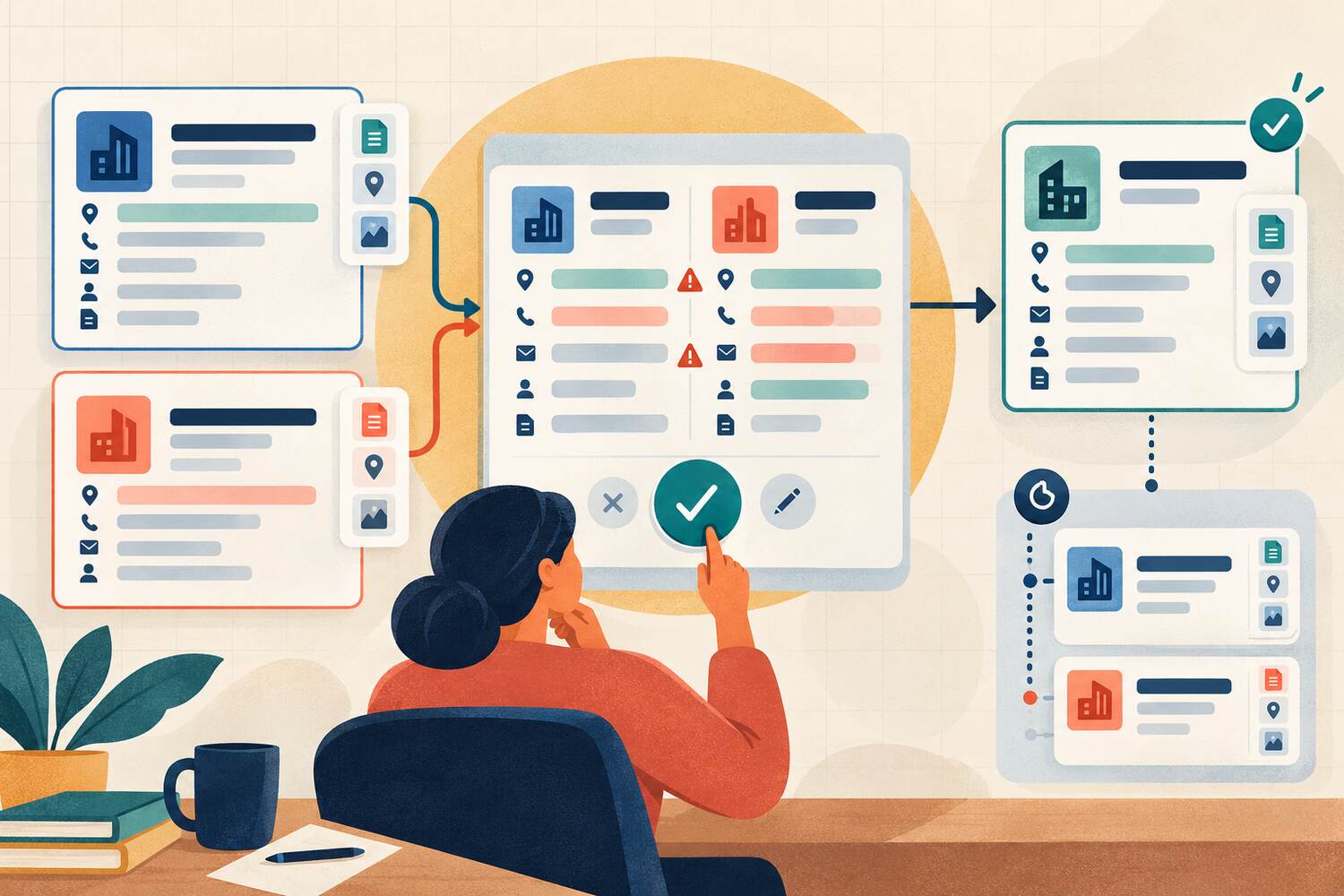
A duplicate record looks like a tidy-up problem until the two rows disagree. One supplier entry carries the current bank verification, another has the approved payment terms, and a third-party address check points somewhere else. An AI system can rank the pair as a likely match, but a high similarity score does not answer the consequential questions: are these truly the same entity, which fields should survive, and what history must remain visible?
This is why an AI-assisted merge needs a human-owned source of truth. The UK Government Data Quality Framework treats uniqueness, completeness and consistency as separate dimensions; a record can be unique yet incomplete, or duplicated while each copy contains valid evidence. The ONS also notes that matching can create false positives and false negatives. The safest workflow therefore separates match suggestion from merge authority.
Write a TRACE merge contract before the first click
A merge contract is a short, reusable decision rule for one record type. It tells reviewers what counts as identity evidence, which system has authority for each field, and when the process must stop. Use TRACE to draft it:
TRACE merge contract
Target entity
Name the thing being identified: a legal supplier, a person, an account, a site or a contract. Do not let a shared name substitute for a shared identity.
Record evidence
List the evidence that can establish a match, such as a verified tax identifier, customer number or approved address. Mark weak signals, including spelling similarity, as supporting evidence only.
Authority per field
Name the source that wins for each important field. The finance system may own payment terms while procurement owns supplier status.
Conflict log
Record every disagreement and the reason for the chosen value. A reviewer should be able to reconstruct the decision without rerunning the AI.
Escalate and retain
Define fields that block an automatic merge, then preserve both original records and their provenance after a decision.
Similarity is not identity
Names, domains and addresses can help find candidates. They should not by themselves authorise a merge when identifiers, ownership or regulated attributes conflict.
Worked example: two supplier records, one uncertain identity
Suppose an AI assistant flags “Northline Studio Ltd” and “North Line Studios” as duplicates. The names and postcode are close. However, the tax identifiers differ, one record is approved for bank payments, and the other carries a current insurance certificate. Treat the suggestion as a review queue, not a merge command.
Reading is a start. Practice makes it stick.
Start learning| AI suggestion | Human decision | |
|---|---|---|
| Identity | Likely duplicate from name and address | Hold: conflicting tax IDs must be resolved by procurement |
| Payment terms | Prefer the newest value | Use the finance-owned approved value |
| Risk status | Combine both labels | Retain both until the legal entity is confirmed |
| History | Keep the merged row | Keep both originals, the decision log and a reversible link |
If procurement confirms that the tax-ID mismatch was a data-entry error, the reviewer chooses a primary record, applies field-by-field survivor rules and logs why each value won. The secondary record can be deactivated, but it remains viewable. The Department for Education used a similar pattern in its duplicate-record design: side-by-side comparison, a chosen primary record, individual field decisions, comments and a retained secondary record. If the identity is not proven, both records stay active and the case is escalated.
Run the merge as a controlled decision
Five review steps
- 1
Freeze the candidates
Capture both records and their update dates before any changes.
- 2
Prove the entity
Check the contract’s identity evidence. Classify the pair as exact, likely or ambiguous.
- 3
Resolve by field
Apply the named source authority instead of choosing the most complete-looking row.
- 4
Record the exception
Log conflicts, missing evidence, reviewer and reason. Stop on any escalation field.
- 5
Preserve and test
Keep the originals, create the reversible link, and check downstream totals, permissions and alerts.
This control also supports accuracy. The ICO advises organisations to make the source and status of personal data clear and, in some cases, to retain an accurate record of a mistake rather than erase all trace of it. A merge log is therefore not administrative clutter; it is evidence that the current record can be explained.
- Choose two low-risk records that a system has flagged as possible duplicates.
- Write the target entity and two pieces of identity evidence that would prove a match.
- Name the authoritative source for three conflicting fields.
- Mark one condition that must stop the merge and require escalation.
- Decide how both originals and the review decision will remain accessible.
Make the rule reusable
Once tested, store the contract beside the workflow and review it when systems or responsibilities change. A good contract works with an assumption log, a workflow change log and an AI handoff card. Together they turn a one-off correction into a controlled, explainable operating practice.
The central discipline is simple: let AI find plausible pairs, but require people to define identity, authority and retained history before data is combined. The source of truth is not whichever row looks most complete. It is the record produced by an explicit, reviewable decision.
Sources
- The Government Data Quality Framework — UK Government
- Data linkage and matching policy — Office for National Statistics
- Principle (d): Accuracy — Information Commissioner's Office
- Resolving potential duplicate records — UK Department for Education
Reading is a start. Practice makes it stick.
Bokili turns skills like this into ten-minute missions for your whole team, with instant feedback and progress you can see.
Start learningKeep reading

AI Learning and Development: Separate Coaching From Assessment
AI learning and development becomes hard to trust when the same tool coaches, rewrites and scores a task. Use three clear zones to make workplace evidence meaningful.
AI Upskilling for Teams: Rehearse the Busy-Day Version
AI upskilling for teams should survive ordinary work pressure. Use a two-lane rehearsal to test the same skill with time, input and interruption constraints.

Checklist, Rubric or Example? Choose the Right AI Review Tool
A checklist catches missing parts, a rubric judges quality and a reference example clarifies intent. Use each review tool for the decision it handles best.