
Learn AI by Mapping the Work You Already Do
Learn AI by mapping one recurring work task, its useful outcome, stakes and human review before choosing a tool or course.
Start with the work, not the tool
To learn AI, choose one recurring task with a clear outcome, manageable stakes and a human who can review the result.
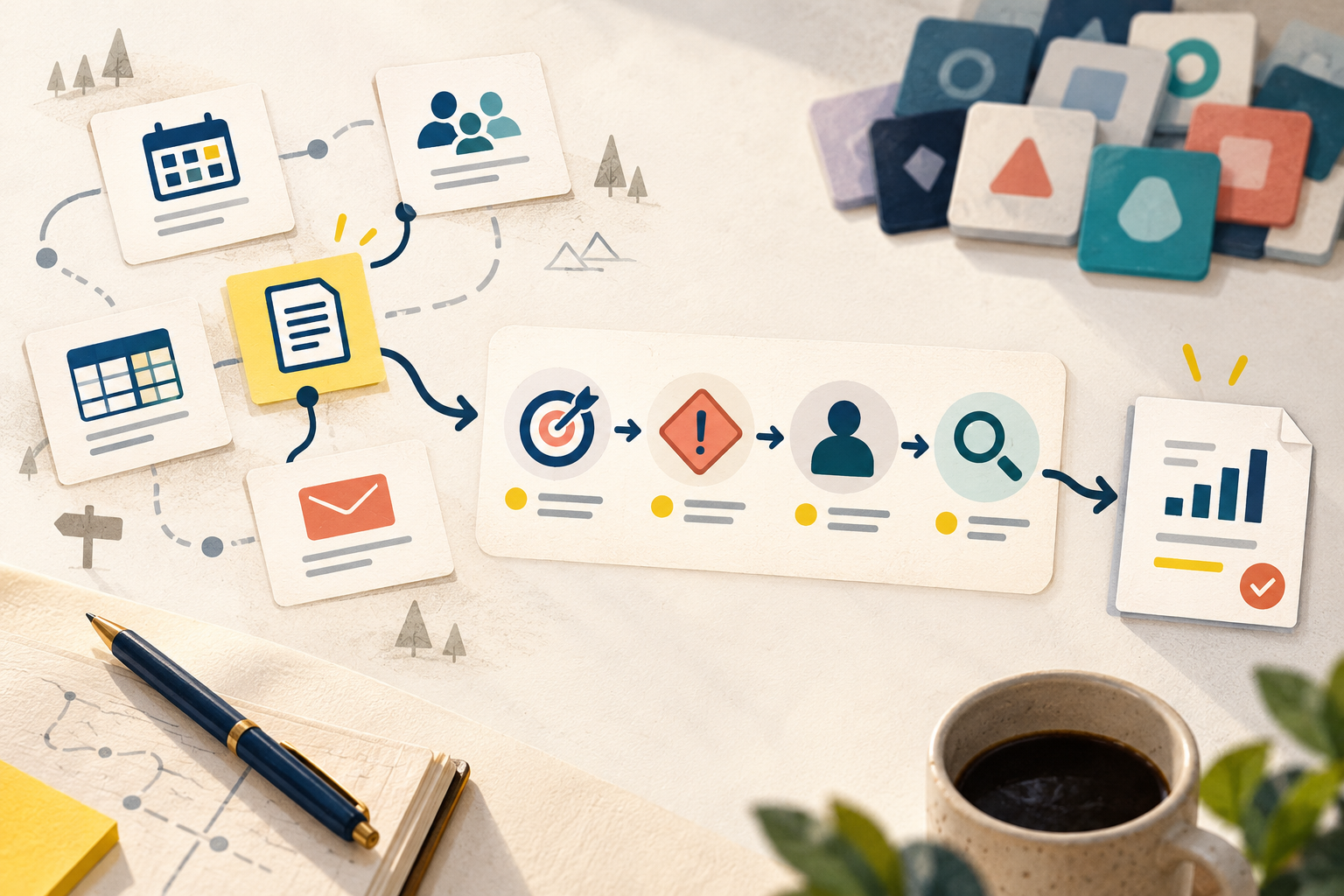
If you want to learn AI but do not know where to begin, another list of tools is rarely the answer. Start with the work you already do. Map a few recurring tasks, then choose one where AI could help without hiding the human decision. A good first task is frequent enough to practise, clear enough to judge and safe enough to repeat with public, fictional or approved material.
This approach turns beginner learning into a small work experiment. OPM’s training guidance starts from desired outcomes, critical behaviours and the performance problem—not from a catalogue of content. NIST’s AI Use Taxonomy similarly centres human goals and tasks. The UK Government AI Playbook says to begin with a clear need and consider whether AI is the right tool at all.
Learn AI with a four-part TASK map
The TASK starter map
T — Task
Name a recurring piece of work in plain language: compare options, summarise a meeting, draft an update or turn notes into a brief.
A — Aim
Define the useful result and audience. “Save time” is vague; “produce a one-page update that lets a sponsor choose” is testable.
S — Stakes
Mark the data, consequences and permissions. Start with public, fictional or approved inputs and a reversible decision.
K — Keep human judgement
Name the source, acceptance check and person who decides whether to use, revise, escalate or reject the output.
The map is deliberately tool-neutral. A task remains useful when an interface changes. It also reveals when AI is unnecessary: if the work is already fast, deterministic and easy to automate with a rule, a spreadsheet or template may be the better choice.
Worked example: choose one task from five
An operations coordinator lists five recurring tasks: scheduling shifts, approving expenses, summarising a weekly meeting, drafting a project update and answering a complaint. Each is real work, but they do not make equally safe first practice.
Reading is a start. Practice makes it stick.
Start learning| First-practice fit | Why | |
|---|---|---|
| Shift scheduling | Low | Personal constraints and coverage decisions create higher stakes. |
| Expense approval | Low | The final decision controls money and policy compliance. |
| Meeting summary | Medium | Useful, but only with approved notes and a clear source check. |
| Project update | High | Frequent, easy to compare with source notes and reviewed before sending. |
| Complaint reply | Medium | Realistic, but tone, commitments and customer data need stronger controls. |
The coordinator selects the project update and sharpens the aim: turn fictional project notes into a decision brief that states the decision, two options, the evidence gap and the owner. The stakes stay low because the case is fictional and the output is reviewed before use. Human judgement remains explicit: the project lead checks every claim and makes the decision.
Run the first practice loop
- 1
Write the TASK map
Capture the task, aim, stakes and keeper of judgement in four short lines.
- 2
Prepare safe inputs
Use public, fictional or approved notes. Remove material the task does not need.
- 3
Create one output
Ask the approved AI tool for the defined work artefact, not for an open-ended conversation.
- 4
Check against a source
Trace claims, figures and constraints to the notes and the acceptance standard.
- 5
Record one lesson
Name one failure, correction or boundary that should change the next attempt.
Avoid three beginner traps
A useful first task is not…
- A high-stakes decision where a weak output can directly harm a person.
- A task that requires confidential inputs before you understand the approved data boundary.
- A vague goal such as “be more productive” with no output or reviewer.
- A one-off novelty that you cannot practise again next week.
- A task whose quality you cannot check against a source, rule or knowledgeable person.
Bokili’s public features page describes short, scenario-based missions built around real work. That format matters because repetition and review make a task map useful: the learner can try a bounded task, inspect the result and carry one lesson into a fresh example instead of memorising a single prompt.
- List five tasks you repeat each week or month.
- Cross out tasks with sensitive inputs or direct high-stakes decisions.
- For the remaining tasks, write one useful output and who reviews it.
- Choose the task with the clearest source and easiest acceptance check.
- Complete the four TASK lines: Task, Aim, Stakes and Keep human judgement.
- Schedule one short practice using fictional, public or approved material.
Use the map to choose what comes next
Once you know the first task, compare learning options with the beginner-course outcomes checklist. Pair creation with checking in an AI learning path, improve repeated failures with the correction loop, and keep proof of progress in an AI skills evidence portfolio. Explore Bokili’s learning features for short workplace practice.
Learning AI begins with a decision about work: what outcome matters, what data is allowed, what could go wrong and who checks the result. A four-line task map gives a beginner a real starting point—and a reason to ignore tools that do not fit the job.
Sources
- Planning & Evaluating Training — U.S. Office of Personnel Management
- AI Use Taxonomy: A Human-Centered Approach — NIST
- Artificial Intelligence Playbook for the UK Government — UK Government
- Bokili Features — Bokili
Reading is a start. Practice makes it stick.
Bokili turns skills like this into ten-minute missions for your whole team, with instant feedback and progress you can see.
Start learningKeep reading
Redact Before You Prompt: Run a Reidentification Check
Removing names is not enough. Use a four-pass reidentification check before approved AI tools receive workplace text.

AI Skills: Build an Evidence Portfolio, Not a Prompt Folder
Make AI skills visible through useful outputs, documented judgement, verification and transfer to a fresh workplace task.
The AI Workflow Friction Test: Remove, Preserve or Strengthen?
Do not remove every step from an AI workflow. Classify friction as waste, learning, safety or coordination before changing it.