AI Course for Beginners: Check the Outcomes Before You Enrol
Choose an AI course for beginners by six practical exit outcomes, realistic practice and evidence you can use at work.
An AI course for beginners should promise demonstrable outcomes
A beginner course page can make almost any syllabus sound complete. Hours, modules, tool lists and certificates are easy to compare, but they do not answer the question that matters: what will you be able to do safely at work when the course ends? Choose an AI course for beginners by its exit outcomes, practice design and evidence—not by its length alone.
Current official catalogues already hint at this direction. Google AI Essentials describes hands-on activities based on real workplace scenarios, including prompting, responsible use and tool selection. Microsoft Learn separates resources by role, such as business user, leader, developer and data professional. The European Commission’s AI-literacy guidance also treats literacy as context-dependent rather than one fixed course level. A useful selection checklist should therefore connect the learner’s role, work tasks and responsibility.
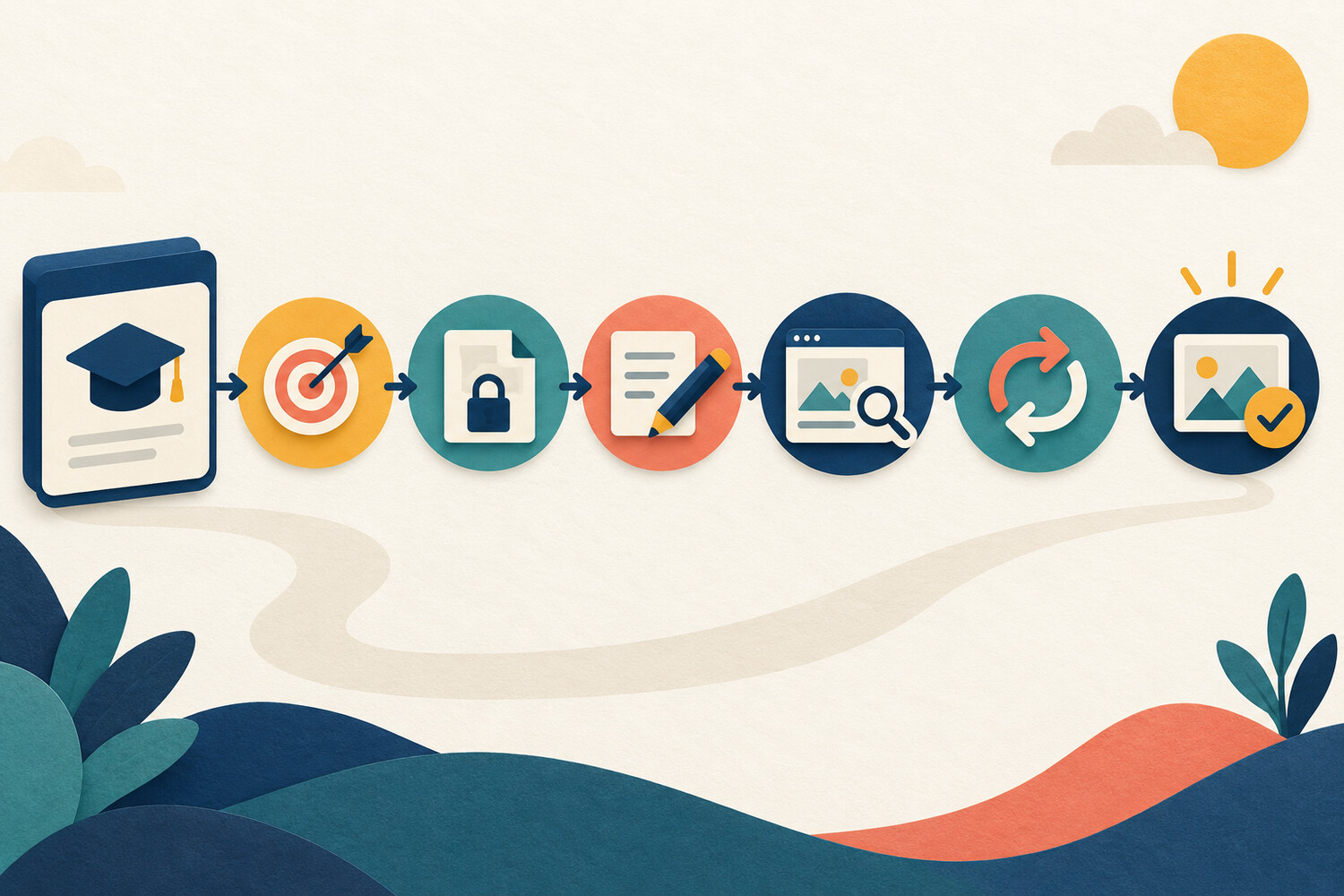
Six outcomes to check before enrolling
1. Select a suitable task
The learner can distinguish a useful, low-consequence starting task from work that needs stronger controls or no AI at all.
2. Protect the input
The learner can remove or avoid sensitive material and follow the organisation’s approved-tool and data rules.
3. Write a clear brief
The learner can state the goal, context, constraints, evidence and expected output instead of relying on a vague prompt.
4. Check against evidence
The learner can compare claims, figures and required details with a trusted source or acceptance standard.
5. Correct and try again
The learner can diagnose one failure, change the input or method and make a better second attempt.
6. Own the final result
The learner can decide whether to use, revise, escalate or reject the output and explain that decision.
How to read a course page
Look for verbs that describe learner action: practise, compare, verify, revise, decide and produce. ‘Understand AI’ may be a valid starting objective, but it is not enough evidence of work readiness. Check whether exercises use realistic scenarios, whether feedback is available and whether the learner must improve an output after the first attempt. Also confirm that the course matches the intended role. A technical lab can be excellent and still be the wrong choice for someone who needs to review client communications.
| Course-page signal | Question to ask | |
|---|---|---|
| Beginner friendly | No prior experience required | What work result will I complete? |
| Hands-on | Exercises are included | Will I make and improve something realistic? |
| Responsible AI | A safety module appears | Will I practise data boundaries and escalation? |
| Certificate | Completion is recognised | What can I demonstrate beyond attendance? |
| Role based | A learner path is named | Do the tasks match my actual responsibilities? |
Worked example: two plausible course descriptions
Reading is a start. Practice makes it stick.
Start learningConsider two illustrative listings. Course A offers eight hours of videos, a glossary quiz and a certificate. Course B offers four shorter modules and asks the learner to draft a customer update, remove sensitive inputs, verify three claims, revise one error and record the final human decision. Course A may explain more concepts. Course B provides clearer evidence for a learner whose goal is safe AI-assisted communication at work.
That does not prove Course B is universally better. If the learner needs technical foundations, governance depth or a recognised credential, Course A may fit a different outcome. The point is to make the choice explicit. Write the result you need first, then test the syllabus, exercises and assessment against it.
A ten-minute pre-enrolment audit
- 1
Minute 1–2: name one task
Write a real work task you want to perform better, plus one reason AI may help.
- 2
Minute 3–4: set the boundary
Note what data, decision or consequence would require extra care or human approval.
- 3
Minute 5–7: scan the outcomes
Mark which of the six outcomes appear as learner actions, not just topics.
- 4
Minute 8–9: inspect the practice
Find one realistic exercise, one feedback loop and one requirement to verify or revise.
- 5
Minute 10: decide
Enrol, compare another option or ask the provider one precise question about the missing outcome.
Build evidence after the course
Once you choose a course, turn the learning into one safe work sample: https://bokili.com/en/learn/ai-course-beginners-safe-work-sample. Then document how you framed, checked and corrected the task in an AI skills portfolio: https://bokili.com/en/learn/ai-skills-work-portfolio. If your employer is choosing training for a group, start with a three-task baseline: https://bokili.com/en/learn/ai-training-employees-three-task-baseline. For a provider comparison focused on no-charge options, use: https://bokili.com/en/learn/free-ai-course-work-skills.
Bokili’s public learning offer is available at https://bokili.com/en. Its short missions are one example of an outcome-led format: practise a work behaviour, receive feedback and leave with something usable. Whatever provider you choose, the same standard applies: a beginner course should help you do responsible work, not merely finish content.
- Complete this sentence: ‘At the end, I need to show that I can…’
- Add the work artifact you will produce.
- Add the source or standard you will check it against.
- Add the data boundary you must respect.
- Add who makes the final decision.
- Use the sentence to compare the next two course pages you open.
Choose the evidence, then choose the course
There is no single best beginner course for every learner. A strong choice connects one role, one practical goal and a visible standard of completion. If a course cannot show where you will select a task, protect inputs, brief the tool, verify the output, correct an error and own the result, keep looking—or ask the provider to make those outcomes clear.
Sources
- Google AI Essentials — Google
- Understanding AI: AI Tools, Training and Skills — Google
- AI Learning Hub — Microsoft Learn
- AI Literacy: Questions & Answers — European Commission
Reading is a start. Practice makes it stick.
Bokili turns skills like this into ten-minute missions for your whole team, with instant feedback and progress you can see.
Start learningKeep reading

AI Training for HR: Separate Interview Evidence From Inference
Teach HR teams to preserve exact interview evidence, remove unsupported inference and keep human scoring tied to the job.

Keep an AI Practice Library Current: Repeat, Rotate, Stretch, Retire
Maintain AI practice as a portfolio: repeat core behaviours, rotate familiar examples, stretch one condition and retire obsolete work.

AI Course for Beginners: Learn When to Stop Prompting
A practical AI course for beginners needs a stop rule for missing evidence, unclear authority, high-consequence use and absent quality standards.