
AI Course for Beginners: Learn When to Stop Prompting
A practical AI course for beginners needs a stop rule for missing evidence, unclear authority, high-consequence use and absent quality standards.

An AI course for beginners should teach more than how to keep prompting. It should teach when to stop. If the source is missing, the tool is not approved, the quality standard is unclear or the decision exceeds the learner’s authority, another prompt may produce more fluent text without making the work safer or more correct. Stopping is not failure. It is a work skill: recognise the boundary, preserve what is known and route the task to a person, source or process that can resolve it.
A stop rule prevents false progress
More output is not the same as more evidence. Pause when the next prompt cannot fix the missing condition.
Why an AI course for beginners needs a stop rule
NIST’s Generative AI Profile describes risks that can arise from model behaviour, inputs, outputs and human use. The UK Government AI Playbook says users should understand AI’s limitations, test outputs, use suitable tools and keep meaningful human control at the right stages. The European Commission’s current AI-literacy guidance similarly ties learning to the specific system, purpose, context and risks. For a beginner, these principles become practical only when the course names the moment to pause.
Without a stop rule, beginners can mistake persistence for competence. They may ask the same unsupported question in five ways, paste more data into an unsuitable tool, or polish a document before anyone has defined what “good enough” means. A useful course makes the boundary visible before it teaches another technique.
The PAUSE rule
P — Proof is missing
Stop when the required fact, source or record is unavailable. Ask for evidence rather than asking the model to fill the gap.
A — Authority is unclear
Stop when you do not know whether you may use the data, tool or output, or whether you may make the decision.
U — Use carries higher consequences
Stop when the result could materially affect a person, payment, entitlement, safety or external commitment and the required review is absent.
S — Standard is absent
Stop when nobody has defined the audience, required content, acceptance criteria or verification method.
E — Escalate or reframe
Route the issue to the right owner, switch to a safe source pack, narrow the task or use a non-AI method.
Worked example: the incomplete pricing reply
A new sales coordinator receives a customer email asking for a renewal price and a delivery commitment. The approved AI tool can help draft a clear reply, but the coordinator has an old price sheet, no confirmed stock date and no authority to offer a discount. The weak approach is to keep prompting until the message sounds certain. The skilled approach is to use PAUSE.
Reading is a start. Practice makes it stick.
Start learningApply PAUSE before another prompt
- 1
Proof
The current price and stock date are missing. The model cannot verify them from the supplied material.
- 2
Authority
The coordinator cannot approve a discount or promise delivery.
- 3
Use
The message would create an external commercial commitment.
- 4
Standard
The company has not yet supplied the approved wording for uncertain dates.
- 5
Escalate or reframe
Draft only the factual acknowledgement, flag the two missing decisions and route them to the pricing and operations owners.
| Keep prompting | Use a stop rule | |
|---|---|---|
| Missing fact | Ask the model to infer or estimate | Name the gap and request the source or owner |
| Permission | Assume that tool access equals decision authority | Check the boundary before using or sharing the output |
| Quality | Polish until the answer feels complete | Define an acceptance test before generation |
| High consequence | Rely on a confident draft | Pause for the required human review |
| Next step | Generate another version | Escalate, narrow or switch to a non-AI route |
Teach the restart condition as well
A stop rule is useful only if the learner knows how work can restart. “Ask a manager” is too vague. Name the missing item, the owner and the safe interim action. For example: “I can draft the acknowledgement now. I need the current price from Finance and the confirmed date from Operations before I can prepare the final reply for approval.” That sentence preserves momentum without pretending the missing decisions have been solved.
Restart checklist
- The required source or fact is available.
- The data and tool are approved for this task.
- The learner’s decision authority is clear.
- The audience and acceptance criteria are stated.
- The required reviewer is available.
- A non-AI fallback exists if the task remains blocked.
- Choose a low-risk task that you might normally give to an AI tool.
- Remove one necessary source, permission or acceptance criterion.
- Write the prompt you would have used, but do not run it yet.
- Apply PAUSE and circle the first boundary you hit.
- Write one escalation or reframing sentence that keeps the work honest.
- Restore the missing condition and run the task with a clear acceptance check.
Build beginner confidence around boundaries, not bravado
Use Bokili’s beginner guides as a sequence. Start with a reversible work task (https://bokili.com/en/learn/ai-course-beginners-reversible-task). Check course outcomes before enrolling (https://bokili.com/en/learn/ai-course-beginners-outcomes-checklist). Improve by correcting one mistake at a time (https://bokili.com/en/learn/learn-to-use-ai-correction-loop). Then pair every creation skill with a verification check (https://bokili.com/en/learn/ai-learning-path-creation-verification-pairs). Bokili’s HR and L&D page explains how short, role-adapted practice can support employees at different levels (https://bokili.com/en/for-hr).
A beginner does not need to know every technique before doing useful work with AI. They do need to recognise the point where technique stops helping. Teach that pause explicitly. It turns uncertainty into a safe next action.
Sources
Reading is a start. Practice makes it stick.
Bokili turns skills like this into ten-minute missions for your whole team, with instant feedback and progress you can see.
Start learningKeep reading

AI Training Is Also a Test of the Organisation
When AI practice fails, test the learner’s behaviour and the organisational conditions that made the right behaviour possible.

Use AI to Prepare a Sales Discovery Brief Without Turning Guesses Into Facts
Build an evidence-first sales discovery brief that separates verified account facts, working hypotheses, open questions and follow-up owners.
AI Training for Employees: Practise the Sharing Decision
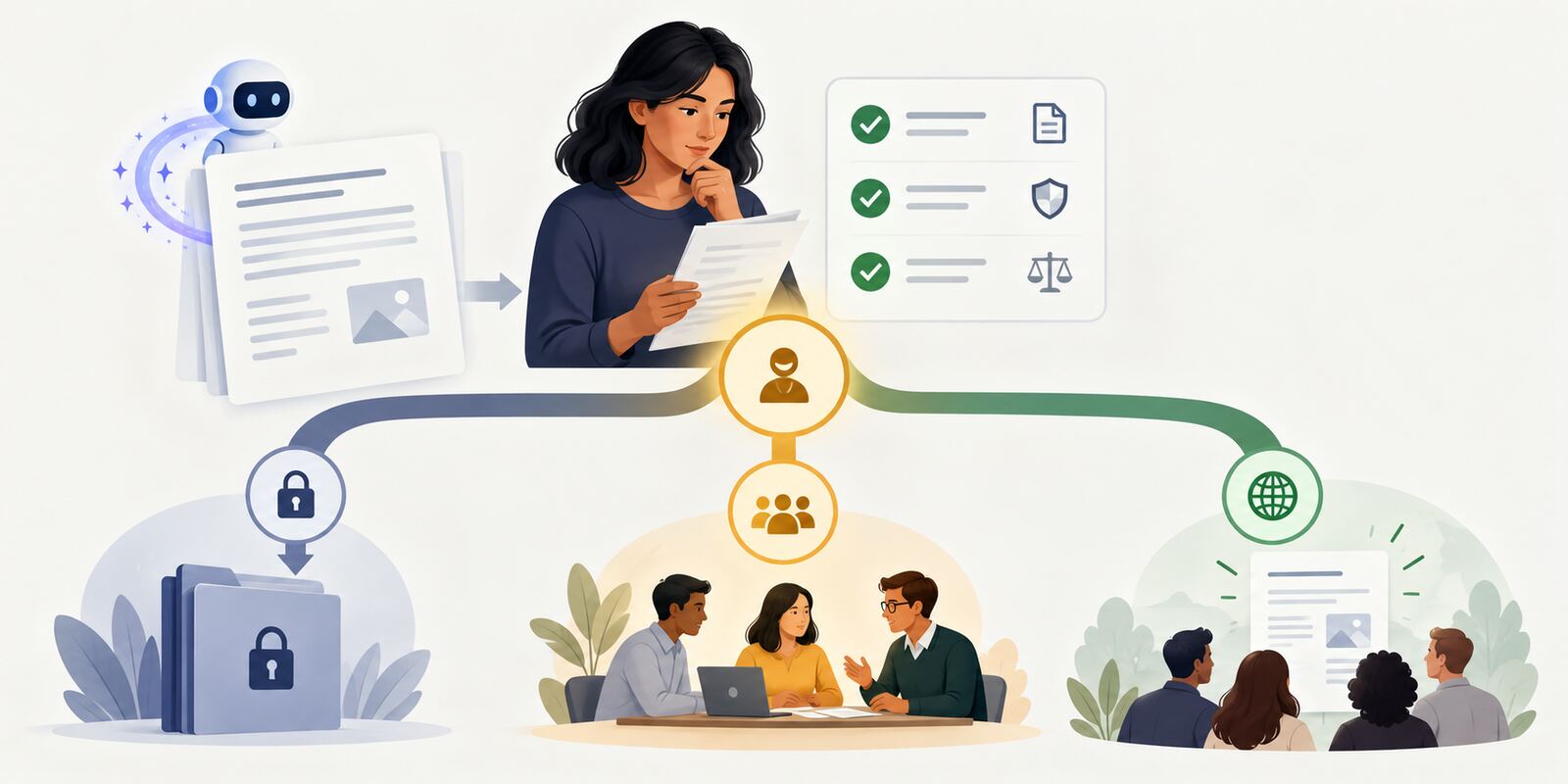
Add a release gate to AI training for employees so a checked output stays private, goes to review or reaches the right audience with approval.