
AI Training for Employees: Practise the Sharing Decision
Add a release gate to AI training for employees so a checked output stays private, goes to review or reaches the right audience with approval.
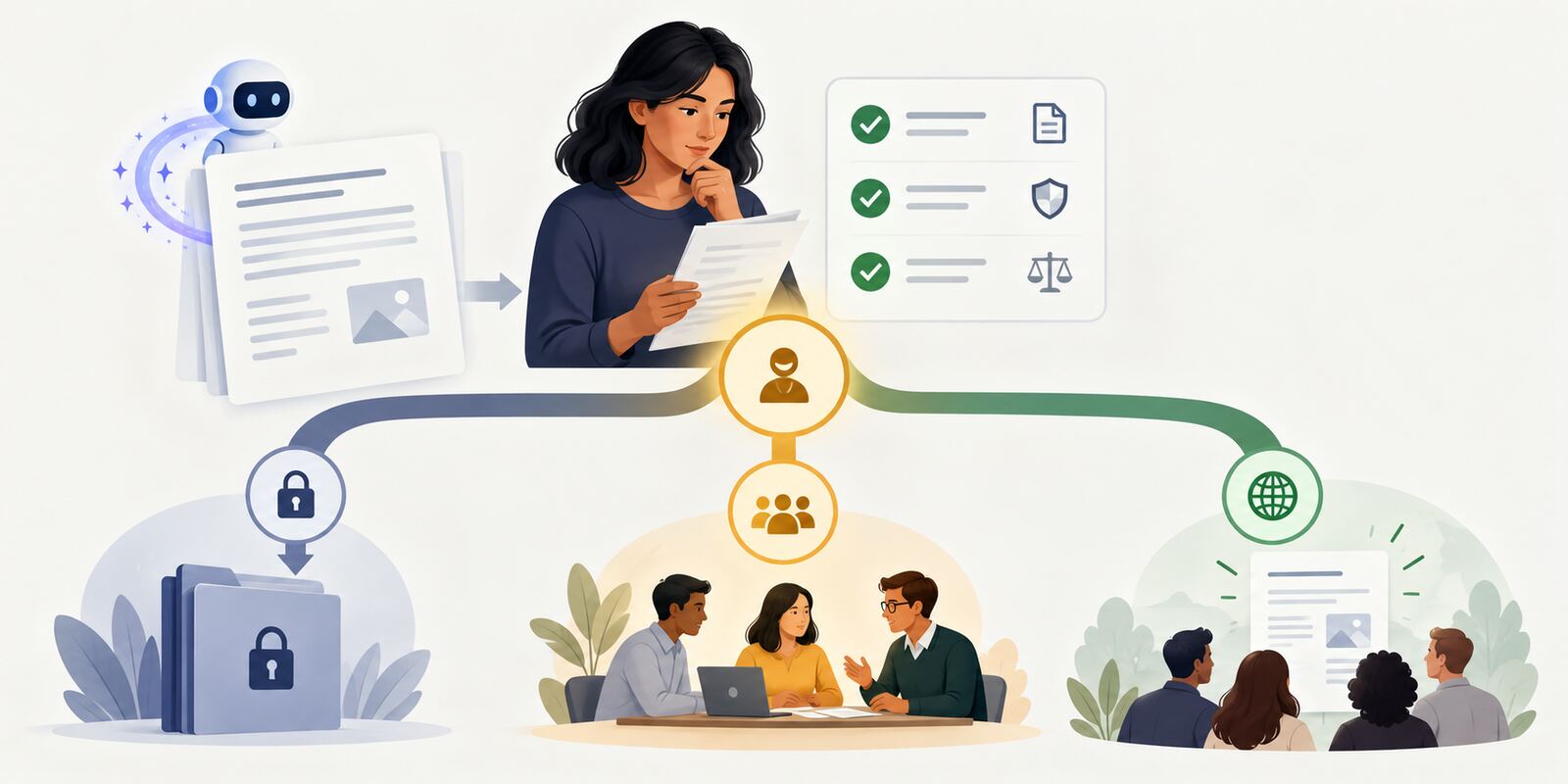
AI training for employees often ends when a learner has produced and checked an answer. Real work has one more decision: who may receive it now? A correct draft can still cause harm when it contains restricted material, lacks approval, reaches the wrong audience or looks final when it is only working notes. Training should therefore include a release gate that asks employees to keep the output private, send it for internal review or approve it for external sharing.
Why AI training for employees needs a release gate
Most practice exercises score the prompt and the output. They rarely score distribution. Yet the employee who creates an AI-assisted document is often the first person able to see its sources, gaps, intended audience and possible consequence. That moment deserves a small, observable skill of its own.
The European Commission’s current AI-literacy guidance says learning measures should reflect people’s knowledge, the system, its risks and the context and purpose of use. The UK Government AI Playbook adds practical controls: test outputs against existing expertise, document source data and keep meaningful human control. UK Government guidance on the people side of AI adoption also recommends continuous, actionable training and properly equipping human reviewers. A release decision turns those principles into behaviour that can be practised.
Teach three release levels
Private, review or release
Private working draft
Keep it with the creator when evidence, data boundaries, ownership or purpose is not yet clear.
Internal review
Share only with the named reviewer or team when the work is ready for checking but not yet authorised for wider use.
Approved release
Share with the intended external or wider audience only after sources, permissions, claims, format and approval are complete.
The levels are not measures of confidence. They are destinations with conditions. A highly confident employee may still need legal, policy, subject-matter or managerial approval. A low-risk internal note may move quickly once its owner and evidence are clear. The aim is to make the next audience deliberate.
Use the CLEAR check before an AI-assisted output moves
CLEAR: a five-part sharing decision
- 1
C — Content
What information appears in the output? Remove material the next audience does not need.
- 2
L — Level
Is this still a working draft, ready for internal review or approved for release? Label it honestly.
- 3
E — Evidence
Can the recipient trace decisive claims, figures and quotations to approved sources?
- 4
A — Audience
Who needs this, who may receive it and who could be affected if it is wrong or misread?
- 5
R — Release owner
Who has authority to approve this use? If nobody is named, hold the output or escalate.
This is not a substitute for information-security, privacy, communications or sector rules. It is the last training habit before those rules meet a real recipient. The ICO’s AI guidance stresses security and data minimisation across the surrounding data flow and business process. Employees should use approved tools, remove unnecessary personal data and follow local policies rather than relying on a generic checklist.
Reading is a start. Practice makes it stick.
Start learningA worked example: the accurate draft that should not leave yet
A marketing employee uses an approved AI tool to turn an internal product brief into a customer email. The draft is clear and every product fact matches the brief. It also includes an unreleased launch date and a claim that has not passed the organisation’s approval process. An output-only exercise might score the draft as accurate. The sharing exercise does not.
CLEAR marks the content as containing restricted timing, sets the level to internal review, confirms that most facts have evidence, narrows the audience to the product and legal reviewers and assigns the campaign owner as the release owner. The employee removes the unreleased date, labels the claim for approval and holds the external send. The skill is not refusing AI; it is knowing when a good draft is not yet a releasable document.
| Output-only training | Release-aware training | |
|---|---|---|
| Finish line | A plausible, checked answer | A checked answer sent to the right audience |
| Data | Safe input is considered | Input and output disclosure are considered |
| Approval | Often implicit | Named before wider sharing |
| Evidence | Creator checks it | Recipient can trace decisive claims |
| Failure signal | Wrong content | Wrong content, audience, timing or authority |
Build the decision into every employee exercise
- Add a named audience and a plausible consequence to the task.
- Include one detail that should be removed, restricted or confirmed before sharing.
- Ask the learner to choose private, internal review or approved release.
- Require a one-sentence reason and a named release owner.
- Score the decision separately from prompt quality and writing quality.
- Use a fresh case later so the learner must recognise the boundary again.
This supports—not replaces—Bokili’s related guides to separating drafts from records, setting authority levels and preserving evidence in marketing claims: https://bokili.com/en/learn/ai-training-employees-drafts-records, https://bokili.com/en/learn/ai-literacy-training-business-authority-levels and https://bokili.com/en/learn/ai-marketing-claims-evidence-sheet. The HR and L&D programme at https://bokili.com/en/for-hr connects short practice, role context and visible progress.
- Choose a familiar low-risk work output and invent a safe source pack.
- Add one restricted detail, one unsupported claim and one approval owner.
- Ask the learner to create and check the output.
- Require a private, review or release decision using CLEAR.
- Give feedback on the audience and authority choice, then change the scenario and try again.
Train the moment between creation and distribution
Employees do not need another warning that AI can be wrong. They need repeated practice at the point where a draft becomes visible to someone else. Add the release gate, make the audience and owner explicit and score the sharing decision as a real workplace behaviour. Bokili helps teams rehearse focused choices like this in short missions adapted to role, level and tools—so the habit appears before the next live document moves.
Sources
- AI Literacy - Questions & Answers — European Commission
- Artificial Intelligence Playbook for the UK Government — UK Government
- The People Factor: A human-centred approach to scaling AI tools — UK Government
- How should we assess security and data minimisation in AI? — Information Commissioner's Office
Reading is a start. Practice makes it stick.
Bokili turns skills like this into ten-minute missions for your whole team, with instant feedback and progress you can see.
Start learningKeep reading

Use AI to Prepare a Sales Discovery Brief Without Turning Guesses Into Facts
Build an evidence-first sales discovery brief that separates verified account facts, working hypotheses, open questions and follow-up owners.

AI Upskilling for Teams: Use a Teach-Back Test
Turn one completed AI lesson into shared working knowledge: explain the method in plain language, then let a colleague apply it to a fresh case.
After AI Automation, Audit the Cases That Passed
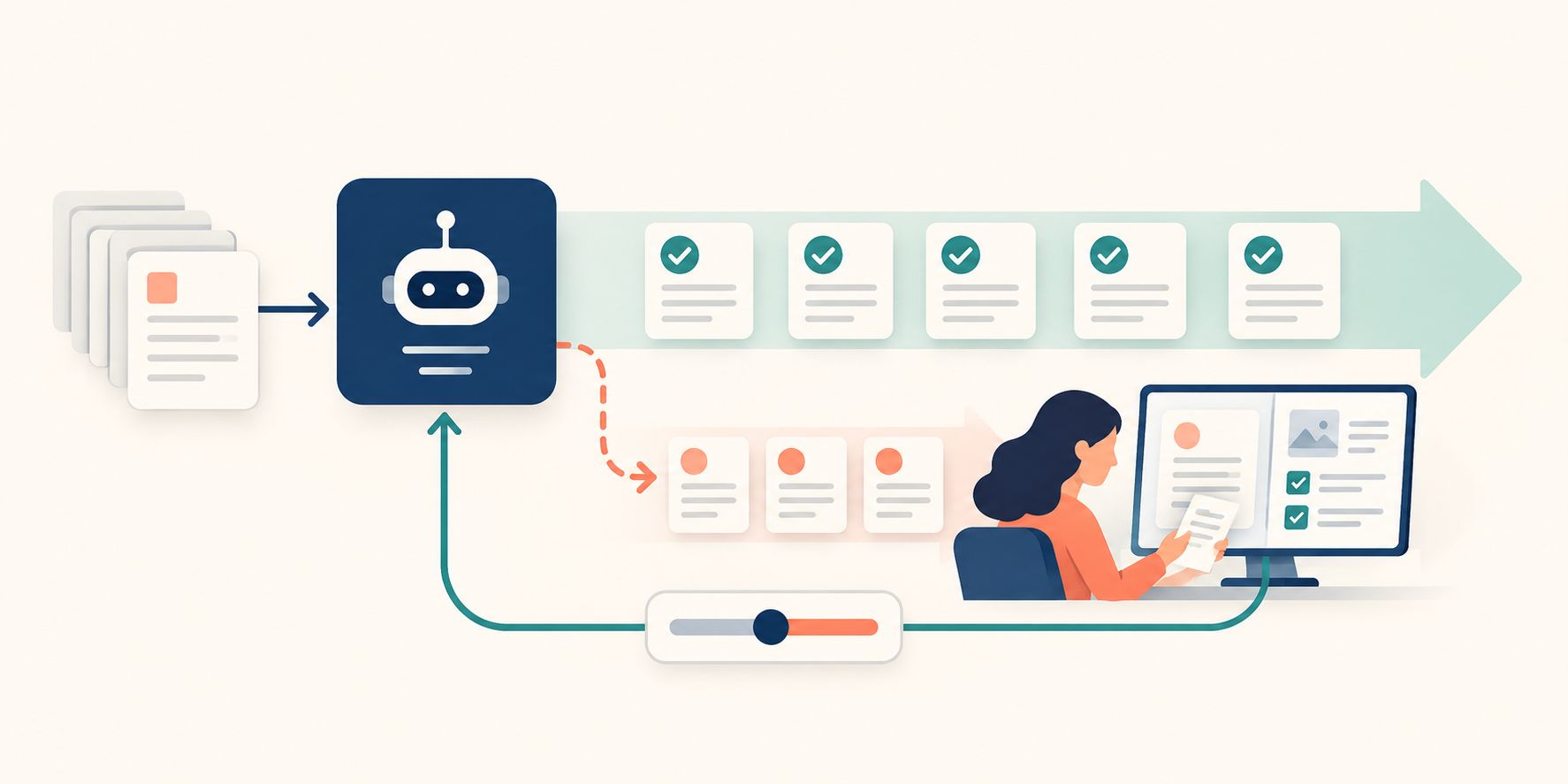
Exceptions show visible failures. A small, risk-based sample of accepted cases can reveal silent ones and feed better thresholds, controls and training.