

After AI Automation, Audit the Cases That Passed
Exceptions show visible failures. A small, risk-based sample of accepted cases can reveal silent ones and feed better thresholds, controls and training.
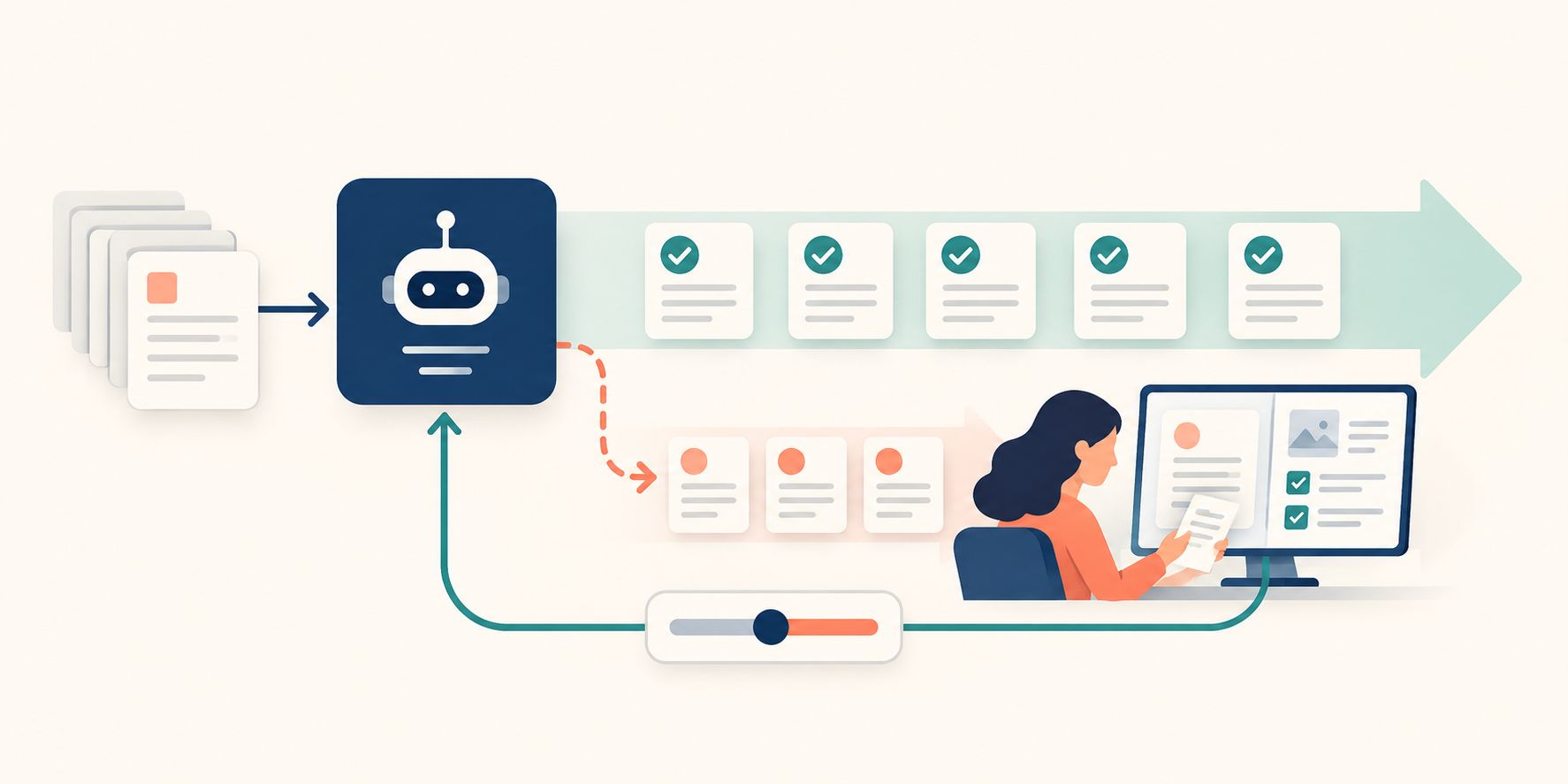
AI automation can look healthy when exception queues stay small and users do not complain. That view is incomplete. If people inspect only the cases the system rejects, they never test the routine cases it accepts. A silent defect can therefore move through the easiest-looking path for weeks. Business and operations leaders need a small, risk-based sampling lane that sends some accepted cases back to a qualified person. The purpose is not to repeat every decision. It is to find defects that the current rules, thresholds and alerts do not know how to see.
Exceptions are not a quality sample
An exception queue shows what the workflow already recognises as unusual. Accepted-case sampling looks for problems outside that existing definition.
Why accepted AI cases need human attention
NIST’s March 2026 report on post-deployment AI monitoring says real operating conditions can expose unforeseen outputs, drift and consequences that controlled pre-deployment tests cannot capture. It also notes that monitoring practice is still developing. The NIST AI RMF Measure playbook recommends comparing generated outputs with new ground truth, using human review for unexpected data and collecting cases from the operating environment for later testing. These sources support a practical conclusion: approval is not the end of measurement.
Sampling is useful because an automated workflow defines success through the controls it already has. A completeness rule may miss a wrong category. A confidence threshold may pass a plausible answer that relies on the wrong source. A routing rule may accept a familiar-looking case with a new combination of details. Review only the visible failures and the organisation learns mainly about known failure modes.
Build a SAMPLE lane after AI automation
The SAMPLE design
Scope
Name the accepted decision or output being checked. Keep the unit narrow enough that a reviewer can apply one clear quality bar.
Amount
Choose a review amount from consequence, change and uncertainty. Increase it after a model, source, rule or workflow change; do not copy a fixed percentage from another process.
Method
Recheck the case against the source and acceptance criteria, preferably without treating the original automated result as the answer key.
Problems
Log material defects, near misses and new exception patterns. Separate them from harmless style preferences.
Learn
Decide whether the finding changes a threshold, source, rule, test case, employee practice or ownership boundary.
Escalate
Predefine when sampling expands, automation pauses or a specialist takes over. A finding needs an action route, not only a dashboard.
The amount should be proportional, not ritualistic. A stable, low-consequence workflow may need only a modest periodic sample. A newly changed workflow, a new source or a task with harder-to-reverse effects deserves more attention. Sampling also needs independence: if the same shortcut drives both automation and review, the second pass may simply repeat the first mistake.
Reading is a start. Practice makes it stick.
Start learningWorked example: routing customer service requests
Imagine a fictional service team that uses an AI-supported rule to route straightforward delivery questions to a self-service answer. Requests mentioning a damaged parcel, account change or refund already enter a human exception queue. The automation appears stable because few messages trigger those terms and the self-service completion rate looks normal.
The team samples a small set of accepted cases and reviews each one against the original message and routing standard. One case asks about a delivery date but also contains an address change written in the final sentence. The system classified it as routine because the leading request looked familiar. The customer did not file a complaint; the defect would not have appeared in the exception queue.
The team does not respond by adding a vague instruction to “be careful”. It records the combined-intent pattern, adds it to the test set, changes the routing rule so account changes take precedence, and gives support staff one short recognition exercise. For a limited period, the sampling amount increases. Once the new rule has been tested on fresh cases, the team can reduce the rate again. One accepted-case defect has become a better control and a better lesson.
Keep sampling tied to decisions
A sampling lane can become performative if reviewers collect error counts but nobody owns the response. Define the action before reviewing: correct the case, widen the sample, update a rule, create a new test, train a role, change the source or pause the automated path. Record enough evidence to explain the decision without retaining unnecessary sensitive content.
Accepted-case sampling gate
- The accepted case type and quality standard are written down.
- The sample reflects consequence and recent change, not an arbitrary universal rate.
- A qualified reviewer can see the original source and the intended outcome.
- Material defects are separated from cosmetic preferences.
- Every finding has an owner and one allowed response.
- The workflow can expand review or stop when a trigger is reached.
- New failure patterns are added to future tests and practice.
Use this control beside, not instead of, the error-cost matrix, the exception-queue estimate and the AI handoff card. Those guides help set the threshold, price visible exceptions and carry context into review. Accepted-case sampling covers a different question: what is passing today that should not be?
- Choose one automated decision that currently accepts routine cases.
- Write the three conditions an accepted case must satisfy.
- Name one defect the current exception rule would probably miss.
- Select five recent low-risk accepted cases that may be reviewed lawfully and safely.
- Recheck them against the original source and criteria.
- For any material finding, choose one action: correct, expand, update, train or stop.
- Name the owner and the date for reviewing the new evidence.
Automation earns trust through evidence after deployment, not through a clean launch alone. Keep a small path back to human judgement, let real accepted cases challenge the rules and feed what you learn into controls and practice. Bokili helps teams turn those findings into focused workplace missions without confusing training with the control itself.
Sources
- Challenges to the Monitoring of Deployed AI Systems — National Institute of Standards and Technology
- NIST AI RMF Playbook — Measure — National Institute of Standards and Technology
- Artificial Intelligence Risk Management Framework 1.0 — National Institute of Standards and Technology
Reading is a start. Practice makes it stick.
Bokili turns skills like this into ten-minute missions for your whole team, with instant feedback and progress you can see.
Start learningKeep reading

AI Upskilling for Teams: Use a Teach-Back Test
Turn one completed AI lesson into shared working knowledge: explain the method in plain language, then let a colleague apply it to a fresh case.

AI Training for HR: Check AI-Drafted Performance Goals
A four-part check helps HR teams and managers turn fluent AI drafts into fair, observable goals that people can actually work towards.

Use ChatGPT Projects to Keep the Review Standard Visible
Put stable acceptance criteria in project instructions, changing evidence in project sources and today’s request in a fresh chat.