
AI Training Is Also a Test of the Organisation
When AI practice fails, test the learner’s behaviour and the organisational conditions that made the right behaviour possible.

AI training is usually treated as a test of the employee: can they choose a suitable task, protect sensitive information, guide the tool and check the result? That matters. But the same exercise tests the organisation too. Can the employee find an approved tool, a usable rule, time to practise, a quality standard and a person who owns the difficult exception? When those conditions are missing, a weak result is not clean evidence of a skills gap. It may be evidence that the system around the learner is not ready.
The two-way test
Every practice task produces two results: evidence about the learner’s behaviour and evidence about whether the organisation has made safe AI use possible.
AI training reveals the system around the learner
The 2026 Skills England employer guide describes effective AI upskilling as practical, inclusive and embedded in everyday work rather than tied to one product. The European Commission’s current AI-literacy guidance also says learning should reflect people’s knowledge, experience, the system in use, its purpose and its risks. Those are not learner-only variables. They depend on decisions about access, policy, work design, support and oversight.
This changes the question leaders should ask after a poor attempt. Instead of starting with “Why did the employee get this wrong?”, ask “Which part of the work system made the right behaviour hard to perform?” The answer may still be a skill gap. It may also be a vague rule, an unavailable source, a tool mismatch, no protected practice time or an escalation route that exists only on paper.
The READY two-way test
R — Route
Is there an approved AI route for this task, plus a non-AI fallback when the route is unavailable?
E — Evidence
Can the learner reach the sources, examples and acceptance criteria needed to check the result?
A — Authority
Is it clear what the employee may decide, what requires review and who owns the exception?
D — Doing time
Has the organisation protected enough time to practise, receive feedback and repeat the task?
Y — Yield feedback
Can a manager or programme owner turn repeated learner friction into a clearer rule, better workflow or new practice case?
Worked example: a useful failure in customer support
A support team practises turning fictional case notes into a five-line customer update with an approved AI tool. The learner produces a polished draft but omits the promised response date and invents a refund threshold. A conventional score says the learner must verify facts more carefully. The two-way test finds three additional problems: the source pack lacks the current refund policy, the exercise never defines whether the date may be inferred, and the escalation owner is not named.
Reading is a start. Practice makes it stick.
Start learningRun the same failure through both lenses
- 1
Observe the behaviour
Record the invented threshold, the missing date and the checks the learner did or did not perform.
- 2
Inspect the environment
Check whether the approved policy, quality standard and escalation owner were available at the moment of work.
- 3
Fix the smallest cause
Add the current policy, state that missing dates must be marked as unknown and name the review route.
- 4
Repeat with a fresh case
Use different fictional notes to see whether the learner now applies the behaviour without copying the first answer.
| Learner-only diagnosis | Two-way diagnosis | |
|---|---|---|
| Question | What did the person get wrong? | What behaviour and system condition produced the result? |
| Response | Assign more generic training | Practise the missing behaviour and repair the enabling condition |
| Evidence | Completion, score or final output | Observed choice, available standard, correction and transfer |
| Owner | The learner | Learner plus policy, tool, manager and programme owners |
Measure readiness without excusing poor practice
A system diagnosis is not a way to remove individual responsibility. It makes responsibility precise. If the rule, source and review route are clear, the learner’s decision becomes easier to assess. If they are absent, leaders can repair the environment before repeating the assessment. The result is fairer to the employee and more useful to the organisation.
Questions for the programme owner
- Was the task suitable for AI and did the learner know the non-AI route?
- Were approved inputs and current source materials available?
- Did the exercise define a visible acceptance standard?
- Were decision boundaries and review owners named?
- Could the learner practise without using confidential work?
- Did repeated friction create a policy, workflow or support action?
- Was the revised behaviour tested on a fresh case?
- Choose one recent AI practice task that produced a weak or hesitant result.
- Write the exact learner behaviour that needs to change.
- Apply READY: Route, Evidence, Authority, Doing time and Yield feedback.
- Mark each missing organisational condition beside the learner gap.
- Assign one repair to a named owner, then schedule a fresh practice case.
Make training a feedback loop for the organisation
Bokili already treats practice as more than content consumption: short missions, role-adapted paths and visible progress make behaviour easier to observe. The next step is to let that evidence improve the system around the learner. The manager practice loop shows how to reinforce one behaviour in context (https://bokili.com/en/learn/enterprise-ai-training-manager-practice-loop). The broken-workflow perspective explains why AI often exposes process faults before it improves them (https://bokili.com/en/learn/ai-reveals-broken-workflow). The prerequisite ladder helps teams find the lowest missing skill instead of repeating a whole course (https://bokili.com/en/learn/ai-skills-employees-prerequisite-ladder).
Good AI training should improve the learner. Great AI training should also make the organisation easier to work in: clearer standards, safer routes, better support and fewer hidden decisions. When the practice task fails, do not waste the signal. Test both sides.
Sources
- Employer guide: What works for AI upskilling in the UK — Skills England / GOV.UK
- AI Literacy — Questions & Answers — European Commission
- AI skills tools package — GOV.UK
- AI training for HR & L&D leaders — Bokili
Reading is a start. Practice makes it stick.
Bokili turns skills like this into ten-minute missions for your whole team, with instant feedback and progress you can see.
Start learningKeep reading

AI Course for Beginners: Learn When to Stop Prompting
A practical AI course for beginners needs a stop rule for missing evidence, unclear authority, high-consequence use and absent quality standards.

Use AI to Prepare a Sales Discovery Brief Without Turning Guesses Into Facts
Build an evidence-first sales discovery brief that separates verified account facts, working hypotheses, open questions and follow-up owners.
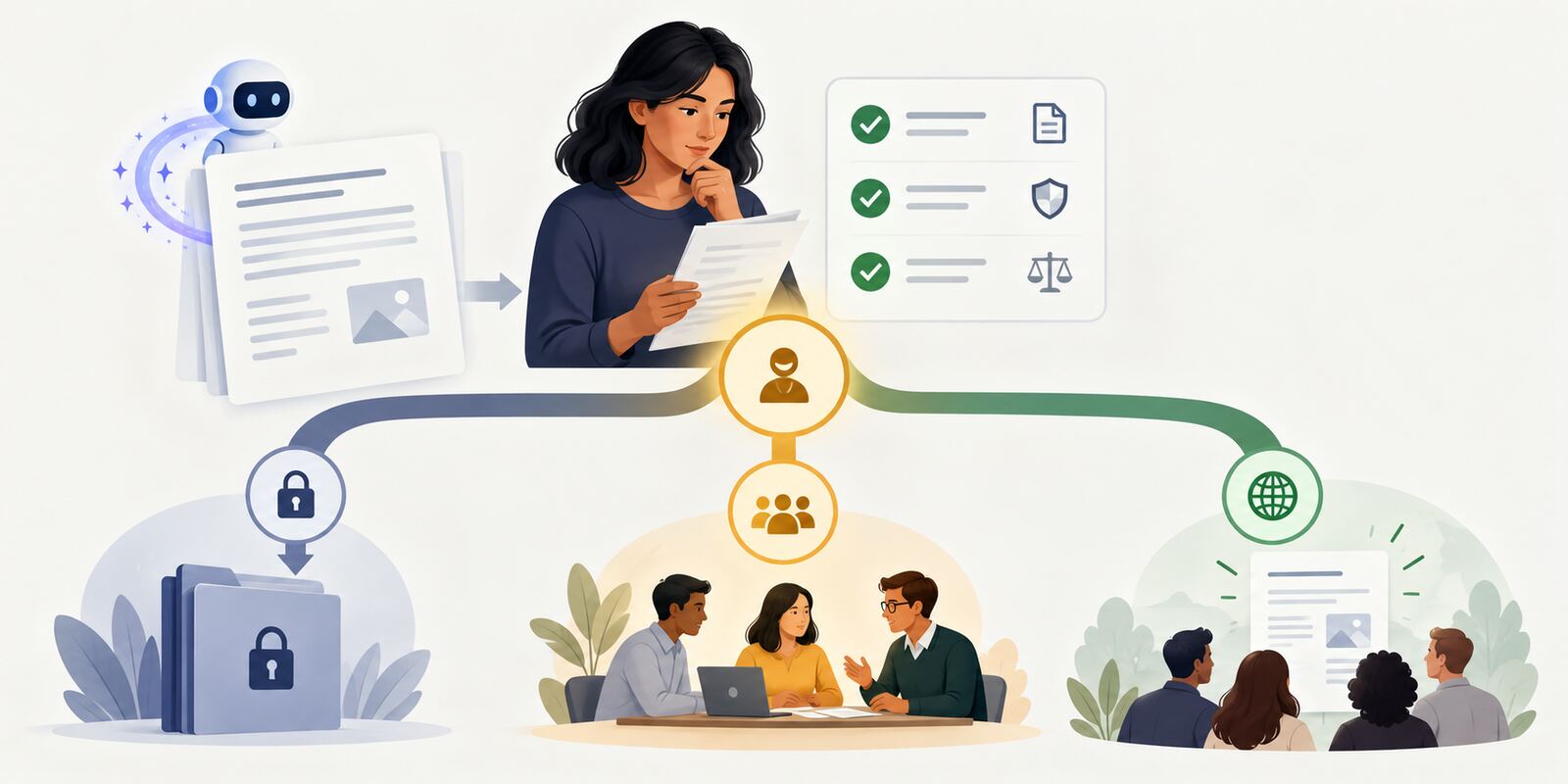
AI Training for Employees: Practise the Sharing Decision
Add a release gate to AI training for employees so a checked output stays private, goes to review or reaches the right audience with approval.