
Learn to Use AI by Correcting One Mistake at a Time
Learn to use AI at work with a four-step correction loop that turns one disappointing output into a reusable skill.
Learn to use AI through a correction loop
If you want to learn to use AI at work, collecting more prompts can feel productive without changing the quality of your work. The useful lesson often sits inside the last disappointing output: what failed, why it failed, which single change might fix it and whether the improvement survives a fresh example.
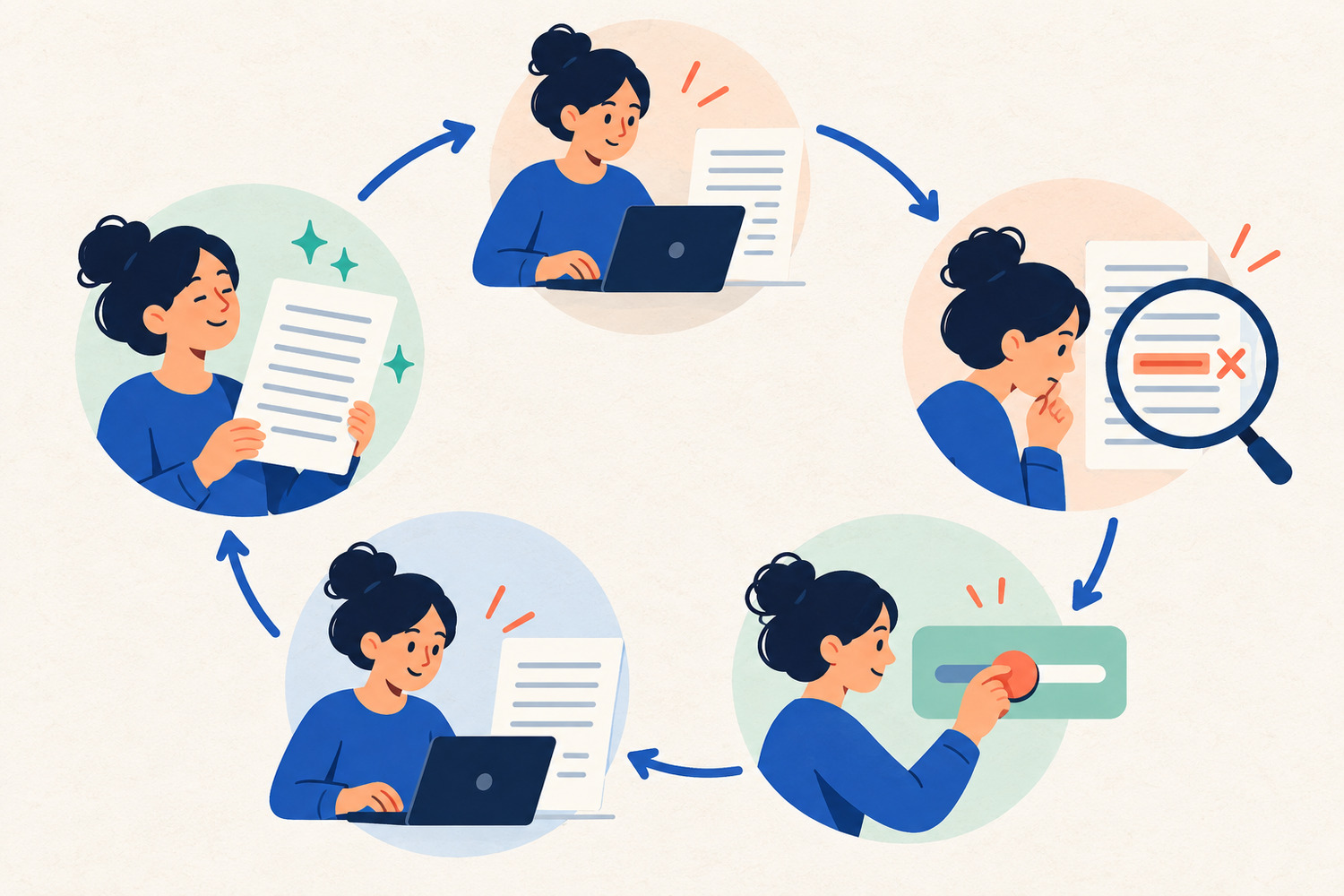
Use a correction loop instead of saving every prompt. Choose one repeated work task, inspect one visible failure, change one part of the method and run the task again. The goal is not a perfect response. It is a reusable lesson you can apply the next time the same problem appears.
Start with a performance gap, not a tool tour
The European Commission’s current AI-literacy guidance says learning should reflect a person’s knowledge, experience, role, use context and the risks of the system involved. NIST’s AI Use Taxonomy similarly centres human goals and outcomes. US Office of Personnel Management guidance describes training needs as the gap between required and current performance, then asks what behaviour must change and how it will be assessed.
Together, these sources support a practical starting point: define the work behaviour you want to improve before choosing another course, tool or prompt pattern. “Get better at AI” is too broad. “Turn meeting notes into actions without inventing owners or dates” is a learnable target because the failure is observable.
| Prompt collecting | Correction loop | |
|---|---|---|
| Starting point | An interesting prompt | A repeated work failure |
| Action | Save and copy | Inspect and change one variable |
| Evidence | One plausible output | A second attempt against a clear standard |
| Lesson | Remember wording | Understand what improved the task |
| Reuse | Hope it transfers | Write a rule for the next attempt |
Use the LOOP method to learn from one mistake
LOOP: four moves from failure to skill
L — Locate
Choose one recurring task and one visible failure that matters: a missing fact, vague structure, wrong tone, unsupported claim or lost constraint.
O — Observe
Compare the output with a trusted source, example or acceptance standard. Describe the failure without guessing at a hidden model process.
O — One change
Change one element only: the input, task order, constraint, example, source, review step or choice of tool.
P — Prove
Run a fresh fictional or non-sensitive example. Keep the change only if the target behaviour improves without creating a new material problem.
After the proof step, preserve one sentence: “When this task has X, I will do Y and check Z.” That sentence is the learning artefact. It is more useful than a long prompt archive because it states when the method applies and how you will judge it.
Worked example: turn notes into action items
A beginner uses an approved AI tool to turn fictional meeting notes into an action list. The first output assigns an owner to every action, even where the notes name no owner. The result looks complete but changes uncertainty into invented certainty.
Reading is a start. Practice makes it stick.
Start learningLocate: the repeated failure is fabricated ownership. Observe: the source notes contain three actions, but only one named owner. One change: add a rule that the output must write “owner to confirm” whenever the source is silent, and require a source phrase beside each named owner. Prove: run a new set of fictional notes with two named owners and one missing owner.
If the second output preserves both named owners and marks the gap, the learner keeps this rule: “For action extraction, never infer ownership; quote the source or mark it for confirmation.” If the output still invents an owner, the next change might separate extraction from formatting or add a human check before distribution. The learner changes one variable at a time, so the lesson remains intelligible.
A ten-minute correction session
- 1
Minute 1–2: pick the failure
Use a low-consequence task and remove confidential or personal information. Name one output property that went wrong.
- 2
Minute 3–4: define the standard
Write what correct behaviour would look like and which source or example lets you judge it.
- 3
Minute 5–6: make one change
Adjust one input, instruction, example, sequence or review step. Keep everything else stable.
- 4
Minute 7–8: retry
Use a fresh fictional example rather than tuning repeatedly to the first case.
- 5
Minute 9–10: keep or discard
Record the lesson, the evidence and the condition under which you will use it again.
Choose mistakes that teach transferable skills
Good candidates for a correction loop
- The output misses a stated constraint or required field.
- A claim lacks evidence or a source cannot be traced.
- The tool confuses extraction with inference.
- The structure hides the decision, owner or open question.
- The tone is wrong for a known audience and you have an approved example.
- The task should be split into smaller stages before another attempt.
Do not use a ten-minute exercise to validate high-consequence medical, legal, employment, safety or financial decisions. Practise the method on fictional or low-risk work and follow your organisation’s approved tools, data rules and review routes.
Build a small path around the correction
If you are comparing programmes, first use the beginner-course outcomes checklist. When the task is too large to diagnose, split it into reviewable stages. Then preserve strong examples in an AI skills work portfolio. These pages answer different questions: what to learn, how to isolate the failure and how to show the resulting skill.
- Choose a recent low-risk AI output that disappointed you.
- Circle one failure you can observe directly.
- Write the acceptance standard before changing the prompt.
- Change one part of the method.
- Test a fresh fictional example.
- Finish this sentence: “When this task has…, I will…, and check…”
Learn by making the second attempt explainable
Beginners do not need an endless prompt collection. They need a way to notice failure, correct it deliberately and carry the lesson into the next task. Keep the loop small, make the standard visible and let the second attempt show whether you learned anything.
Bokili turns this kind of deliberate practice into short workplace missions with role-adapted tasks and feedback. See how the learning loop works on the Bokili features page.
Sources
- AI Literacy: Questions & Answers — European Commission
- AI Use Taxonomy: A Human-Centered Approach — NIST
- Planning & Evaluating Training — US Office of Personnel Management
- Bokili Features — Bokili
Reading is a start. Practice makes it stick.
Bokili turns skills like this into ten-minute missions for your whole team, with instant feedback and progress you can see.
Start learningKeep reading

The AI Handoff Card: Carry Context Into Human Review
Use a five-field handoff card to carry sources, AI contribution, human changes and open questions into the next review.
AI Training Platform for Companies: Map Learner Data Before You Buy
Before choosing an AI training platform for companies, map learner identity, work inputs, feedback, access, retention, export and deletion.
AI Makes Options Cheap. Your Team Still Pays to Consider Them
AI can generate options faster than a team can judge them. Set decision criteria, an option cap and a selector before asking for more.