
AI Learning Path: Pair Every Creation Skill With a Check
Build an AI learning path that pairs useful output with source, constraint, assumption and decision-boundary checks.

An AI learning path should not teach people to create faster for three weeks and check their work in week four. That sequence makes verification feel like a specialist add-on. A stronger path pairs each creation skill with a checking skill from the start, so learners practise producing and judging the same work in one loop.
This approach fits how workplace AI is actually used. NIST describes AI use through human goals and activities, while the European Commission’s AI-literacy guidance stresses the context, experience and risk of the people using a system. The path therefore starts with real work outcomes and observable checks, not a tour of features.
Build an AI learning path from paired skills
Four creation-and-check pairs
Summarise + source check
Create a concise summary, then verify each important statement against the supplied source.
Rewrite + constraint check
Adapt tone or format, then check that required facts, limits and audience needs survived the rewrite.
Compare + assumption check
Compare options, then expose the assumptions that would change the result.
Recommend + decision-boundary check
Draft a recommendation, then state what AI may advise, what needs approval and what it must not decide.
These pairs keep the learning outcome concrete. “Know prompting” is difficult to observe. “Produce a summary whose material claims can be traced to the source” can be demonstrated, reviewed and improved. OPM training guidance similarly recommends defining critical behaviours and evaluating whether learning transfers into performance.
| Feature-led path | Paired-skill path | |
|---|---|---|
| Lesson unit | A tool or prompt technique | A work output plus its check |
| Evidence of progress | Completion or speed | A reviewed artefact and correction |
| Failure response | Try another prompt | Diagnose the error and improve the check |
| Transfer to work | Depends on remembering features | Uses a repeatable create-check loop |
A worked four-week learning path
Suppose a customer-support team wants to use AI for internal case summaries and reply drafts. The path should not begin with every available tool. It should begin with two representative tasks, safe sample material and a reviewer who can recognise a good result.
One practical sequence
- 1
Week 1 — Summarise and trace
Learners summarise a fictional case, mark each material claim and link it back to the source note. The pass condition is traceability, not brevity alone.
- 2
Week 2 — Rewrite and preserve
Learners turn the summary into a customer-ready draft, then check required facts, prohibited promises, tone and escalation language.
- 3
Week 3 — Compare and challenge
Learners compare two response options, list the assumptions behind the comparison and test one assumption against the case record.
- 4
Week 4 — Recommend and bound
Learners recommend a next action, state who approves it and identify any case that must be escalated rather than handled by AI.
Each week leaves a small artefact: a source map, a constraint checklist, an assumption log or an authority note. Those artefacts show what the learner can do and make coaching more precise. They can also form a work portfolio without exposing confidential material when exercises use safe, fictional examples.
Reading is a start. Practice makes it stick.
Start learningSet a pass condition for both halves
A paired lesson fails if either half is missing. A polished draft with no source check is incomplete. A perfect checklist with no usable output is also incomplete. Write one observable pass condition for creation and one for verification. For example: the reply is clear and complete; every claim about policy is supported by the source pack.
NIST’s Measure guidance recommends choosing evaluation methods that fit the purpose and context. For training, that means using the same kind of task people will face at work, then reviewing the result with explicit criteria. Scores should guide feedback and support, not reward speed alone.
Keep the path durable when tools change
Interfaces will change. The paired skills remain useful because they describe work rather than buttons: summarise and trace, rewrite and preserve, compare and challenge, recommend and bound. Tool guidance can sit underneath those skills as a replaceable layer. This makes the learning path easier to update and reduces the risk that employees mistake product familiarity for sound judgment.
- List the first four creation skills in your current AI learning path.
- Write the failure each skill could introduce into real work.
- Pair each skill with one check that can catch that failure.
- Add a creation pass condition and a verification pass condition.
- Remove or postpone any lesson that has no real task, check or reviewer.
Make progress visible
Track whether learners can complete the pair with less help and whether the artefact improves after feedback. Do not confuse lesson completion with capability. A useful dashboard should lead to a support action: extra practice on source checking, a narrower task, a better example or a clearer review standard.
Bokili can support short, practical learning around these paired skills. Explore the Bokili feature set, then connect this path to guides on learning through a correction loop, logging assumptions, building an evidence portfolio and separating drafts from acceptance tests.
The simple design rule is durable: never add a creation skill without its checking twin. That is how an AI learning path builds useful output and the judgment to decide when that output is ready.
Sources
- AI Use Taxonomy: A Human-Centered Approach — NIST
- AI RMF Playbook — Measure — NIST
- AI literacy — Questions and Answers — European Commission
- Planning & Evaluating — U.S. Office of Personnel Management
- Bokili Features — Bokili
Reading is a start. Practice makes it stick.
Bokili turns skills like this into ten-minute missions for your whole team, with instant feedback and progress you can see.
Start learningKeep reading

Use Gemini Notebook to Test One Claim Against One Source
A focused source check turns a fluent answer into inspectable evidence before you widen the notebook.
AI Training for Employees: Teach the Clarifying Question
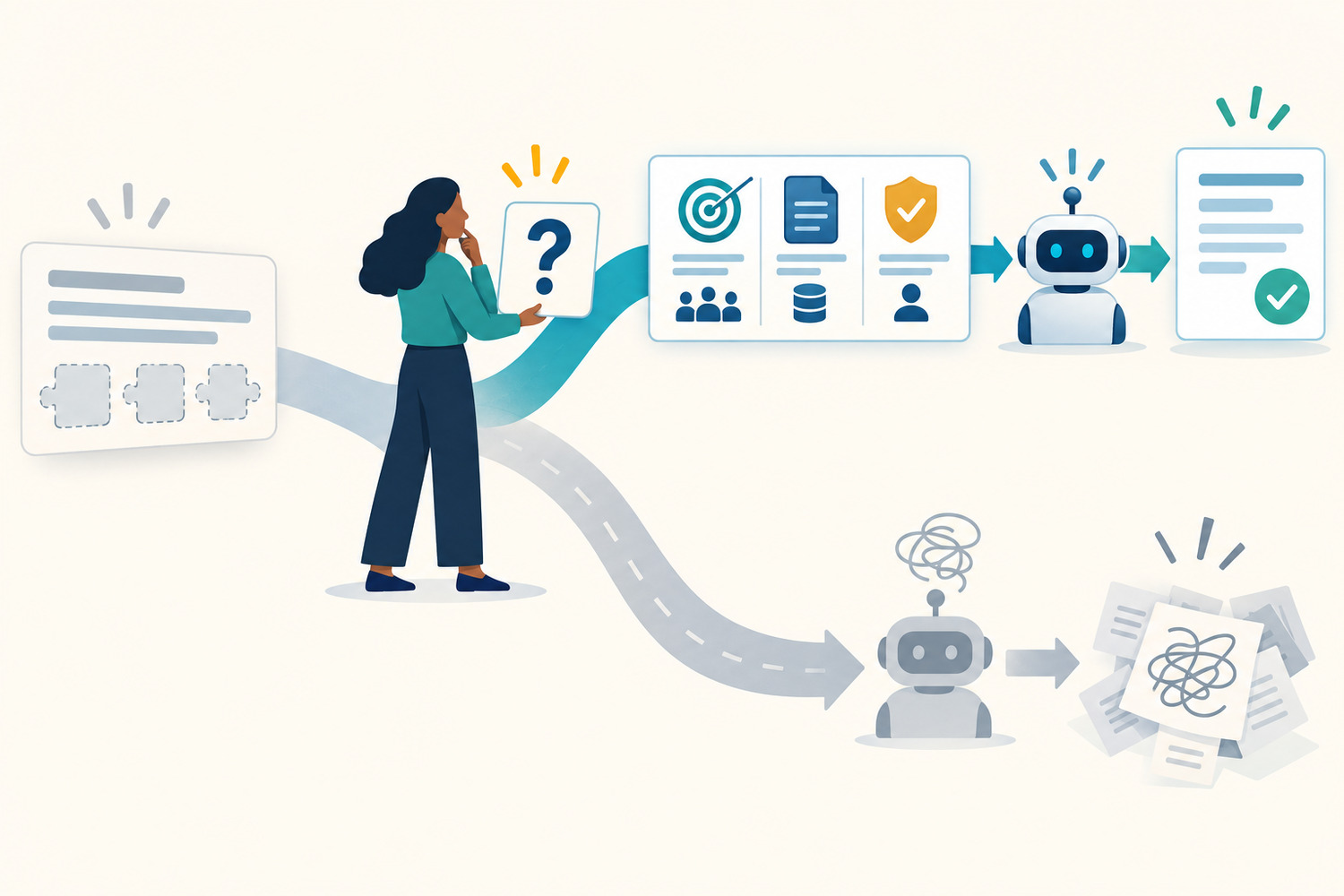
AI training for employees should teach one consequential clarifying question before prompt writing, so the task, evidence and approval boundary are clear.
An AI Training Leaderboard Should Reward Verification, Not Speed
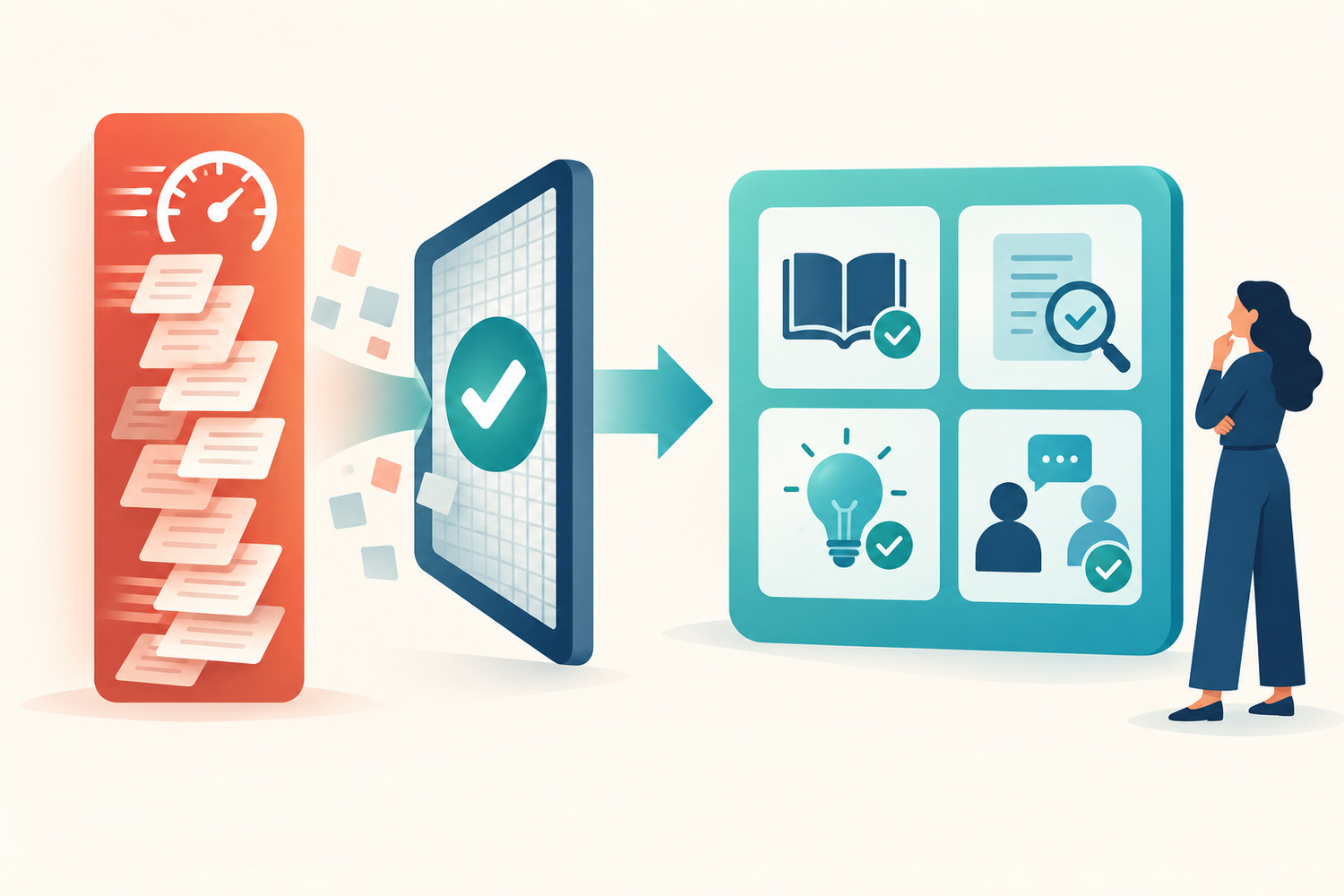
A learning leaderboard is useful only when its points make careful practice, evidence checks, correction and peer help more visible than raw output volume.