
AI Training Should Start With the Profession, Not the Tool
AI fluency becomes useful when employees practise the standards of their own work—evidence, judgement and responsibility—not generic interface skills.
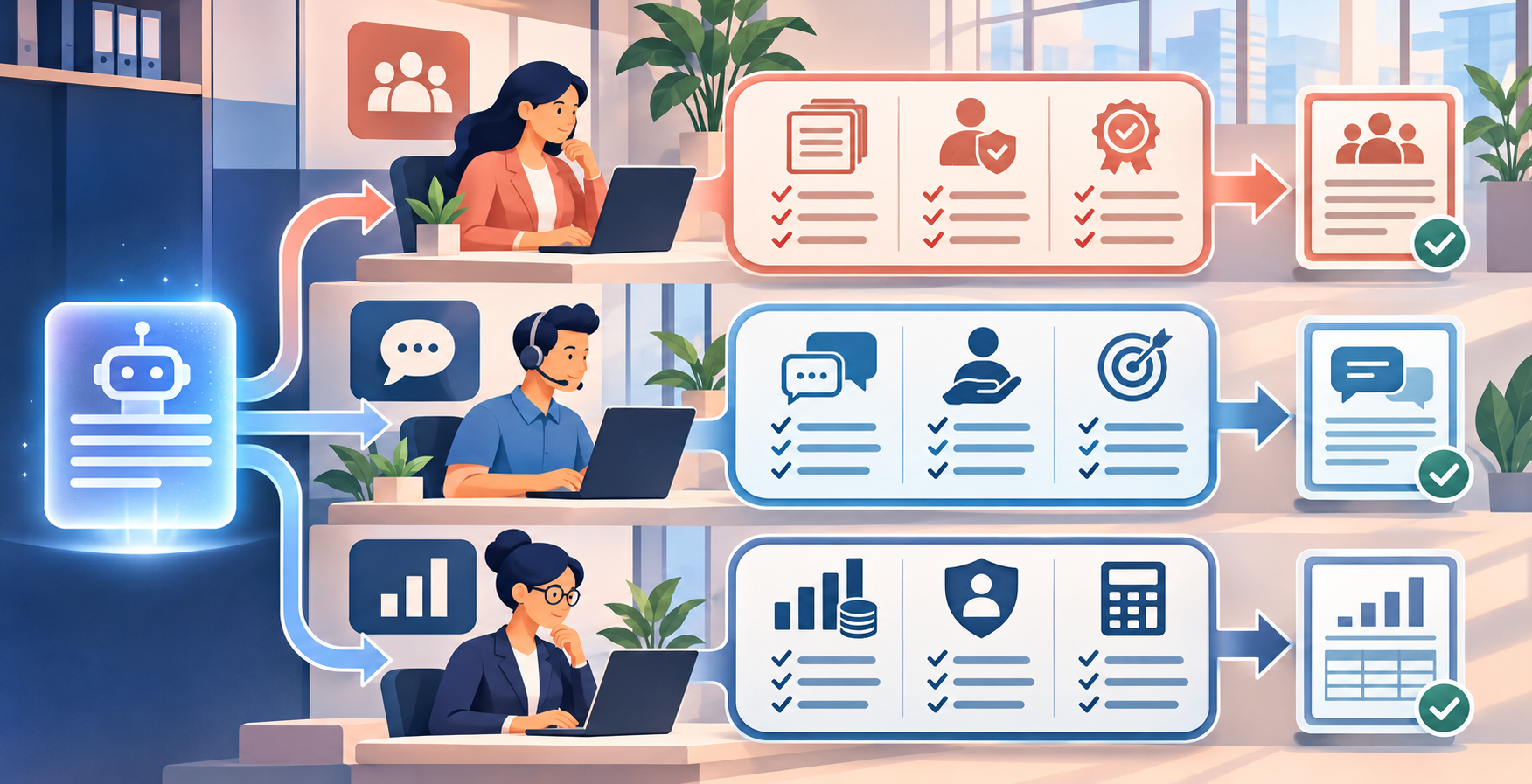
AI training often begins with a tool: a feature tour, a prompt pattern or a list of shortcuts. Work does not begin there. A payroll analyst, customer-support lead and HR adviser may use the same model, yet they owe different evidence, judgement and responsibility to the people who rely on their work. Useful AI fluency starts with those professional standards, then teaches the tool inside them.
The point of view
A tool can accelerate an activity. It cannot decide what counts as competent work in a profession.
The same AI activity can carry different obligations
NIST’s AI Use Taxonomy describes human–AI work through goals and activities such as content creation, synthesis, recommendation and decision-making. That is a useful starting point because the interface alone does not tell us the outcome or consequence. Summarising a document for a private brainstorm is not the same work as summarising evidence for an employment decision.
The US Office of Personnel Management makes a related distinction in training needs assessment: organisations should identify required performance, current performance and the occupational competencies behind the gap. The UK Skills England employer guide, updated in July 2026, likewise recommends training that connects to real tasks and decisions, aligns with professional standards and reflects role-specific responsibilities.
Together, these sources point to a simple design rule. Do not ask only what the AI tool can do. Ask what good work must preserve when the tool is used.
Four professional anchors before tool practice
Outcome
Name the person, decision or service the work must support. A polished artefact is not an outcome by itself.
Evidence
State which records, sources, calculations or examples make the result trustworthy in this role.
Judgement
Identify the choices that require professional interpretation, including uncertainty, exceptions and competing duties.
Responsibility
Name who may approve, reject, explain or escalate the result when consequences extend beyond the learner.
Generic tool confidence can hide professional weakness
A learner may become fast at prompting while remaining unsure about the standard that the answer must meet. That creates an awkward training result: people can produce more drafts, but reviewers still have to reconstruct the brief, find the governing evidence and decide what was never delegated.
| Tool-first session | Profession-led practice | |
|---|---|---|
| Starting point | Features and prompt techniques | A real work outcome and its existing standard |
| Practice task | The same generic example for everyone | A role-shaped task with approved, safe materials |
| Feedback | Was the prompt clear and the answer fluent? | Did the result meet evidence, judgement and responsibility requirements? |
| Evidence of learning | Completion or a saved prompt | A reviewed artefact plus an explained professional decision |
Reading is a start. Practice makes it stick.
Start learningWorked example: one employee update, three professions
Imagine three colleagues asked to use an approved AI assistant to draft a short employee update. The source pack is fictional and the final message still needs human review. The visible task looks identical. The professional standard is not.
The HR adviser checks whether the message accurately reflects policy, distinguishes confirmed rules from interpretation and routes unresolved employee-rights questions to the responsible specialist. The customer-support lead focuses on clear next actions, service commitments and wording that does not promise a remedy nobody approved. The finance analyst checks that figures reconcile to the source, periods are comparable and no forecast is presented as an agreed budget.
All three may use the same steps—extract, organise, draft and review—but the decisive checks differ. Training should keep the common AI behaviour while making the professional test explicit. Otherwise, ‘role-based’ means little more than changing the nouns in an example.
Turn one professional standard into practice
- Choose one repeated, bounded work outcome with a named user.
- Ask a respected practitioner what makes an apparently good result unacceptable.
- Write two or three observable checks using evidence, not adjectives.
- Create a safe example that contains one realistic professional tension or exception.
- Require the learner to explain one judgement, not only submit the final draft.
- Use a reviewer who understands both the work and the organisation’s AI boundary.
The practical implication for AI leaders
The European Commission’s current AI-literacy guidance asks organisations to consider people’s knowledge and experience as well as the system’s context. That supports differentiated learning, but differentiation should not become a separate course for every job title. Build a shared core around safe task choice, input boundaries, verification and escalation. Then attach the professional anchors that change the standard of the work.
Three existing Bokili guides help with the next layer: use the role-based skills matrix to name capability (https://bokili.com/en/learn/ai-skills-for-employees-matrix), teach task decomposition when the work needs reviewable passes (https://bokili.com/en/learn/ai-training-employees-task-decomposition), and define done before delegation (https://bokili.com/en/learn/define-done-before-ai-delegation). Each solves a different design question; none replaces the profession’s own evidence and responsibility.
- Write one AI-assisted task that two different roles might perform.
- For each role, name the person affected and the professional consequence of a weak result.
- List one source or record the role must consult.
- Write one judgement the AI must not make on the employee’s behalf.
- Turn the difference into a short practice case with fictional or approved material.
- Ask a practitioner whether the checks describe competent work in plain language.
Keep the profession in the loop
AI training should make people better at their work, not merely more comfortable with an interface. Start with the outcome, evidence, judgement and responsibility that already define competent practice. Then let the tool accelerate the parts that can safely move faster. Bokili’s short, role-adapted missions can provide that practice loop across approved tools; the professional standard remains the anchor.
Sources
- Training Program Management and Needs Assessment — U.S. Office of Personnel Management
- AI Use Taxonomy: A Human-Centered Approach — National Institute of Standards and Technology
- Employer guide: What works for AI upskilling in the UK — Department for Work and Pensions and Skills England
- AI Literacy — Questions & Answers — European Commission
Reading is a start. Practice makes it stick.
Bokili turns skills like this into ten-minute missions for your whole team, with instant feedback and progress you can see.
Start learningKeep reading
AI Upskilling for Teams: Audit Participation Friction
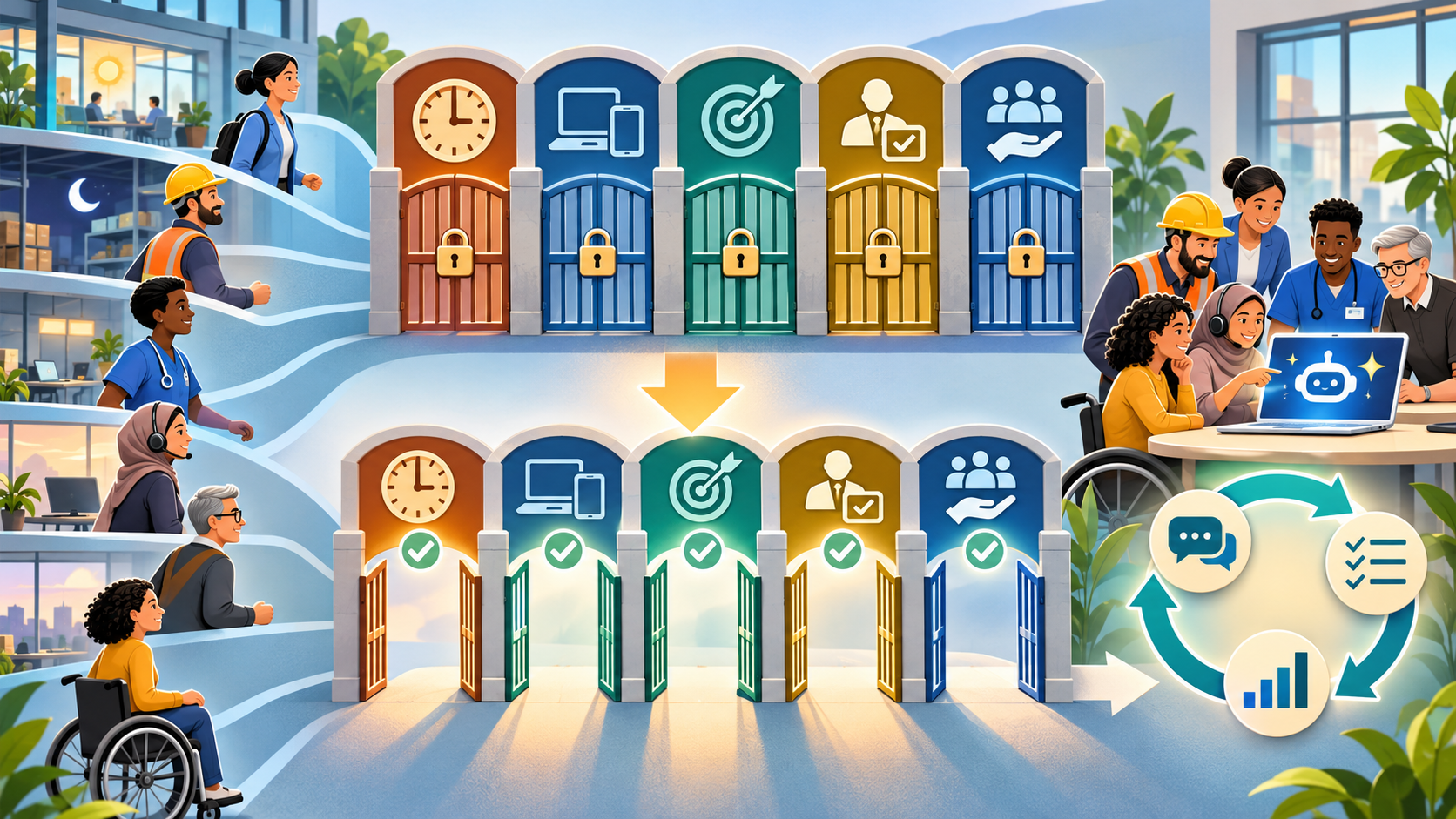
AI upskilling for teams stalls when time, access, relevance, manager permission or support is missing. Audit the friction before blaming motivation.

AI Course for Beginners: Compare Two Answers Fairly
Use the SAME comparison card to test two AI answers with one task, one input and one success rule—then choose by evidence, not polish.

Use AI to Compare Supplier Proposals Without Hiding Evidence Gaps
A procurement workflow for mapping supplier responses into one fixed evidence matrix without inventing equivalence or filling missing proof.