
AI Upskilling for Teams: Audit Participation Friction
AI upskilling for teams stalls when time, access, relevance, manager permission or support is missing. Audit the friction before blaming motivation.
AI upskilling for teams can look like a motivation problem when one group completes practice and another does not. More reminders are the usual response. They are rarely a diagnosis. People may lack protected time, a working device, a role-relevant task, manager permission or a clear place to ask for help. Before changing the course, audit the friction around participation.
The search intent
This is an implementation guide for L&D and enablement leaders who need to improve participation without mistaking access problems for attitude.
Why AI upskilling for teams stalls outside the course
The Skills England employer guide on AI upskilling, updated in July 2026, recommends accessible timing, format and language, protected time, support for different levels of digital experience and role-relevant practice. Its message is practical: a well-designed lesson can still be unreachable in the working day.
The OECD’s 2026 report on barriers to adult training places lack of time due to work commitments among the leading reported barriers across participating countries. It also shows that barriers arise at several stages: before someone considers learning, while choosing it, at enrolment and during participation. That broader evidence should not be used to guess why one employee stopped. It should prompt the organisation to collect local, proportionate evidence.
The European Commission’s current AI-literacy guidance adds a context test: learning measures should reflect staff knowledge and experience, the AI systems used and the setting. A company-wide invitation does not create a company-wide opportunity if those conditions differ sharply between teams.
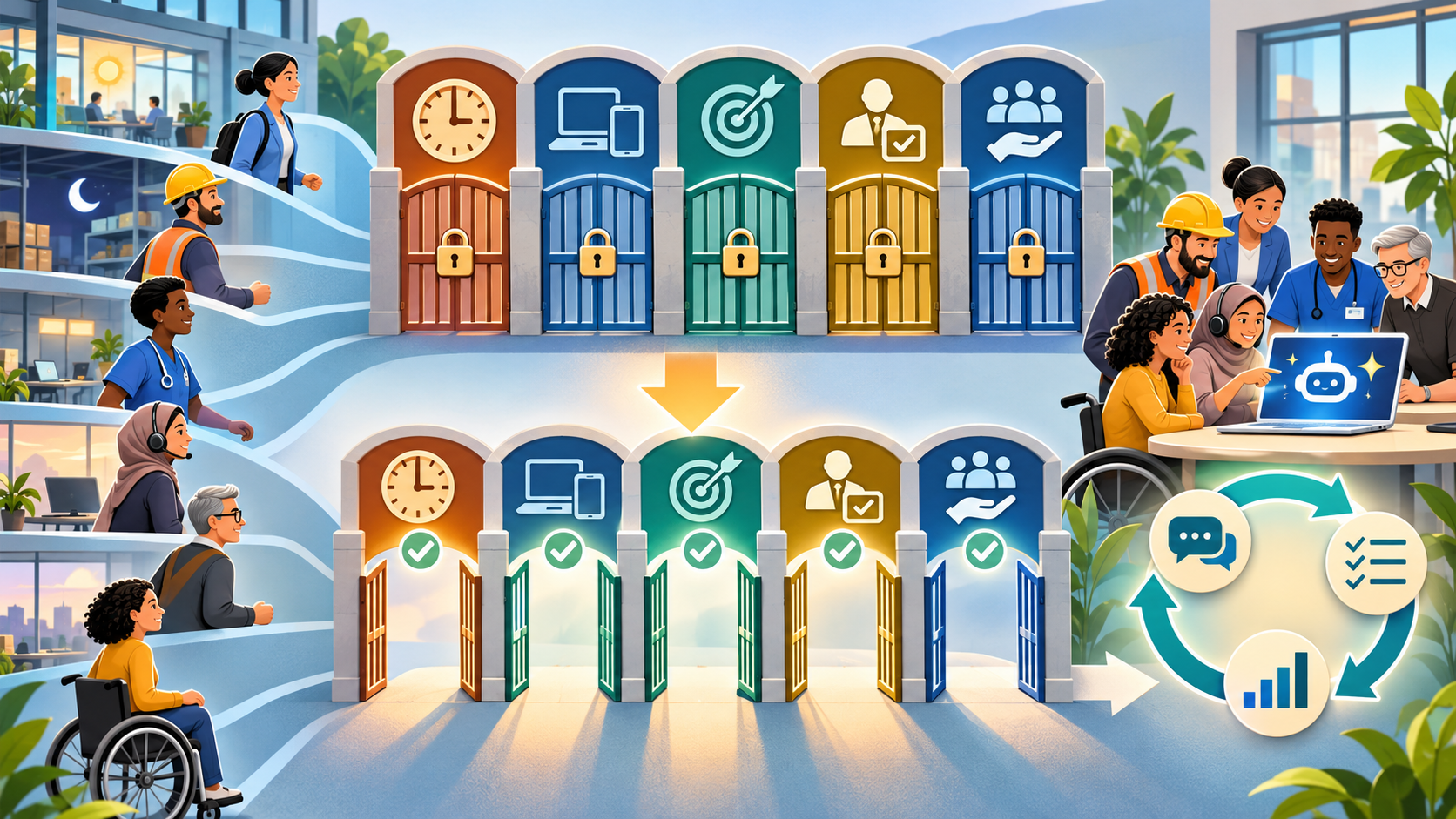
Audit five participation frictions
Time
Can the learner complete the practice during paid work, including busy periods and different shifts?
Access
Can they reach the approved tool, account, device, language and accessible format needed for the full task?
Relevance
Does the exercise resemble a decision or artefact in the learner’s role rather than a generic office example?
Permission
Has the manager made space for learning and clarified which tools, inputs and mistakes are acceptable in practice?
Support
When the learner is blocked, is there a visible person or route that can resolve access, work or safety questions?
Worked example: the completion gap between two shifts
A fictional service company gives 80 operations employees one ten-minute mission on checking an AI-written handover note. The day team completes most attempts. The evening team rarely starts. The dashboard can show the difference; it cannot explain it.
The programme lead speaks with the shift manager and five employees, then walks through the learner journey. The mission arrives near the evening peak. Shared terminals block the approved AI account. The example assumes a daytime escalation route, and the shift manager thinks practice is optional if the queue is long. None of those findings is evidence of low interest.
Reading is a start. Practice makes it stick.
Start learningThe team moves the mission to the first quiet overlap, confirms paid time, enables the approved account on two shared devices, rewrites the scenario around an evening handover and names the duty manager as the support route. It then watches starts, completed attempts and support questions for two weeks. This fictional example does not promise a participation increase. It shows how to replace a motivational story with testable operating changes.
| Reminder response | Friction-audit response | |
|---|---|---|
| Question | Why will people not engage? | Where does the learning journey become difficult or impossible? |
| Evidence | Open and completion counts | Journey walkthroughs, short learner conversations and team context |
| Action | Send another message | Remove one barrier and retest the same practice |
| Fairness | Assumes the offer is equally reachable | Checks whether time, access and support differ by role or shift |
Collect enough evidence to act, not to surveil
Start with aggregate patterns by team, shift or location only where that grouping is appropriate and permitted. Then use a few voluntary conversations or a brief journey test to understand the pattern. Do not infer confidence, commitment or ability from a missing completion. Keep questions close to the learning setup: when was time available, which step failed, what did the manager say, and where would the learner ask for help?
A fair participation-friction audit
- State that the purpose is to improve the learning setup, not assess employee performance.
- Compare invitations, starts, completed attempts and support requests without treating any one measure as skill.
- Include different shifts, roles, locations, language needs and access requirements.
- Walk through the complete task using the actual approved account and device.
- Ask managers what work they deprioritise when practice happens.
- Change one or two conditions, then retest before redesigning the whole programme.
- Record unresolved barriers, their owner and the next review date.
Connect the audit to the right Bokili pages
Use the accessibility rehearsal when an interface may block the journey (https://bokili.com/en/learn/ai-training-platform-companies-accessibility-rehearsal). Use the multilingual-team guide when a shared standard needs natural local language and context (https://bokili.com/en/learn/corporate-ai-training-multilingual-teams). Use the champions-network guide when questions have no reliable local route (https://bokili.com/en/learn/ai-champions-network-support-bottleneck). Bokili’s HR and L&D page explains the supporting practice model: short missions adapted to role, level and tools, with visible participation and progress (https://bokili.com/en/for-hr).
- Choose one team with lower starts or completions than the programme average.
- Write the exact moment the learner is expected to practise.
- Check time, account, device, language, role fit, manager permission and support route.
- Mark each condition as confirmed, uncertain or blocked.
- Choose the smallest blocked condition the organisation can change this week.
- Set a review date and decide which local evidence will show whether the journey improved.
Participation is a design signal
AI upskilling for teams should not make enthusiasm the price of entry. A learner still has responsibility to take part, but the organisation has responsibility to make the practice reachable, relevant and supported. Treat a participation gap as a design signal first. Audit the working conditions, remove the smallest material barrier and observe what changes. Bokili can supply focused, role-adapted missions and feedback; managers and programme owners still have to create the conditions in which people can use them.
Sources
- Employer guide: What works for AI upskilling in the UK — Department for Work and Pensions and Skills England
- Helping adults overcome barriers to training — OECD
- AI Literacy — Questions & Answers — European Commission
- Bokili — AI fluency training for companies and teams — Bokili
Reading is a start. Practice makes it stick.
Bokili turns skills like this into ten-minute missions for your whole team, with instant feedback and progress you can see.
Start learningKeep reading
AI Training Should Start With the Profession, Not the Tool
AI fluency becomes useful when employees practise the standards of their own work—evidence, judgement and responsibility—not generic interface skills.

AI Course for Beginners: Compare Two Answers Fairly
Use the SAME comparison card to test two AI answers with one task, one input and one success rule—then choose by evidence, not polish.

Use AI to Compare Supplier Proposals Without Hiding Evidence Gaps
A procurement workflow for mapping supplier responses into one fixed evidence matrix without inventing equivalence or filling missing proof.