
AI Makes It Easier to Work Alone. That Is Not Always a Gain
AI can remove routine coordination and still weaken valuable exchange. Protect the human conversations that carry context, challenge and trust.
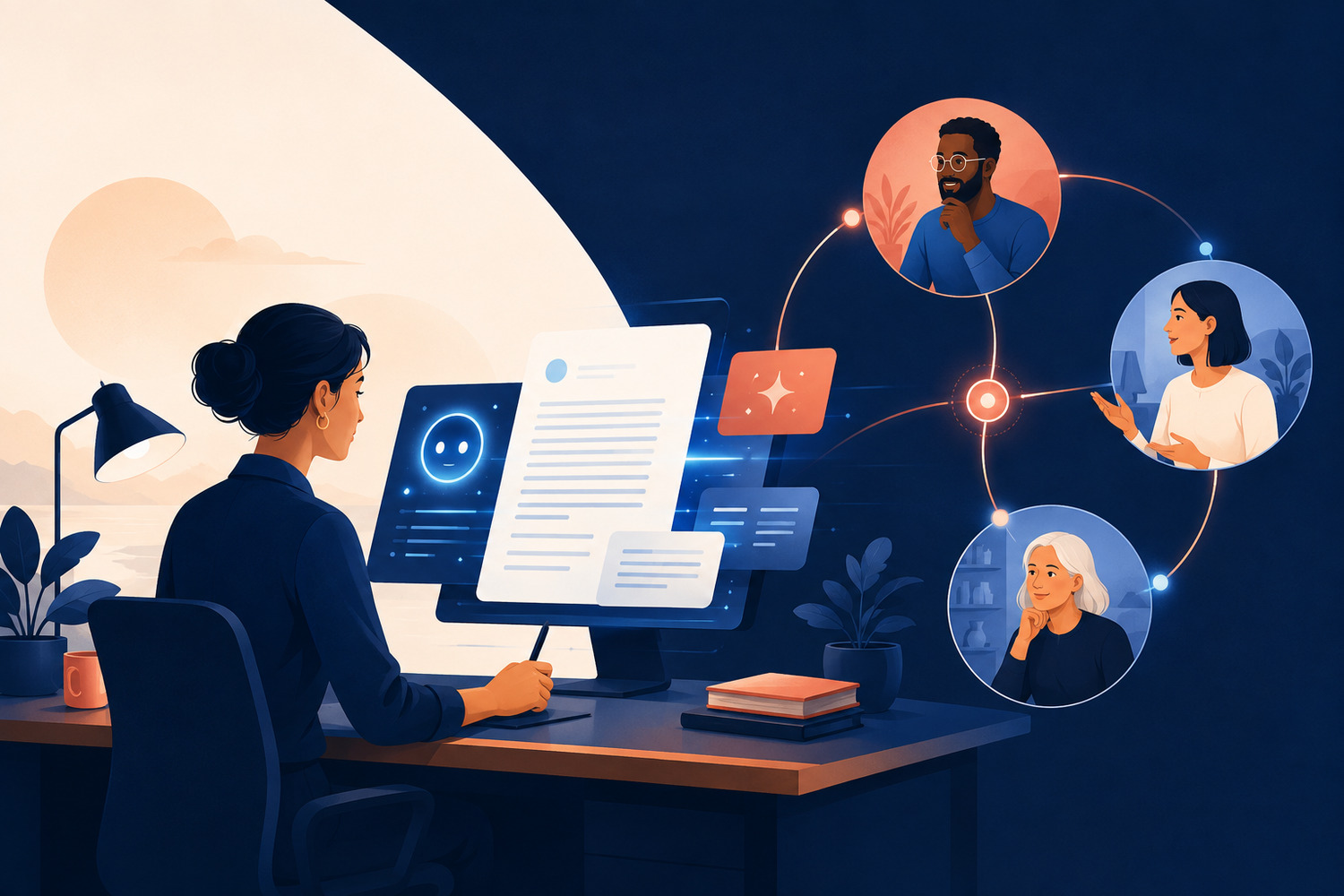
Generative AI can remove a familiar reason to speak to a colleague. A worker who once asked for a starting point, a quick explanation or help shaping a draft can now open a private chat and keep moving. That is a genuine gain: fewer interruptions, faster first passes and more independence. But it also changes the social plumbing of knowledge work. When small questions disappear, some waste goes with them—and so can the context, challenge and trust that travelled through the same conversations.
The useful question is no longer whether AI reduces communication. It is which communication a team can safely remove, and which exchanges it must deliberately protect. Treating every avoided message or meeting as productivity risks confusing quiet work with complete work.
The perspective
AI should remove low-value coordination without removing the human contact that carries local context, constructive disagreement and accountability.
What changed: individual work became easier to expand
A workplace study posted on 24 August 2026 analysed digital activity from more than 40,000 people across 11 international companies during Microsoft Copilot adoption. Among frequent users, activity increased in both productivity and communication applications, but much more in document-focused tools. The researchers also observed fewer emails, shorter exchanges and contact with fewer unique people. They are careful about the limits: the data show activity, not perfect measures of time or output quality, and they cannot say which lost conversations were valuable.
A separate field experiment at Procter & Gamble found a more optimistic side. Individuals using generative AI could perform at a level similar to two-person teams without AI on product-development tasks, and AI helped people cross technical and commercial knowledge boundaries. AI can therefore replace some benefits of asking another person—not merely automate keystrokes.
These findings are not contradictory. Together they describe a shift in the cost of working alone. AI can supply a draft, explanation or alternative that previously required another person. That can protect focus and reduce dependence on whoever happens to be available. Yet the same convenience can make isolation feel efficient even when the task would benefit from lived experience, disagreement or a relationship that lasts beyond the document.
The wrong goal is maximum silence
Many organisations measure the visible friction of collaboration: meeting hours, message volume, response time and interruptions. They rarely measure the value that travels through a short exchange. A colleague may add the exception that is absent from the policy, explain why a customer reacts differently in one market, or challenge an assumption before it hardens into a recommendation.
Generative AI is especially good at making an answer available. It is less able to know which unwritten local fact matters today, which stakeholder has lost confidence, or which apparently sensible option will fail because of a history the model cannot see. Those facts often live in relationships rather than repositories.
| Good communication to reduce | Human exchange to protect | |
|---|---|---|
| Routine retrieval | Where is the current template? | Why does this case need an exception? |
| Status | What stage is the task at? | What changed our confidence in the plan? |
| Formatting | Turn these notes into a brief. | Which competing concern deserves more weight? |
| Known process | What are the documented steps? | Where does practice differ from the written process? |
| Approval | Who owns the decision? | What does the owner need to hear before deciding? |
Reading is a start. Practice makes it stick.
Start learningProtect the conversations that change the work
The answer is not to force people back into every meeting or to require a colleague to watch each prompt. A 2026 field experiment on human–AI collaboration found that a highly structured paired-use protocol reduced document production and was associated with lower quality than unstructured use, while a different intervention that changed how individuals thought about working with AI showed benefits at the top of the quality distribution. The lesson is modest but important: more prescribed collaboration is not automatically better.
Teams need a smaller design choice. Let AI absorb predictable coordination, then place human contact at moments where it can change direction, reveal context or assign responsibility. These moments should be short enough to keep the focus benefit and specific enough to avoid performative collaboration.
Three human moments worth protecting
Before: add local context
Ask one person close to the work what is missing from the written brief: an exception, relationship, constraint or recent change.
During: invite a different reading
Share the strongest AI-assisted option and ask a colleague to name the assumption they would challenge, not to rewrite the whole draft.
Before action: make accountability explicit
Let the decision owner hear the unresolved evidence gap, affected people and stop condition in plain language.
A worked example: the quiet project proposal
A project manager uses AI to turn research notes into a polished proposal. The draft is faster than the old process and the manager avoids two rounds of status email. That is useful. But the draft assumes the customer will accept a standard implementation sequence. A delivery lead knows the customer rejected that sequence last year, while an account manager knows the relationship has recently improved.
The efficient workflow is not to recreate the old committee. The manager uses AI for synthesis, then protects two human moments: a ten-minute context check with delivery and a challenge question with the account owner. The proposal keeps its speed, gains a relevant exception and reaches the approver with the assumption visible. AI reduced coordination; the team preserved judgment.
Make the trade-off visible
A falling message count is not proof that collaboration is weaker, just as a rising document count is not proof that useful work increased. Leaders should look for the quality of the remaining exchanges. Are teams still surfacing exceptions? Do people challenge important assumptions before decisions? Can less-experienced staff reach local experts when the written answer is insufficient? Do corrections become shared knowledge, or remain inside private chats?
This is also a learning question. Bokili’s guides on building an AI champions network, making AI hand-offs reviewable and recovering from a wrong answer all point to a common principle: individual skill creates more value when teams can see the boundary, correction or lesson.
- Choose one task that now happens mostly between a person and an AI tool.
- Name the colleague interaction that used to occur during that task.
- Decide whether it carried routine information or unique context, challenge or accountability.
- If it was valuable, place one short human check at the moment it can still change the work.
- Remove any meeting or message that no longer serves a clear purpose.
AI makes it easier to work alone, and that can be liberating. The mistake is to assume that less contact is always the same as less friction. The better organisation automates the exchange of predictable information while making room for the conversations that produce surprise, correction and commitment. The goal is not more communication. It is keeping the human contact that makes the work wiser.
Sources
- Adoption of Generative AI in the Workplace: Increasing and Shifting the Balance of Productivity and Communication Activity — Microsoft Research and University of Arizona
- The Cybernetic Teammate: A Field Experiment on Generative AI and Teamwork — Organization Science
- Scaffolding Human–AI Collaboration: A Field Experiment on Behavioral Protocols and Cognitive Reframing — Microsoft
Reading is a start. Practice makes it stick.
Bokili turns skills like this into ten-minute missions for your whole team, with instant feedback and progress you can see.
Start learningKeep reading
AI Learning and Development: Turn Policy Rules Into Behaviour Pairs
AI learning and development works better when abstract policy rules become paired actions employees can recognise, practise and use at the point of work.
An AI Mission Should Change One Constraint at a Time
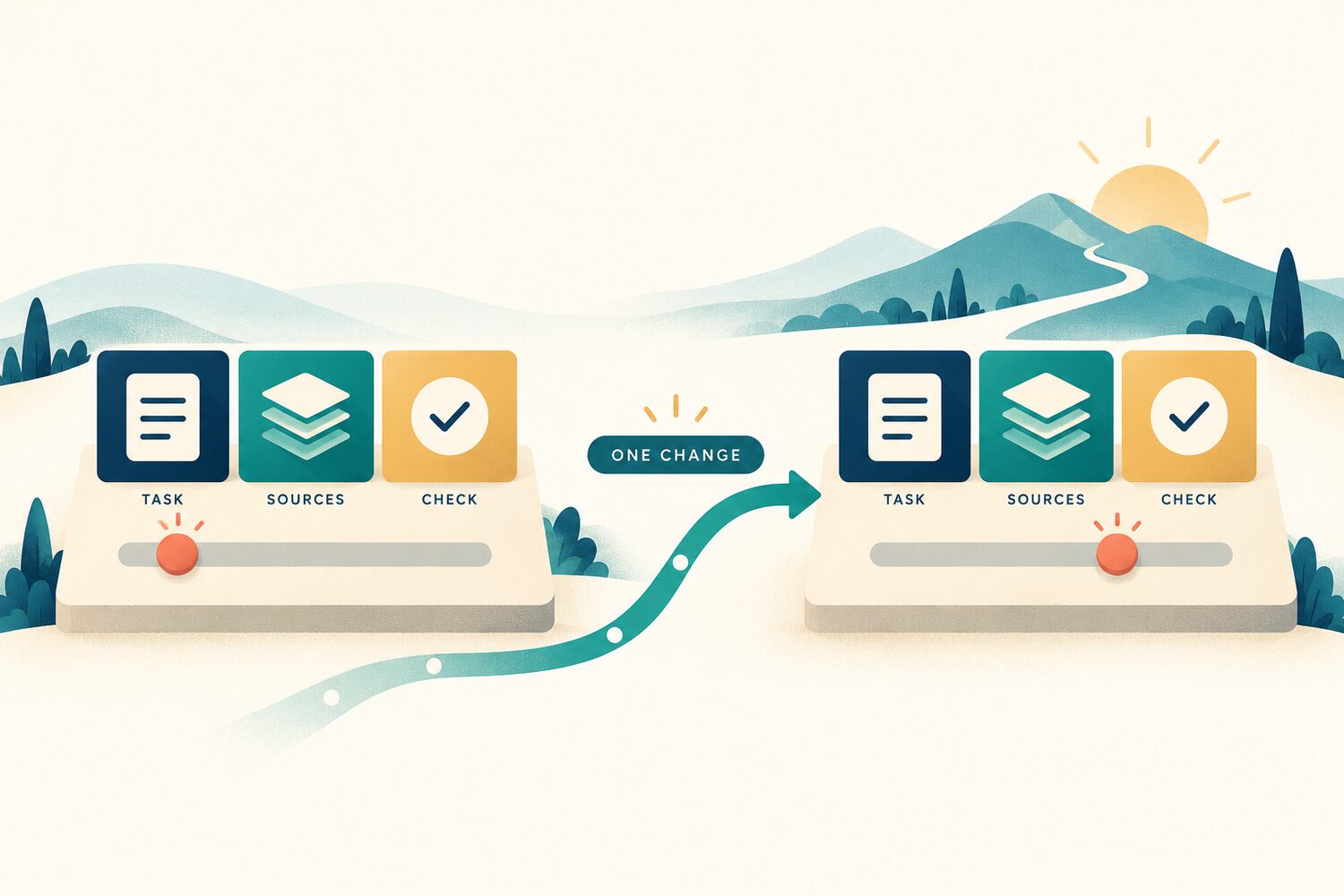
Keep the task, source pack and acceptance check stable. Change one condition so learners and coaches can see which AI skill improved.
AI Training for Employees: Reset Skills After a Role Change
A completed course does not prove readiness for new tasks, data or authority. Use a narrow role-change reset to collect fresh evidence without restarting every course.