AI Fluency Begins After the First Wrong Answer
The real test of AI skill is not a polished first answer. It is the ability to find a failure, choose a safe repair and prove the result.
A polished first answer is the easiest part of using AI to admire. It is also the least reliable proof of skill. Real work starts when the answer is plausible but wrong: a source has been stretched, a constraint has vanished, a number no longer matches the table, or the tone is right while the decision is not.
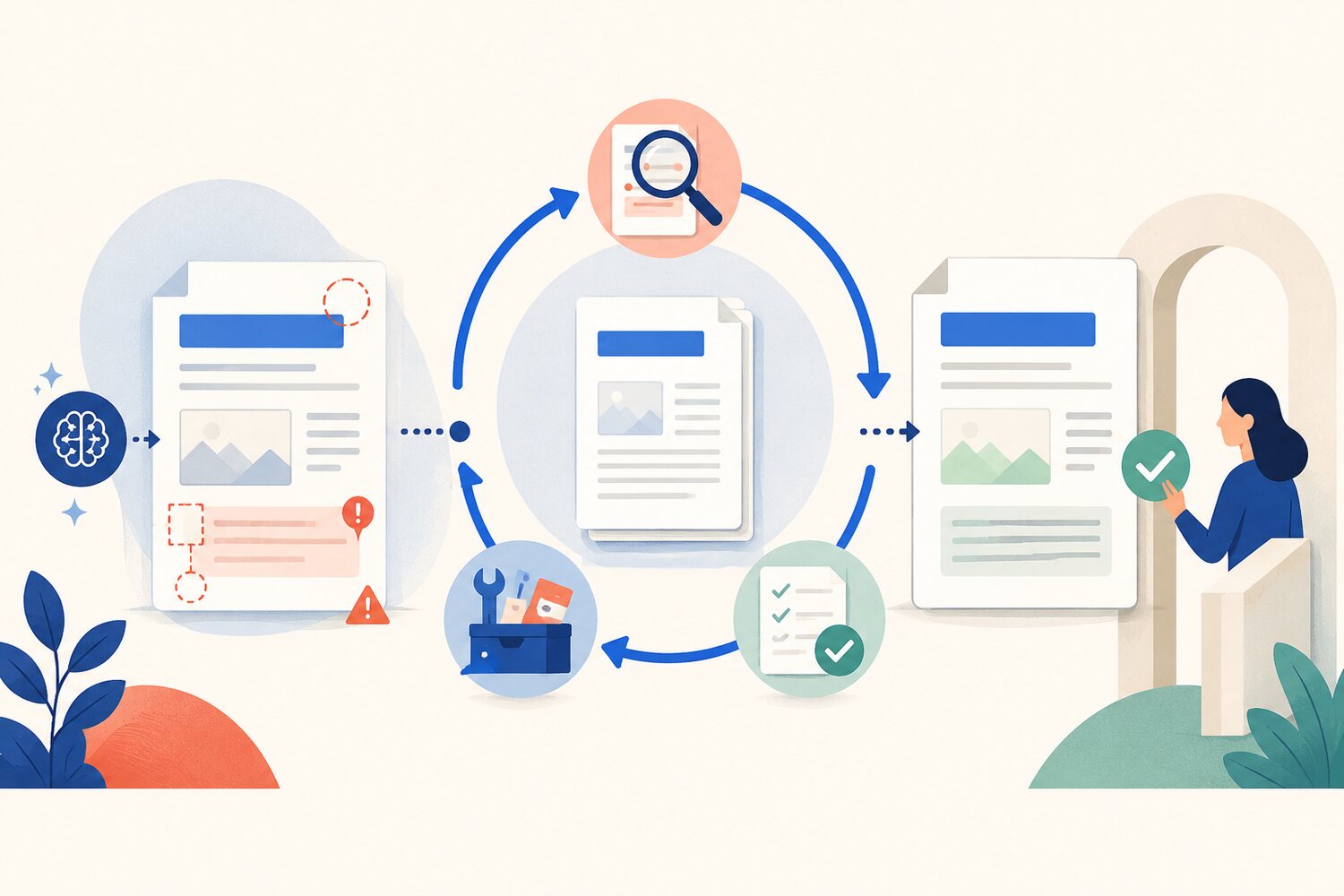
AI fluency begins at that moment. The useful employee is not the person who can always produce a smooth draft. It is the person who can locate the failure, choose the right recovery action and prove that the repaired result is safe to use.
The recovery test
Do not ask only, “Can this person get a good answer?” Ask, “What do they do with a convincing wrong one?”
Perfect demos teach the wrong reflex
Most demonstrations begin with tidy inputs and end with an impressive output. Learners see the successful route, copy the prompt and assume that a similar-looking answer deserves similar trust. But AI systems can fail in ordinary use, and a fluent answer does not expose where the reasoning, source use or interpretation broke.
Microsoft’s human–AI interaction guidelines explicitly treat failure as a design condition. They recommend making the system’s capabilities and likely mistakes clear, supporting efficient correction, and helping users recover when the system is wrong. That principle belongs in training too. A learner needs practice after the mistake appears, not only before the first prompt is sent.
| Success-only practice | Recovery practice | |
|---|---|---|
| Example | A clean brief with an obvious answer | A realistic brief with one planted failure |
| Learner action | Produce and polish | Diagnose, repair and verify |
| Evidence | The output looks good | The failure and correction trail are visible |
| Judgement | Accept or reject the whole answer | Choose the smallest safe recovery |
Use the FIND–FIX–PROVE loop
Three moves after a wrong AI answer
FIND the failure
Name the smallest observable problem. Is the answer unsupported, incomplete, inconsistent with the source, outside the brief, badly calculated or unsafe? “It feels wrong” is not yet a diagnosis.
FIX with the right move
Choose deliberately: edit the output yourself, add missing evidence, narrow the task, ask the AI to mark uncertainty, restart from a cleaner source, or stop using AI for this part. More prompting is not always the answer.
PROVE the repair
Check the corrected claim against the source, recompute the number, compare with the brief or ask the accountable reviewer. The AI cannot certify its own repair simply by sounding more confident.
The loop separates three skills that are often collapsed into “review the answer”. Finding requires attention. Fixing requires a recovery strategy. Proving requires evidence outside the answer itself. A learner can be strong at one and weak at another, which makes the loop useful for coaching.
Worked example: the status update that invents progress
Reading is a start. Practice makes it stick.
Start learningImagine a project coordinator asks an approved assistant to turn rough notes into a weekly update. The notes say that supplier testing is delayed, the launch date is unchanged and the owner of one action is not recorded. The draft reads smoothly, but it says testing is “on track” and assigns the action to Maya.
Recover without starting from zero
- 1
1. Find two separate failures
“On track” contradicts the delayed test. “Maya” has no support in the notes. One is a source contradiction; the other is an invented detail.
- 2
2. Fix each failure differently
Replace the progress claim directly with the supported status. For the missing owner, ask the assistant to label the field “owner to confirm” and never infer names that are absent from the source.
- 3
3. Prove line by line
Match every status, date and owner in the revised update to the notes. If a material claim cannot be traced, remove it or route it to the project owner.
- 4
4. Keep the lesson
Add a reusable instruction: preserve uncertainty, do not upgrade status language, and mark missing owners rather than guessing. Save the check alongside the prompt, not as a separate afterthought.
Different failures need different recovery moves
| Failure signal | Best first recovery | |
|---|---|---|
| Missing context | The answer fills gaps with generic assumptions | Add the missing source or narrow the task |
| Unsupported claim | A specific fact cannot be traced | Return to evidence; remove or label the claim |
| Constraint drift | Length, audience or required sections disappear | Restate the constraint and revise only the affected part |
| High-consequence uncertainty | The answer influences rights, safety, money or a binding decision | Stop and escalate to the accountable person |
NIST’s AI Risk Management Framework playbook recommends documenting human oversight, system overrides, reported errors, response times and response types. For everyday training, that does not require a heavy incident system. A small recovery record—failure, action, evidence and owner—can reveal which mistakes recur and which lesson or workflow needs to change.
Measure the recovery, not the apology
A learner passes when they can show this
- They point to the exact sentence, cell, assumption or omission that failed.
- They classify the failure before changing the prompt.
- They choose a recovery move that fits the consequence.
- They verify the repaired output against an independent source or reviewer.
- They preserve useful uncertainty instead of forcing a complete answer.
- They know when the correct recovery is to stop and escalate.
This is stronger evidence than asking whether the learner noticed “a hallucination”. It shows the behaviour that protects work: precise diagnosis, proportionate correction and external verification.
- Take a safe, non-sensitive work example and add one believable error to an AI draft.
- Give the draft and original source to a colleague without naming the error.
- Ask them to mark the exact failure and classify it.
- Have them choose one repair action and explain why it is proportionate.
- Require one independent check before the result is approved.
- Record the failure, repair and proof as a three-line recovery note.
Fluency is what happens after confidence breaks
The goal is not to make learners suspicious of every AI answer. It is to replace blind acceptance and blanket rejection with a better habit: find the problem, fix only what needs fixing and prove the result. Bokili’s short practice missions can turn that recovery loop into observable behaviour, with realistic tasks and immediate feedback rather than perfect demonstrations.
A good first answer saves time. A good recovery skill protects the work.
Sources
- Guidelines for Human-AI Interaction — Microsoft Research
- AI RMF Playbook — Measure — NIST AI Resource Center
- Artificial Intelligence Risk Management Framework: Generative Artificial Intelligence Profile — NIST
- Bokili — Practical AI skills for real work — Bokili
Reading is a start. Practice makes it stick.
Bokili turns skills like this into ten-minute missions for your whole team, with instant feedback and progress you can see.
Start learningKeep reading
AI Training for Employees: Separate Drafts From Records
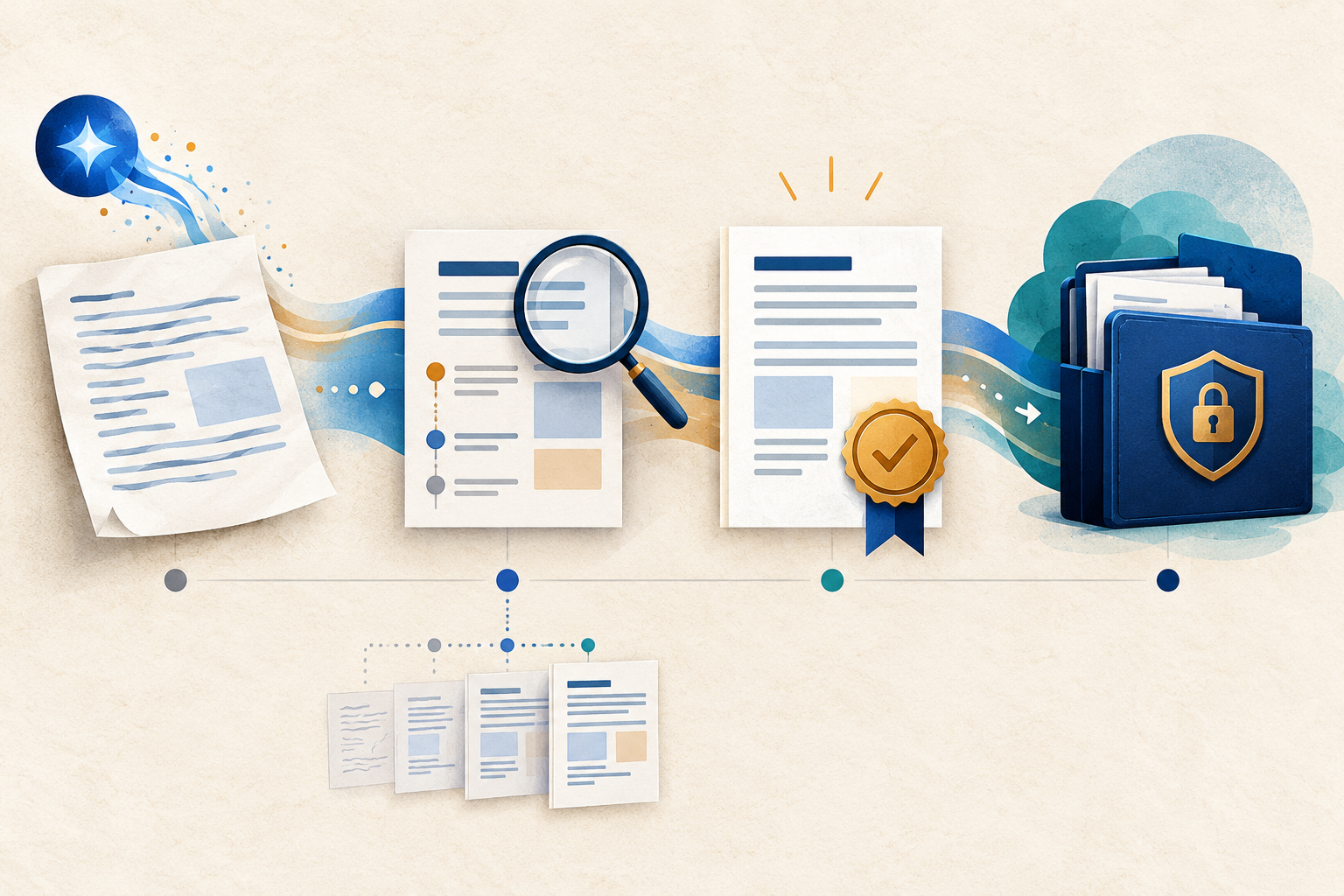
Teach a four-state path—Draft, Checked, Approved, Recorded—so polished AI output never becomes organisational fact by accident.
Use Gemini Notebook Mind Maps to Turn Policy Into Questions
Use a Gemini Notebook mind map as a question index for a long policy—then open the cited source before you trust any answer.
AI Training for HR: Build a Four-Part Policy Answer
Teach HR teams to separate the source, written rule, human discretion and next step before turning an AI draft into employee guidance.