
AI Training for HR: Build a Four-Part Policy Answer
Teach HR teams to separate the source, written rule, human discretion and next step before turning an AI draft into employee guidance.
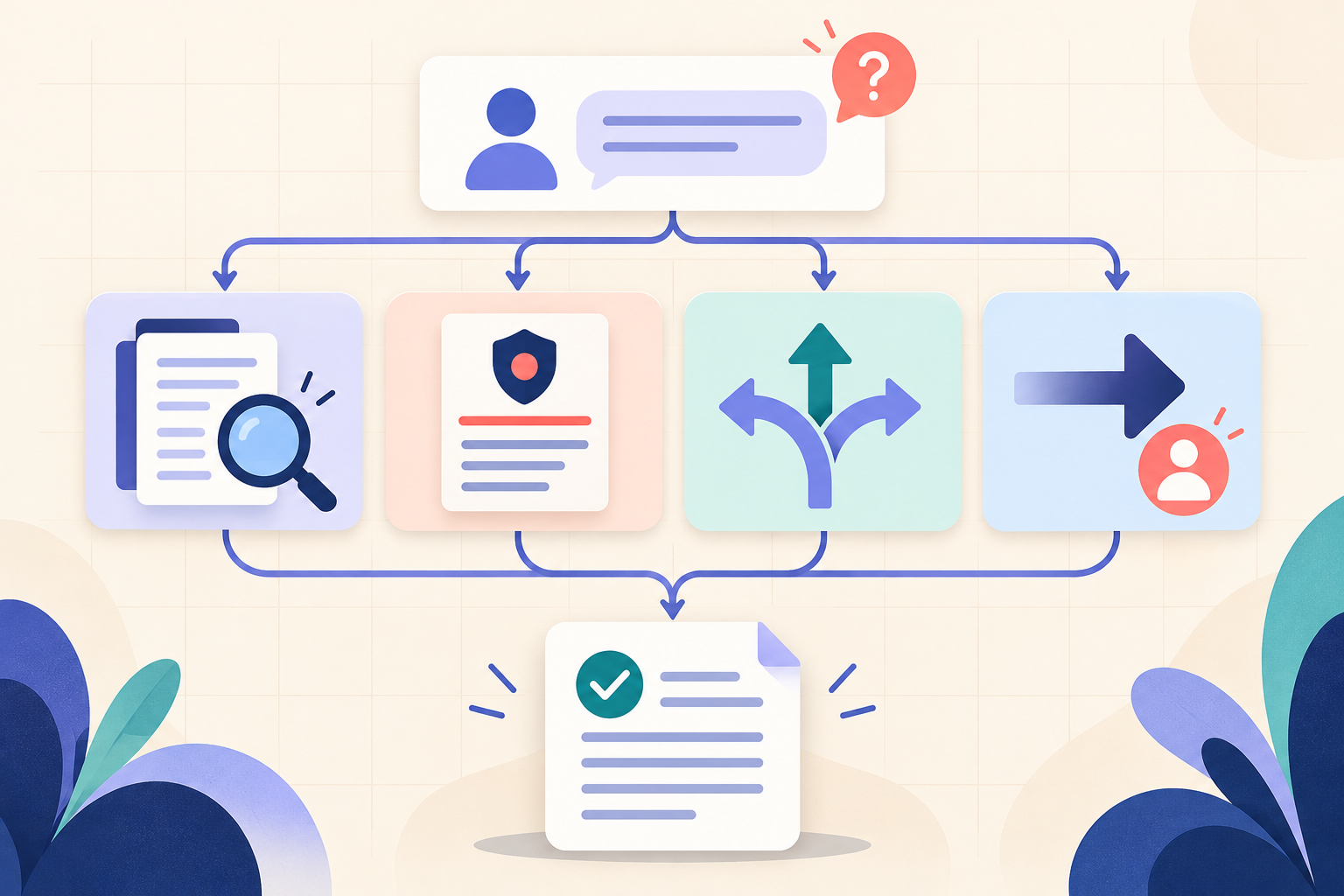
AI training for HR often teaches how to draft a policy answer, but not how to make that answer reviewable. A fluent response can quietly turn a limit into a ban, present manager judgement as a right, or omit the person who must decide. HR teams need a small structure that keeps the source, rule, discretion and next step separate.
The four-part policy answer is a practice format, not legal advice. It trains an employee to ground an AI-assisted response in the organisation’s approved text, identify what the policy actually says, show where judgement remains and route the question to the right next action.
What AI training for HR should test
The useful skill is not producing a friendly paragraph. It is preserving the boundary between written policy and human judgement. The European Commission’s AI-literacy guidance says training should reflect the relevant system, people’s knowledge and the context and risk of use. The UK Government AI Playbook likewise recommends meaningful human control at the right stages and validation checks for AI-generated responses.
Training design should therefore make the critical behaviour observable. US Office of Personnel Management guidance recommends naming the performance gap, the required behaviour and how it will be monitored. For a policy-answer exercise, the behaviour is simple: show the basis of the answer and do not invent authority.
The four-part policy answer
1. Source
Name the approved policy, section and effective date used for the answer.
2. Rule
State only what the text clearly requires, allows or limits.
3. Discretion
Identify any choice, exception or missing fact that belongs to a manager, HR or another owner.
4. Next step
Tell the employee what to provide, who decides and what happens next.
Worked example: a £650 training request
Use this fictional policy excerpt: “Employees may spend up to £500 per calendar year on role-relevant training with manager approval. Requests above £500 require L&D review. Reimbursement requires a receipt.” The employee asks: “Can I book a £650 course?”
A weak AI answer says, “No. The annual training limit is £500.” It sounds decisive but changes the policy. The text does not prohibit a £650 course; it routes requests above £500 to L&D review.
| Weak answer | Four-part answer | |
|---|---|---|
| Source | Not shown | Learning policy, section 4, current version |
| Rule | £500 is the maximum | Up to £500 needs manager approval |
| Discretion | None mentioned | Above £500 needs L&D review |
| Next step | Do not book | Send course details and manager approval to L&D before booking |
Reading is a start. Practice makes it stick.
Start learningThe corrected answer is longer by only a few words, yet it is safer because it preserves the actual route. It also exposes any missing fact. If the policy excerpt had no effective date or did not say whether tax is included, the answer should mark that gap rather than fill it with a guess.
Use AI to structure the answer, not to create the rule
Work only from the fictional policy excerpt below. Answer the employee’s question using four labels: Source, Rule, Discretion, Next step. Quote no more than one short phrase. If the text does not answer something, write “Not stated” and name the decision owner who should confirm it. Do not invent an exception or legal requirement.

[Paste the fictional policy excerpt and question.]
Source: Learning policy, section 4.
Rule: Up to £500 requires manager approval.
Discretion: Requests above £500 require L&D review.
Next step: Send the course details and manager approval to L&D before booking.
Use fictional or approved training material. A qualified HR reviewer checks the result before it becomes a real employee response.
The prompt is deliberately narrow. It tells the tool what structure to return and what to do when the source is silent. It does not authorise the model to interpret employment law, approve an exception or make a personnel decision. Those boundaries belong to the organisation and the named human owner.
Review the four labels before polishing the prose
Start with accuracy, not tone. Check that the source exists and is current. Compare every rule statement with the text. Look for words such as “may”, “must”, “normally”, “subject to” and “unless”; they often determine whether a sentence is a rule or a decision point. Confirm that the named owner really has authority. Only then turn the four labels into a natural reply.
This method connects naturally to other HR practice. Use the job-description audit when AI drafts hiring criteria, the three levels of authority to distinguish advice from action, an exception library for recurring edge cases, and the escalation sentence when the source is incomplete.
- Choose a low-risk fictional policy with one clear rule and one review route.
- Write an employee question that sits just beyond the simple rule.
- Ask the AI for Source, Rule, Discretion and Next step.
- Underline every phrase supported directly by the policy.
- Mark any invented limit, promise, exception or decision owner.
- Revise the answer and have a qualified HR colleague check it.
Make the boundary visible
A good policy answer does more than sound helpful. It lets another person see where the answer came from, what is fixed, what remains a judgement and what the employee should do next. That is a concrete capability HR teams can practise and review.
Bokili’s role-adapted missions can turn this structure into short, repeatable practice for HR and L&D teams. Start with one low-risk policy and one realistic question. The goal is not faster prose. It is a reliable boundary between the document and the decision.
Sources
- AI training for HR & L&D leaders — Bokili
- AI Literacy — Questions & Answers — European Commission
- Artificial Intelligence Playbook for the UK Government — UK Government
- Planning & Evaluating — Training Needs Assessment — U.S. Office of Personnel Management
Reading is a start. Practice makes it stick.
Bokili turns skills like this into ten-minute missions for your whole team, with instant feedback and progress you can see.
Start learningKeep reading

A Guided AI Mission Should Remove the Blank Page, Not the Decision
Good guidance should organise the task, context and standard—then leave one consequential choice for the learner to make and justify.
AI Upskilling for Teams: Build Two-Person Skill Coverage
AI upskilling for teams becomes resilient when every priority work task has a primary practitioner, a practice partner and shared evidence.
AI Meeting Notes Need a Commitment Check
AI-generated action items are drafts. Use four commitment states to stop suggestions, assignments and dates becoming promises nobody made.