
AI Learning and Development: Use Retrieval, Not Rewatching
Replace passive replay with a short loop that asks employees to recall, apply, correct and repeat an AI workflow.
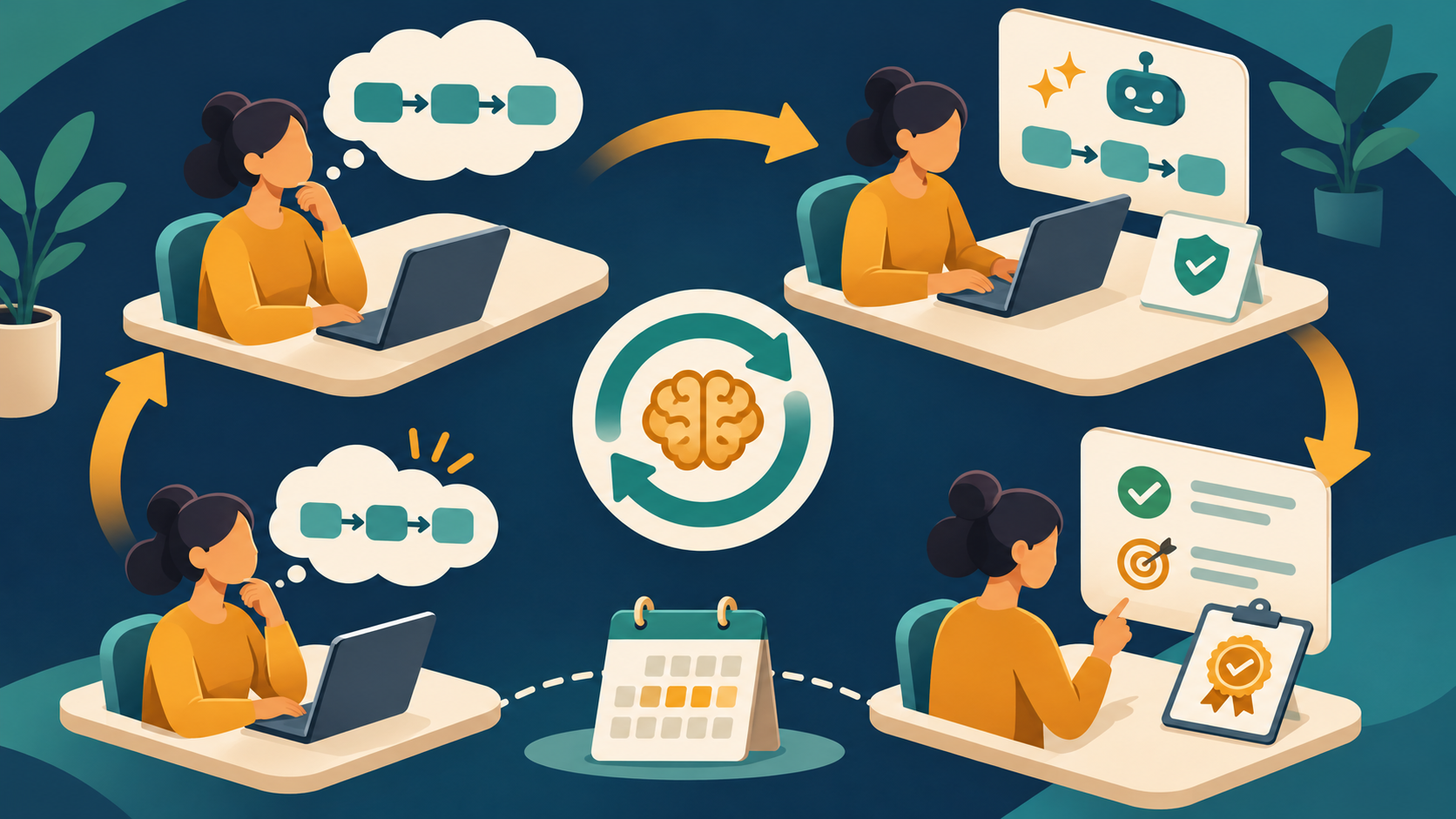
AI learning and development often starts with a clear demo and ends with a weak test: “Did everyone watch it?” Rewatching can make a workflow feel familiar, but familiarity does not show that an employee can recall the steps, apply them to a fresh task and notice a weak result. A stronger design asks people to retrieve the method from memory, practise it on safe work and repeat after a gap.
This is not an argument against courses or demonstrations. Initial instruction matters. The change comes after it: replace some passive review with short retrieval-and-application loops. Research on 10,514 people in naturally occurring workplace training found that spacing between retrieval events interacted with the intended retention interval. The study supports spaced retrieval in real settings, but it does not give every employer one perfect schedule.
AI learning and development needs evidence of recall
| Passive review | Retrieval practice | |
|---|---|---|
| Learner action | Replay the same explanation | Reconstruct the method without notes |
| Task | Watch the original example | Apply the method to a fresh safe case |
| Feedback | Little or delayed | Compare, correct one gap and try again |
| Evidence | Completion or viewing | A work sample and visible quality check |
| Repeat | More content immediately | Return after a planned gap |
The useful distinction is simple. Passive review asks whether the material still looks familiar. Retrieval practice asks whether the learner can produce the method when the answer is not in front of them. For AI skills, retrieve job behaviour rather than trivia: the sequence of a safe workflow, the quality bar, the stop conditions and the point where a person must decide.
The RECALL loop
Retrieve
Write the workflow steps and quality checks from memory before opening notes.
Execute
Use the method on a new, low-risk task with synthetic or approved data.
Compare
Check the work against the source, example answer or agreed rubric.
Correct
Fix one important gap and state what caused it.
Apply
Use the corrected method on a varied case so the learner cannot copy the first answer.
Later repeat
Schedule another short attempt after a gap that fits how long the skill must be retained.
Worked example: a support-summary workflow
A support team is learning to turn fictional case notes into a concise handoff summary. The quality bar is: preserve the customer’s request, separate facts from assumptions, identify the unresolved owner and avoid personal data. After a demonstration, the learner closes the guide and writes those checks from memory. They then summarise a fresh fictional case.
The learner compares the summary with the original notes and a short rubric. Suppose the summary is accurate but omits the unresolved owner. The coach gives one focused correction: “Name the next owner and the evidence they still need.” The learner revises the work and later receives a different case with a new ambiguity. That produces evidence of usable recall, not just recognition of the original example.
Choose a gap from the retention goal
Reading is a start. Practice makes it stick.
Start learningDay 0
Teach the workflow, model one example and make the quality bar explicit.
Day 2
Ask for the method from memory and a fresh safe task. Give focused feedback.
Day 7
Repeat with a varied case and fewer cues. Record the missed step, not only the score.
Day 21
Use a realistic scenario that includes a stop condition or escalation point.
This timeline is a practical starting hypothesis, not a universal optimum. The workplace study found that longer retention goals tended to require longer spacing, so teams should test and adjust. A skill used every day may need a short early gap. A monthly governance decision may need a later check. Keep the attempt short enough to fit the workday.
Design the loop around real work
The UK employer guide on AI upskilling says good training should be practical, integrated, modular and sustainable. It recommends real tasks, small applied projects with feedback, reflection and repeat practice. It also stresses responsible use, including confidentiality, data protection, transparency and human oversight. Retrieval practice fits that design when the retrieved method includes those safeguards rather than only a prompt formula.
Start with one role and one approved task. Define the quality bar in observable terms. Use synthetic or approved data. Give feedback on the biggest gap first. Store only the evidence you genuinely need. Then vary the next case so the employee must adapt the method instead of copying a pattern.
A ten-minute retrieval exercise
- Choose one AI workflow an employee has already been shown.
- Hide the guide and ask the learner to write its steps, quality checks and stop condition.
- Give a new low-risk example with synthetic or approved data.
- Compare the result with the source or rubric and correct the most important gap.
- Book a later five-to-ten-minute repeat with a varied case.
For a broader programme, Bokili’s AI training for HR and L&D leaders is built around short, realistic workplace tasks. Related Learn guides can help you connect the loop to measurement and maintenance: Measure AI Training by Work Transfer, Build an AI Skills Refresh Cycle, Map Existing Practice Before AI Training and Use a Correction Loop to Learn AI.
Measure what the learner can do later
Completion still helps with administration, but it is not the final signal. Track whether the learner can reconstruct the workflow, meet the quality bar on a fresh task, recognise when to stop and improve after feedback. If recall fails, shorten the early gap, simplify the method or strengthen the cue. If the learner succeeds only on the original example, vary the task. Good AI learning and development does not end when content has been seen. It ends when safer, better behaviour can be produced again.
Sources
- The spacing effect stands up to big data — Behavior Research Methods / PubMed
- Employer guide: What works for AI upskilling in the UK — Skills England / GOV.UK
- AI training for HR & L&D leaders — Bokili
Reading is a start. Practice makes it stick.
Bokili turns skills like this into ten-minute missions for your whole team, with instant feedback and progress you can see.
Start learningKeep reading

AI Training for Employees: Pause Before Recording a Meeting
Teach employees a five-part check for purpose, notice, sensitive data, approved tools and downstream use before an AI recorder joins.

Critical Thinking Is Not a Module in AI Training
Make judgement observable by adding one challenge question—and one correction—to every realistic AI practice task.
AI Training for Employees: Add Two New-Hire Checkpoints
Build AI training into onboarding with a safe first-week practice and a fresh transfer check after the new hire learns the workflow.