
AI Work Is Not Fast Until the Correction Loop Is Fast
First-draft speed hides the queue. Measure detection, repair and verification to learn when AI-assisted work is truly ready.
A team can produce an AI draft in seconds and still finish the job later than before. The delay has simply moved. Someone must spot the weak claim, find the right source, repair the wording, resolve a disagreement and confirm that the result is safe to use. If leaders measure only time to first draft, they reward the most visible moment and ignore the queue that determines when work is actually ready.
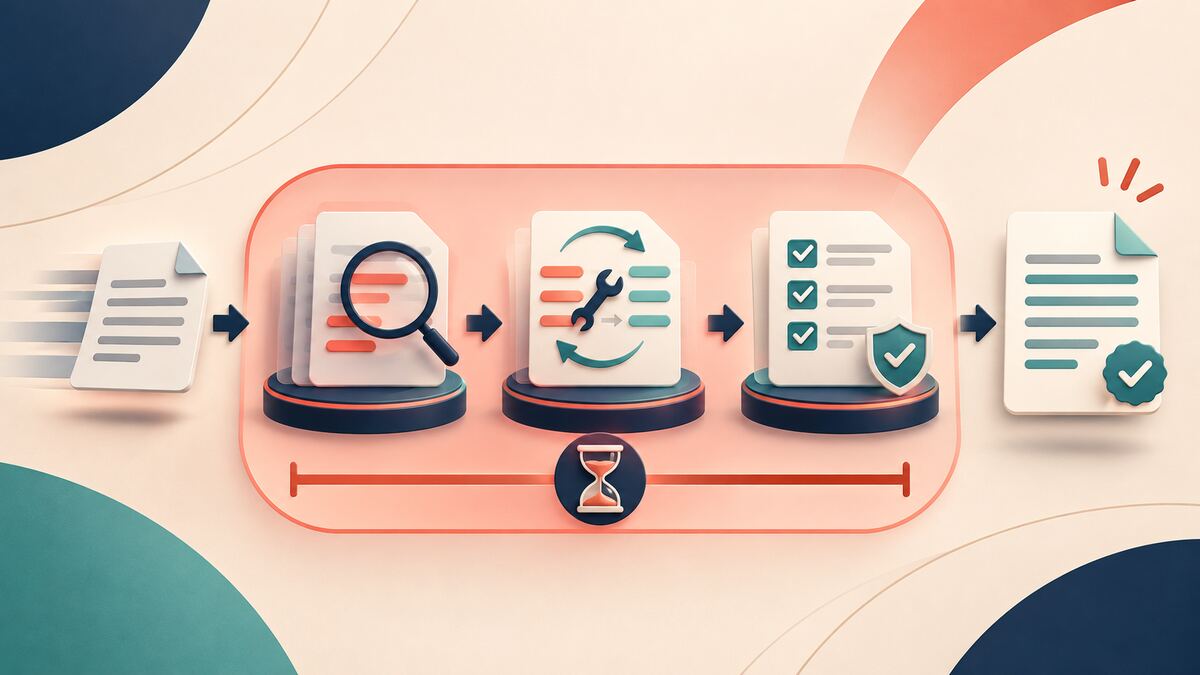
The better measure is correction-loop time: the elapsed time from the first usable draft to a corrected, verified and decision-ready result. This is not a case against generative AI. It is a case for measuring the whole human–AI workflow. NIST’s AI Risk Management Framework playbook recommends metrics for errors, response time and time to repair. The UK government’s AI playbook similarly calls for testing, regular checks, user feedback and routes to human review.
The correction clock
Measure four moments, not one
Draft
When does the first answer arrive, and is it usable enough to review?
Detect
How long until someone notices a material error, omission or ambiguity?
Repair
How long does it take to obtain evidence, rewrite the affected part and resolve ownership?
Verify
How long until an authorised reviewer confirms that the corrected result is ready for its intended use?
A fast draft helps only when the next three stages remain short and predictable. If detection depends on a busy specialist, or verification happens in a weekly meeting, the AI has accelerated one step inside a slow system. The total workflow may still feel fast to the person prompting, while the customer, colleague or decision-maker waits.
Why correction time grows quietly
Correction work is easy to hide because it is scattered. A reviewer leaves a comment. A domain expert checks a rule. An analyst opens the source. A manager decides whether the exception is acceptable. None of these actions looks large on its own, yet their waiting time accumulates. The queue grows fastest when there is no named reviewer, no evidence standard and no clear stop rule.
Detect
The reviewer marks the exact claim or decision that may be wrong.
Repair
The owner corrects only the affected section and records the source or assumption.
Verify
The authorised reviewer checks the correction against the agreed standard.
Release
The result moves forward, or the unresolved issue is escalated with an owner and deadline.
A worked example: one policy update
Imagine a retail team using AI to update a customer FAQ after a return-policy change. The first draft arrives in two minutes. It sounds polished, but it invents a 45-day return window. A content manager notices the problem the next morning, waits for legal to confirm the current rule, rewrites three answers and sends them back for approval. The published update is ready two days after the first draft.
Reading is a start. Practice makes it stick.
Start learningThe two-minute draft is real, but it is not the useful productivity measure. The correction clock is almost two days. The practical improvement is not merely a better prompt. The team can attach the approved policy before drafting, name the legal reviewer, require every time limit to cite the policy section, and set a same-day review window. Those changes reduce detection and waiting time as well as rework.
| First-draft metric | Correction-loop metric | |
|---|---|---|
| Start | Prompt submitted | Task opened with evidence and owner |
| Finish | Text appears | Result is verified and ready to use |
| Blind spot | Review and waiting time | Unresolved issues are recorded |
| Management question | How quickly did AI answer? | Where did the work wait, and why? |
What leaders should change
Start with a small sample of real tasks rather than a dashboard project. For each task, record four timestamps, the type of correction, who owned it and whether the issue could have been prevented. Separate active repair time from waiting time. A ten-minute correction delayed by a two-day queue calls for a workflow change; a two-hour factual reconstruction calls for better evidence, scoping or tool choice.
- Choose one repeatable task with a clear definition of ready.
- Record draft, detection, repair and verification timestamps for ten cases.
- Tag the main cause: missing context, unsupported claim, unclear instruction, policy exception or reviewer delay.
- Improve the largest source of elapsed time, then repeat the sample.
- Keep a human decision point where the consequence of a wrong answer is material.
Do not use correction time to pressure reviewers into approving faster. The aim is to remove avoidable waiting and make standards explicit, not to weaken scrutiny. A slower verification step may be entirely appropriate for high-impact work. The useful question is whether the delay is deliberate and proportionate, or accidental and unmanaged.
Connect the metric to capability
Correction latency also reveals what people need to learn. Repeated evidence gaps point to source handling. Long ownership disputes point to governance. Slow repairs point to weak recovery skills. Bokili’s guides on the AI rework ratio, measuring saved time and recovering from a wrong answer can help teams turn those observations into practice.
- Pick one recent AI-assisted task that reached a real decision or customer.
- Write down the four timestamps: draft, detection, repair and verification.
- Circle the longest interval and label it active work or waiting.
- Name one change that would shorten that interval without lowering the review standard.
- Assign an owner and test the change on the next three tasks.
AI work is fast only when the result reaches its destination faster and with the required quality. Measure the correction loop, and the hidden queue becomes something a team can improve.
Sources
- AI RMF Playbook: Measure — NIST
- Artificial Intelligence Playbook for the UK Government — UK Government
Reading is a start. Practice makes it stick.
Bokili turns skills like this into ten-minute missions for your whole team, with instant feedback and progress you can see.
Start learningKeep reading

AI Training for Employees: Pause Before Recording a Meeting
Teach employees a five-part check for purpose, notice, sensitive data, approved tools and downstream use before an AI recorder joins.

Critical Thinking Is Not a Module in AI Training
Make judgement observable by adding one challenge question—and one correction—to every realistic AI practice task.
AI Training for Employees: Add Two New-Hire Checkpoints
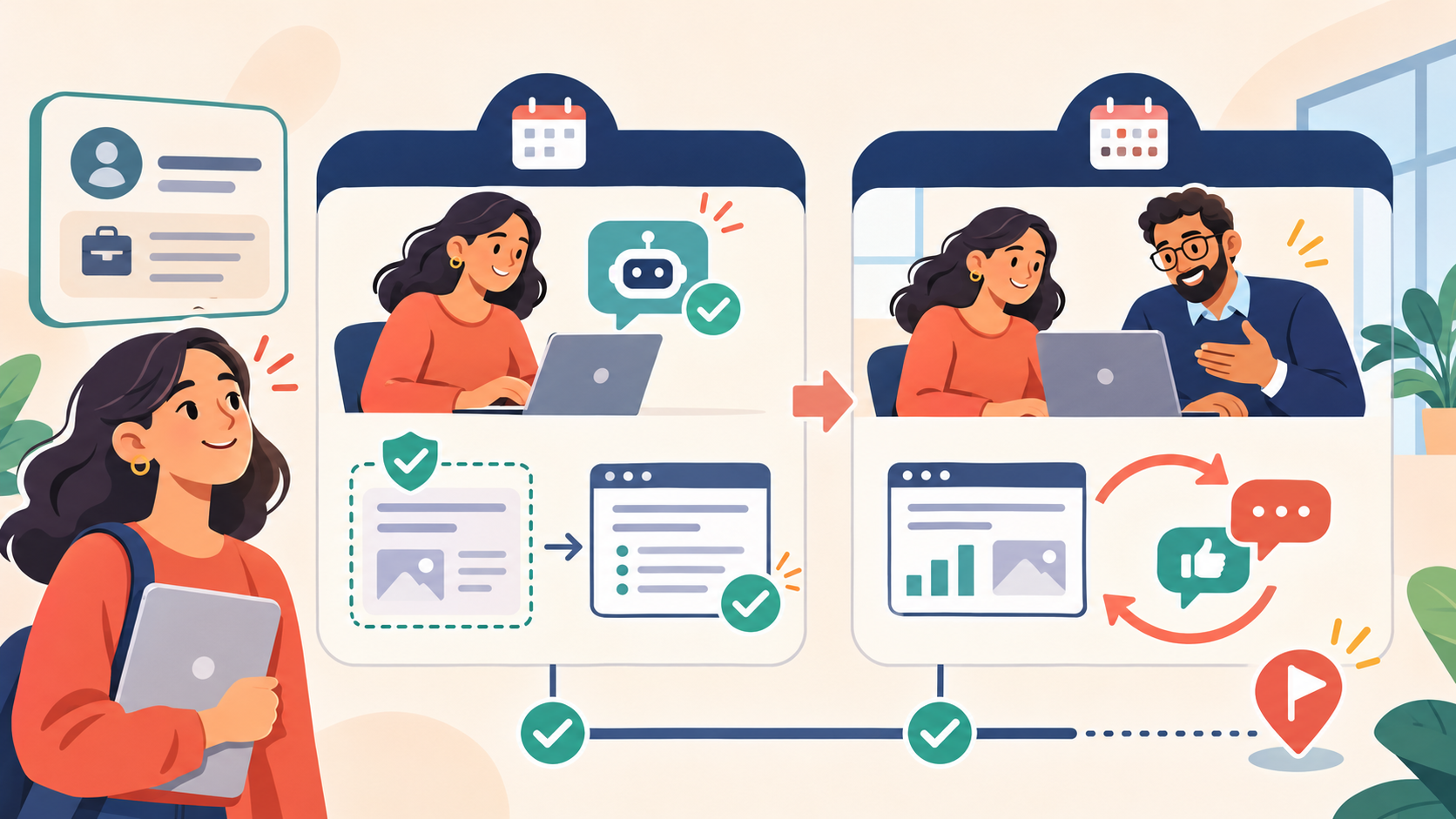
Build AI training into onboarding with a safe first-week practice and a fresh transfer check after the new hire learns the workflow.