
Learn to Use AI: Write Your Expected Answer First
Learn to use AI with PREP: predict the answer, name the evidence and red flag, then compare the output before you trust it.
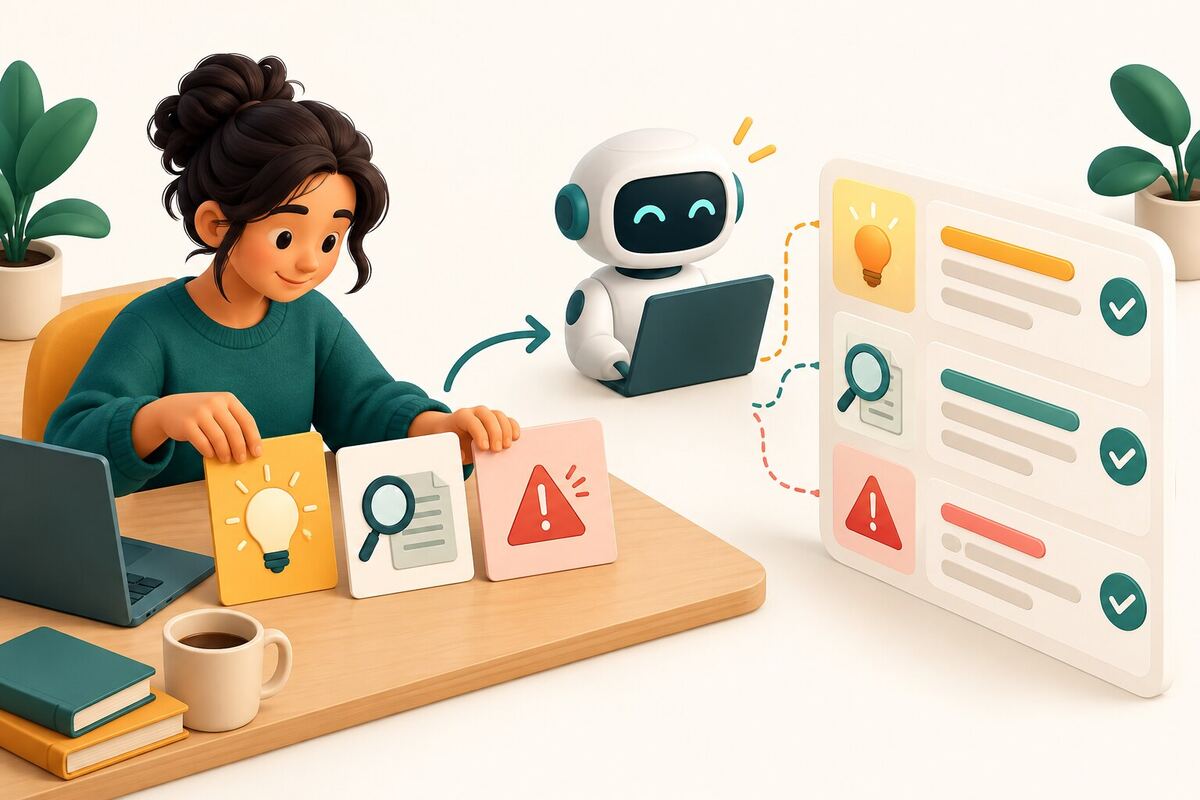
If you want to learn to use AI, do one thing before you write a prompt: write the answer you expect. You do not need to predict the exact wording. Note the likely conclusion, the evidence you would need and one red flag that would make the answer unsafe or incomplete.
This small step changes the exercise. Instead of asking, “Does this sound good?”, you can ask, “What did the AI add, omit or change?” That is a better way to build judgement because a fluent response is not the same as a supported one.
Why beginners need an expectation before the prompt
Generative AI can produce confident, polished language even when a claim needs checking. NIST’s Generative AI Profile treats confabulation—confidently stated false or erroneous content—as a distinct risk. The UK Government AI Playbook also advises users to verify outputs and use suitable safeguards for the context.
For a beginner, the hard part is often not writing the prompt. It is noticing what changed after the response arrived. Once you read a plausible answer, it can anchor your judgement. A short prediction written first gives you a reference point that the model did not create.
| Prompt first | Expectation first | |
|---|---|---|
| Starting question | What can the AI tell me? | What do I already expect, and why? |
| Quality check | Does it sound convincing? | Does it match evidence and the task? |
| Surprise | Easy to accept | A cue to investigate |
| Learning record | The final answer | The difference between prediction and result |
Learn to use AI with the PREP method
PREP
Predict
Write the likely answer in one sentence before opening the AI tool.
Require
Name the evidence the answer must use: a policy section, approved data, a source link or a calculation.
Examine
Compare the response with your prediction. Mark every addition, omission, contradiction and unsupported leap.
Preserve
Save one lesson for the next attempt: a better check, a clearer boundary or a case where AI should not decide.
PREP is not a test of whether you can outguess a model. Your prediction may be wrong. That is useful when the difference sends you back to evidence. The goal is to make your reasoning visible before persuasive language arrives.
A worked ten-minute example
Use a short, non-sensitive document you know, such as an approved expense policy. Imagine the question is: “Can a colleague claim a taxi home after a late client event?” Do not paste confidential material into a public tool. Use an approved system and follow your organisation’s rules.
Reading is a start. Practice makes it stick.
Start learningRun the exercise
- 1
Minute 1: predict
Write: “Probably yes when public transport is unavailable and the manager approves it.” This is a hypothesis, not a fact.
- 2
Minute 2: require evidence
Write: “The answer must cite the relevant policy section and state any cost limit or approval rule.”
- 3
Minute 3: name a red flag
Write: “A simple yes with no policy reference, limit or exception is not enough.”
- 4
Minutes 4–6: ask
Provide the approved policy text or use an authorised retrieval tool. Ask for a short answer, the cited clause and any uncertainty.
- 5
Minutes 7–9: compare
Mark what matches your prediction, what differs and which claim lacks direct support in the policy.
- 6
Minute 10: preserve
Record one lesson, such as: “For policy questions, always require the clause and escalation route.”
Suppose the AI says the taxi is allowed after 9 p.m., but the policy only refers to unavailable public transport and manager approval. The specific time sounds useful, yet it is unsupported. PREP makes that addition visible because your evidence requirement was written before the answer.
Do not turn your prediction into the answer
Your first guess is a comparison point, not a fact. When prediction and output differ, return to the source.
What this teaches that prompt tips do not
Prompt templates can improve structure, but they do not automatically improve judgement. The European Commission’s AI literacy guidance says the necessary level of knowledge depends on the context and the people using the system. A practical learning routine should therefore match the real task, its risks and the evidence available.
Training also improves when learners can compare a baseline with a result. The U.S. Office of Personnel Management’s training evaluation guide emphasises defining outcomes and collecting evidence at appropriate levels. PREP applies that logic to one small practice session: capture what you expected, observe the output and record what changed.
Choose a good first task
- The source material is approved and non-sensitive.
- You can check the answer in under ten minutes.
- A wrong answer will not harm a person or trigger a real decision.
- The task has a clear evidence source.
- You can repeat it later and compare your judgement.
Build the habit, then widen the task
Start with a reversible task and repeat PREP three times. You can pair it with a correction loop, choose a safe first work task, and learn when to stop prompting. Bokili’s learning features can support a longer path, but the core habit is simple: expectation, evidence, comparison, lesson.
- Choose one short approved document.
- Write the likely answer in one sentence.
- Name the evidence the answer must show.
- Write one red flag.
- Ask the AI, compare the result and save one lesson.
Learning to use AI is not learning to accept faster. It is learning to notice the gap between a plausible answer and a useful, supported one. Write that gap down before the prompt.
Sources
- Artificial Intelligence Risk Management Framework: Generative Artificial Intelligence Profile — NIST
- AI Literacy — Questions & Answers — European Commission
- Training Evaluation Field Guide — U.S. Office of Personnel Management
- Artificial Intelligence Playbook for the UK Government — UK Government
Reading is a start. Practice makes it stick.
Bokili turns skills like this into ten-minute missions for your whole team, with instant feedback and progress you can see.
Start learningKeep reading
An AI Roadmap Without a Stop-Doing List Is Just More Work
Pair every AI investment with a decision to retire, redesign, protect or stop work, so the roadmap changes the operating model instead of adding tasks.
AI Skills for Employees: Separate Forecasts From Scenarios
AI skills for employees should include one number-label habit: distinguish a forecast, scenario, target and unsupported guess before anyone acts.

Use ChatGPT Scheduled Tasks for a Weekly Skill Rehearsal
Turn a recurring ChatGPT reminder into a ten-minute practice loop with safe material, fixed criteria and one visible correction.