
Corporate AI Training for Multilingual Teams
Keep one shared standard for safe AI work, then localise the language, scenario, tools and review that turn it into practice.
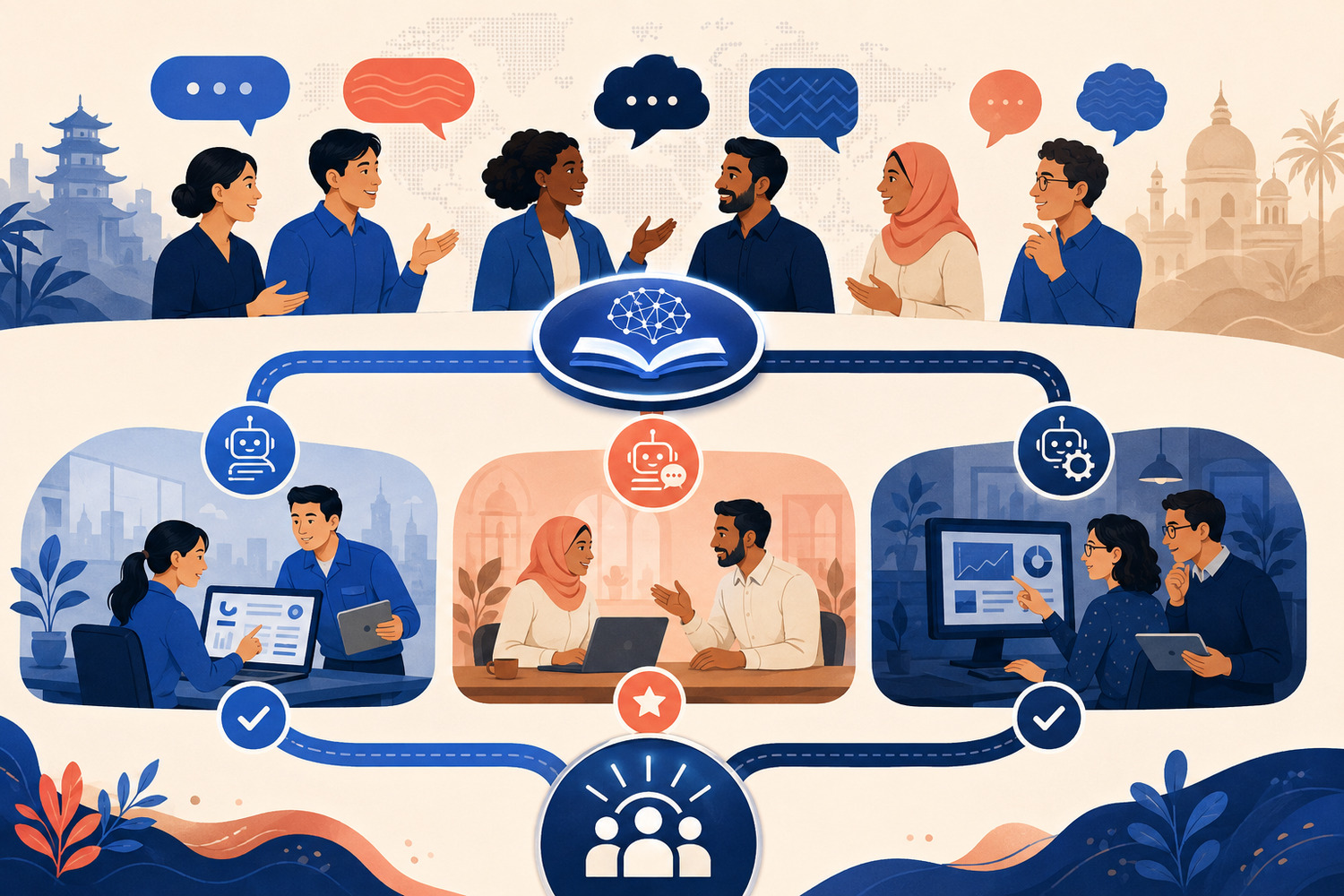
Corporate AI training for multilingual teams fails when localisation is treated as the final translation step. A shared English course may carry the company policy, but it rarely carries every team’s approved tools, customer context, examples, data boundaries or escalation language. The better design keeps one common standard for outcomes and safety, then localises the practice that proves people can apply it. That creates consistency without pretending that the same words produce the same behaviour everywhere.
The design rule
Standardise what good work must achieve. Localise the language, scenario, tool access, evidence and review route used to practise it.
Why corporate AI training needs more than translation
The European Commission’s current AI-literacy guidance says organisations should consider people’s technical knowledge, experience, education and training, as well as the context and purpose of the AI system. It explicitly rejects a one-size-fits-all format. Language is part of that context, but it is not the whole of it.
The W3C makes a useful distinction: internationalisation prepares content so it can be adapted, while localisation is the actual adaptation to a particular language and culture. Applied to corporate learning, this means designing a stable core that can travel, then changing the parts that must feel true in local work. A translated example about a US sales process is not local practice for a German service team or a French HR team.
The reader problem is operational. L&D leaders need one programme they can govern, yet local teams need exercises they recognise and reviewers who understand the decisions. Building a separate curriculum for every country creates drift and maintenance work. Translating one central deck creates apparent consistency but weak transfer. The solution is a two-layer design.
Use the CORE–LOCAL model for multilingual corporate AI training
One shared core, five local decisions
CORE — common outcomes
Define the behaviours every learner must demonstrate: choose an appropriate task, protect restricted data, check material claims, preserve human decisions and escalate when required.
L — Language
Use natural workplace language, not literal terminology. Localise instructions, feedback, metadata and the words people use to pause or report a concern.
O — Operating context
Replace generic examples with a familiar role, customer, document and consequence. Keep the learning objective unchanged.
C — Current tools and access
Show only the accounts, models, connectors and permissions available to that team. Do not teach controls learners cannot use.
A — Authorities and rules
Name the local policy owner, applicable rules, data boundary and escalation route. Distinguish company-wide requirements from local additions.
L — Local review
Use a reviewer who can judge both the language and the work. Check one fresh output against the shared standard.
What should stay shared—and what should change?
| Keep shared across the company | Adapt for each locale or team | |
|---|---|---|
| Outcome | The observable skill and quality threshold | The task used to demonstrate it |
| Safety | Core prohibited uses and minimum data rules | Local examples, regulation and escalation wording |
| Evidence | What must be checked before use | Approved sources and records available locally |
| Tooling | The principle of approved access | The actual product, account and permissions |
| Review | The criteria for sign-off | The reviewer, language and workflow |
| Maintenance | Triggers for programme refresh | Owner and timetable for each local version |
Worked example: one skill, three realistic practices
Reading is a start. Practice makes it stick.
Start learningSuppose the shared outcome is: “The learner can turn a customer request into a draft response without exposing personal data or inventing a commitment.” The central team defines the safe-input rule, the requirement to verify dates and terms, and the final human approval.
The French version uses a service request written in natural French, an approved French knowledge-base article and the local escalation phrase used by the support team. The German version uses a different approved tool because that business unit has not enabled the same connector. Its case includes the contractual wording the German reviewer expects. The English version reflects the UK workflow and its account permissions.
All three learners produce the same kind of evidence: a safe input decision, a checked draft, a note about the unresolved point and a named approver. The scenarios differ, but the standard does not. L&D can compare performance without forcing identical exercises.
Prevent localisation drift
Multilingual programmes usually drift in small ways. A policy changes in the source language but not in every version. A local editor adds a helpful shortcut that weakens the control. A tool name changes, while the screenshot and exercise remain old. The risk grows when localisation has no owner or change log.
Give every shared rule a stable identifier. Record which local elements depend on it. When a rule, tool, workflow or observed error changes, update the source and route only the affected local items for review. Do not assume automatic translation settles meaning; a native reviewer must check whether the instruction produces the intended action.
A ten-minute localisation test
- Choose one core behaviour from an existing AI course.
- Ask a local manager which task best demonstrates that behaviour in their team.
- Replace the example, approved tool, source and escalation route with the local reality.
- Have a native speaker perform the exercise without extra explanation.
- Record one wording or context change needed before wider release.
If the learner can finish only by translating the instruction back into the source language, the version is not ready. If the exercise works but tests a different skill, the core has drifted. The target is both: natural local practice and comparable evidence.
Connect the multilingual layer to the wider programme
A multilingual design should fit the same operating model as the rest of corporate learning. Use AI Training for Employees: Add a First-Week Access Gate to place local practice before broad access. Extend the boundary with corporate AI training for contractors. Use the role-based AI skills matrix to keep outcomes consistent across jobs, and the skills refresh cycle to update every locale when the work changes. The Bokili programme for HR and L&D supports practical learning across teams.
Corporate AI training becomes scalable when “global” does not mean generic and “local” does not mean uncontrolled. One shared standard gives the programme integrity. Local language, examples, tools and review make that standard usable. Start with one behaviour in three teams, test the evidence, and expand only after each version produces the same safe result.
Sources
- AI Literacy — Questions & Answers — European Commission
- About Internationalization — W3C Internationalization
- Internationalization and Localization Markup Requirements — W3C
- Bokili for HR and L&D — Bokili
Reading is a start. Practice makes it stick.
Bokili turns skills like this into ten-minute missions for your whole team, with instant feedback and progress you can see.
Start learningKeep reading
AI Learning and Development: Turn Policy Rules Into Behaviour Pairs
AI learning and development works better when abstract policy rules become paired actions employees can recognise, practise and use at the point of work.
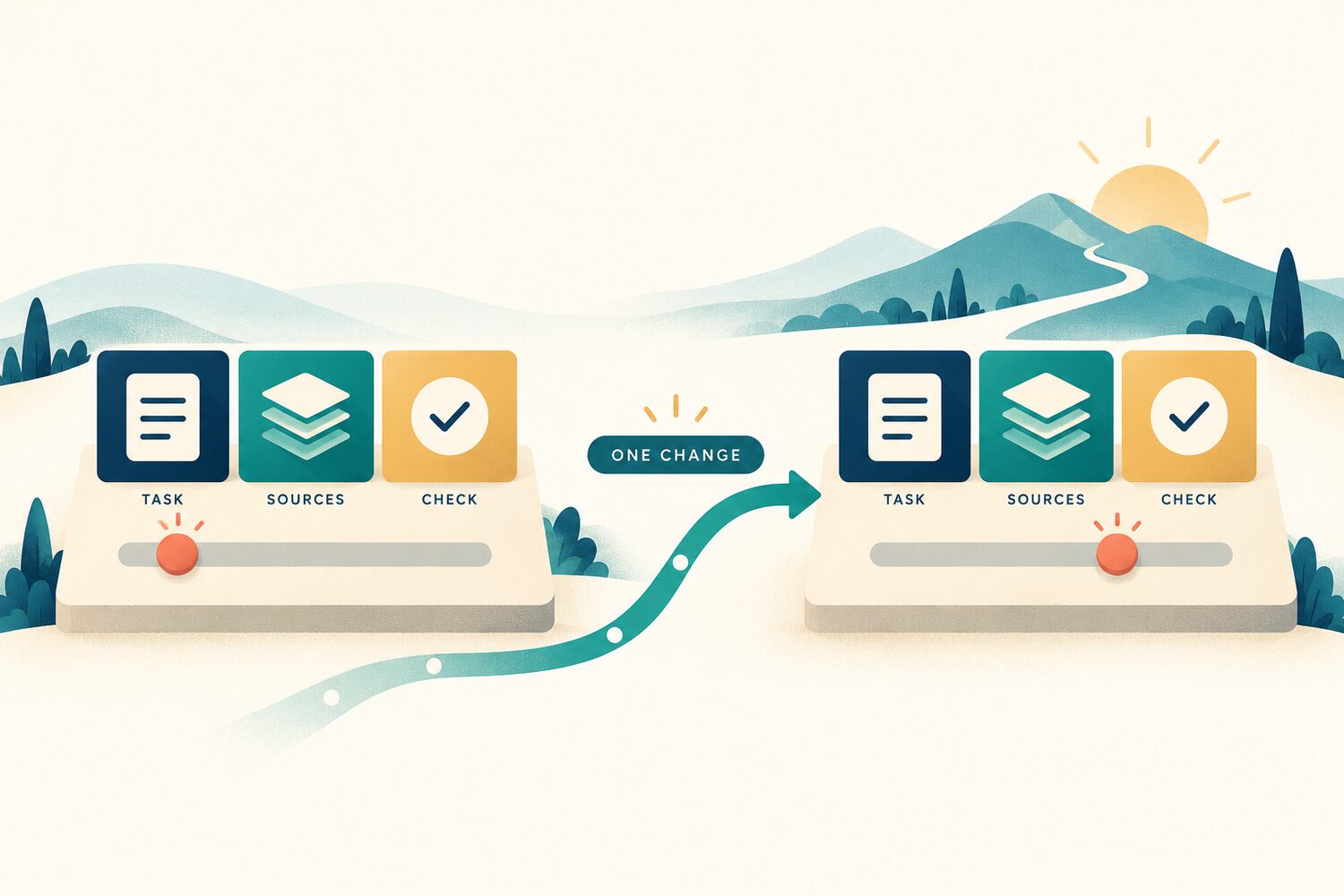
An AI Mission Should Change One Constraint at a Time
Keep the task, source pack and acceptance check stable. Change one condition so learners and coaches can see which AI skill improved.
AI Training for Employees: Reset Skills After a Role Change
A completed course does not prove readiness for new tasks, data or authority. Use a narrow role-change reset to collect fresh evidence without restarting every course.