Corporate AI Training Must Include Contractors Who Use Your AI
Build corporate AI training around everyone who uses an AI system on the organisation’s behalf—not only people on the employee list.
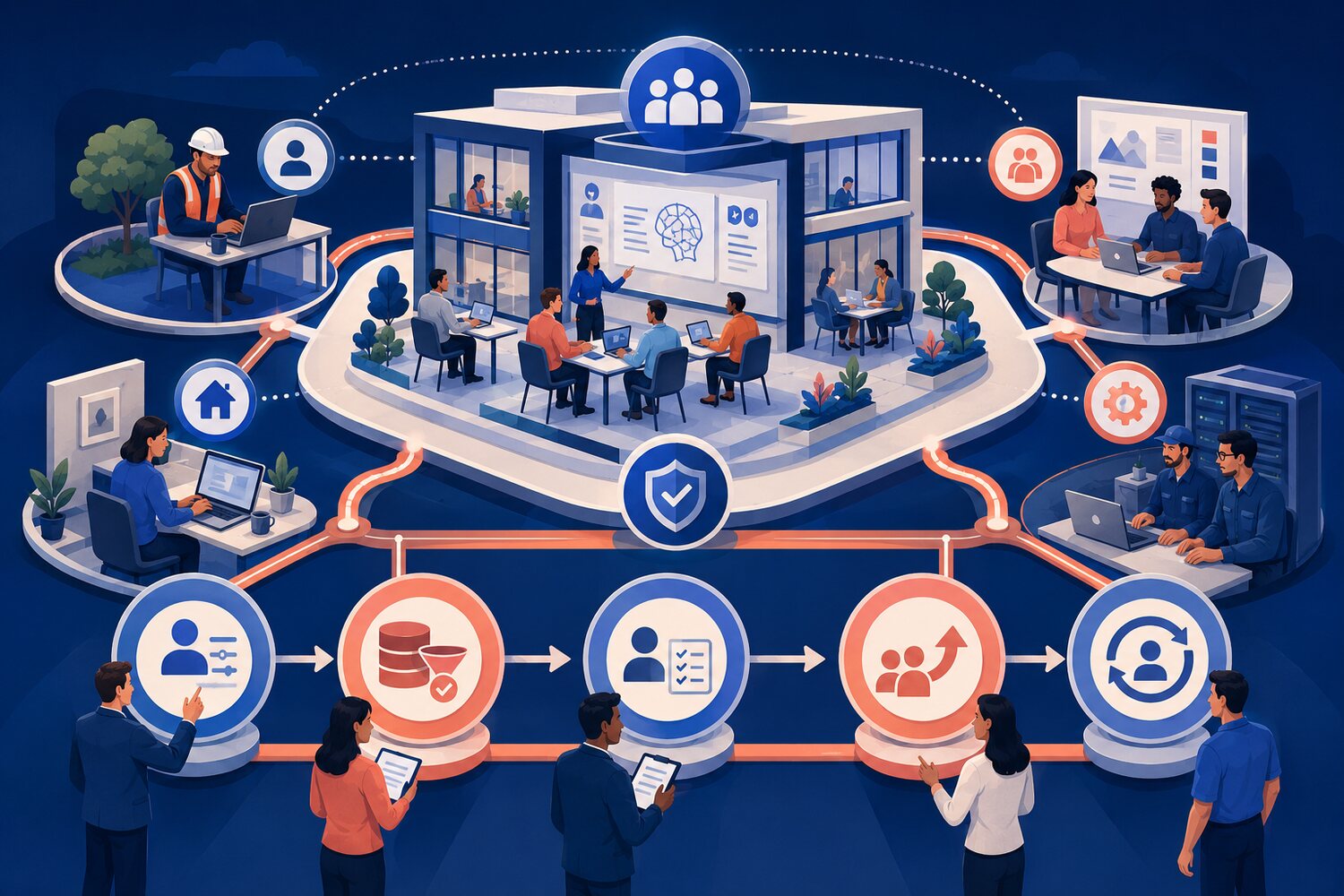
Corporate AI training often stops at the employee directory. That boundary is too narrow when contractors, agencies or service providers operate AI systems on the organisation’s behalf. The practical question is not only “Who is on payroll?” It is “Who can use this system, enter organisational data, influence an output or affect a customer, worker or decision?” A useful programme follows that work boundary and gives each external actor the context, controls and escalation route they need.
Why corporate AI training needs a work boundary
The European Commission’s current AI-literacy Q&A says Article 4 continues to require measures that support AI literacy for staff and other people who operate or use AI systems on behalf of providers or deployers. It explicitly gives contractors, service providers and clients as possible examples. The amended rule does not mandate a particular individual level, and the right measure depends on knowledge, experience, training and the context of use. That makes a generic annual course a weak boundary test.
This is not just a compliance question. A contractor can choose a model, paste sensitive material, accept an output, write a customer-facing claim or pass an AI-assisted decision back to your team. NIST’s Generative AI Profile and AI RMF Playbook both treat third-party personnel and services as part of the risk picture. Training should therefore connect access to a named task, clear data limits, human review and a way to stop or report problems.
The five-part contractor learning brief
Actor and system
Name the external organisation, the people or roles with access, the approved AI system and the accountable internal owner.
Task and affected people
Describe the exact work use, the decisions it may influence and who could be affected. Do not authorise “general productivity” when the real work is specific.
Data and tool limits
State what may be entered, what is prohibited, which accounts or models are approved, and how outputs and prompts are retained.
Review and escalation
Define the human check, evidence required, stop conditions, incident route and who can approve exceptions.
Refresh and exit
Set triggers for retraining, access review and removal: system changes, task changes, observed errors, policy updates and contract end.
Worked example: an external agency drafting campaign copy
A marketing agency is asked to draft product campaign copy with an approved generative AI tool. The learning brief names the agency account and the internal campaign owner. It permits public product information and an approved claims sheet, but prohibits customer data, unpublished prices and confidential research. The agency must preserve the source behind each factual claim, use the company’s claims register and route health, safety or performance claims to a named reviewer.
The agency does not need the same curriculum as an HR analyst or software engineer. It needs a short foundation on the organisation’s AI rules, a task rehearsal using safe sample content, a review of one fresh draft and a clear escalation route. When the campaign, model or approved claims change, the brief triggers a refresh. When the contract ends, the owner removes access and records the hand-off.
Reading is a start. Practice makes it stick.
Start learning| Employee programme only | Work-boundary programme | |
|---|---|---|
| Who is mapped | People in the HR system | Employees plus external actors using AI on the organisation’s behalf |
| Learning input | One generic policy course | Shared rules plus task, system, data and role context |
| Evidence | Completion record | Completion plus observed task rehearsal or reviewed work sample |
| Change trigger | Annual renewal | System, task, policy, error or access change |
| Exit | Handled through employment process | Named owner removes project, tool and data access when work ends |
Run a ten-minute external-use scan
- Choose one agency, contractor or service provider that touches an AI-assisted workflow.
- Write the exact system, task and organisational data they can access.
- Name the person who reviews the output and the event that must stop the work.
- Check whether the contract, access record and learning record tell the same story.
- Create one missing action with an owner and date.
Checklist before an external actor gets access
Contractor AI training gate
- An internal owner accepts accountability for the use.
- The authorised system and task are named.
- Data rules use concrete examples from the work.
- The external actor practises with a safe sample before live work.
- A reviewer can inspect the output and its evidence.
- Stop conditions and the reporting route are understood.
- Training refresh triggers are recorded.
- Access removal and work-product hand-off are part of exit.
Connect the boundary to the rest of the programme
Do not build a separate learning universe for every supplier. Reuse the organisation’s shared foundation, then add the minimum context needed for the external task. Bokili’s risk-based AI literacy approach, AI training for HR workflows, platform pre-launch checklist and marketing claims register provide useful adjacent controls. The Bokili programme for HR and L&D can support a shared practice layer while owners keep task and access decisions local.
The outcome is a cleaner corporate AI training boundary: everyone who can materially shape AI-assisted work receives the right preparation, and nobody receives broad access simply because their organisation passed a generic course. Start with one external workflow, test the five-part brief, and use what you learn to map the next one.
Sources
- AI Literacy — Questions & Answers — European Commission
- Artificial Intelligence Risk Management Framework: Generative Artificial Intelligence Profile — NIST
- AI RMF Playbook — Govern — NIST AI Resource Center
- Bokili — AI fluency training for companies and teams — Bokili
Reading is a start. Practice makes it stick.
Bokili turns skills like this into ten-minute missions for your whole team, with instant feedback and progress you can see.
Start learningKeep reading

Corporate AI Training: Test for Obsolete Habits
Corporate AI training should test which old habit survives a tool, policy or workflow change—then practise the replacement on a fresh case.

AI Often Reveals the Broken Workflow Before It Improves It
An AI pilot can expose missing sources, rules, owners and skills before it creates speed. Diagnose the gap before prescribing more training.

AI Skills for Employees: Build a Prerequisite Ladder
Build AI skills for employees in the right order: frame the task, set boundaries, check the result and decide what happens next.