
AI Skills for Employees: Budget the Review Work
AI skills for employees should include the work that happens after generation: choosing the right review path, attaching evidence and knowing when specialist approval is required.
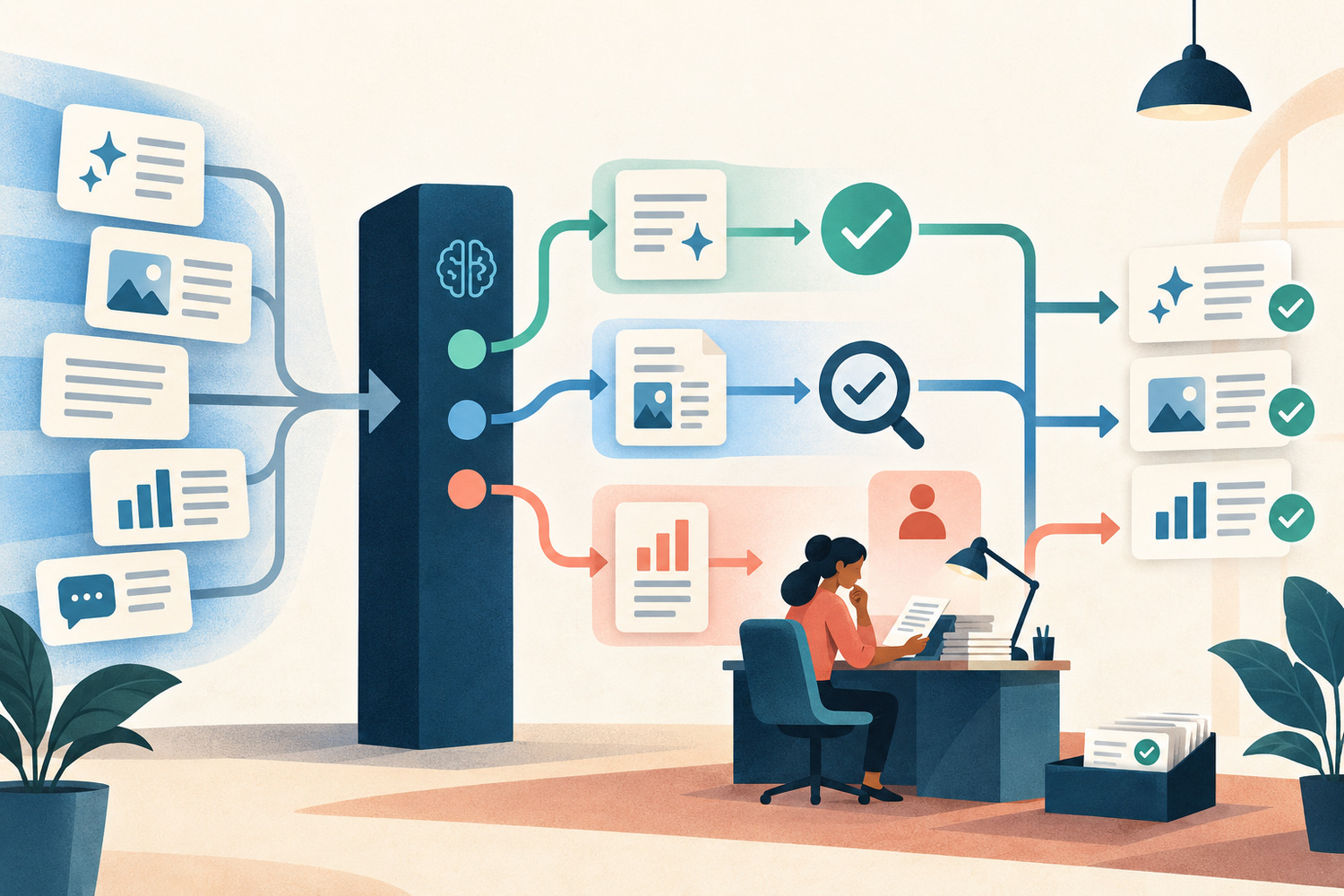
AI skills for employees are often taught as creation skills: write the prompt, improve the draft and save time. But every new draft can create downstream work. Someone must check the evidence, notice omissions, judge the consequence of an error and decide whether the output can move forward. If training increases generation without planning that review, the organisation may simply move the bottleneck.
The practical response is to budget review before launching the training. For each workflow, define the lightest check that is still adequate, the person with authority to perform it and the evidence the maker must attach. Then train employees to prepare reviewable work—not just fluent output.
AI skills for employees must include review routing
Not every output needs the same review. A low-stakes brainstorm may need a quick sense check. A summary used to make a decision may need line-by-line source tracing. Work that affects employment, customers, money, safety or a public commitment may need a qualified specialist or may be unsuitable for the tool. Treating every task as “human reviewed” hides these differences.
NIST’s AI Risk Management Framework says organisations should define and assess human-oversight processes, document how outputs will be used and consider costs connected to AI errors. The European Commission’s current AI-literacy Q&A similarly says skills should fit the system, context and risk; it also separates employee skills from the skills needed by the human in the loop. These sources do not prescribe a review budget. They support the underlying design choice: oversight must be specific enough to operate.
CLEAR: set the review budget before training
C — Consequence
Name what could change if the output is wrong or incomplete. Use the real decision, audience and reversibility—not the polish of the draft.
L — Lineage
Specify the evidence that must travel with the output: source passages, assumptions, exceptions, input version or calculation notes.
E — Expertise
Identify who is qualified and authorised to approve the work. A colleague with time is not automatically the right reviewer.
A — Available capacity
Check whether the reviewer can absorb the expected flow. If not, narrow the use case, improve the hand-off or stop scaling it.
R — Route
Write one path: accept, return for correction, escalate or do not use AI. Make the maker responsible for preparing that route.
Worked example: supplier summaries create a review queue
A fictional procurement team wants twelve buyers to use AI for supplier summaries. Training focuses on faster first drafts. Each buyer sends a polished page to one compliance reviewer, but the page does not identify source passages or separate exceptions from recommendations. The reviewer must reconstruct the evidence, so the queue grows even when drafting time falls.
Reading is a start. Practice makes it stick.
Start learning| Before the review budget | After CLEAR | |
|---|---|---|
| Output | A fluent supplier summary | Summary plus source passages, assumptions and exceptions |
| Review rule | A person checks it | Source check for factual sections; specialist approval for compliance claims |
| Maker skill | Generate and edit | Prepare evidence, flag uncertainty and route the decision |
| Capacity decision | Train all buyers immediately | Pilot with two buyers, measure returns and expand only if the reviewer can sustain the flow |
The team does not solve this by telling the reviewer to work faster. It changes the employee skill standard. A submitted summary is incomplete unless it carries evidence and flags every unresolved exception. Two buyers practise on fictional proposals, receive feedback and retry. The reviewer records accept, return or escalate and the reason. The pilot expands only when the return causes and queue are understood.
Build one reviewable practice task
- 1
Choose one workflow
Use a frequent, bounded task with an identifiable reviewer and approved inputs.
- 2
Write the consequence
State what a wrong or missing claim could change and whether the effect is reversible.
- 3
Publish the evidence packet
Tell the learner which sources, assumptions, exceptions and versions must travel with the output.
- 4
Rehearse the route
Require accept, return, escalate or no-AI decisions; include at least one plausible output that should not pass.
- 5
Measure the queue
Track why work returns and whether review capacity remains adequate. Do not count faster drafts as success by themselves.
Connect maker training to reviewer capacity
The enterprise reviewer-track guide explains how reviewers can practise requirements, audit trails, counter-checks and escalation. The workflow-constraint method helps identify whether review is actually limiting safe completion. The omission-check guide provides one concrete behaviour for source-based summaries. Together, they turn “use human oversight” into tasks that both makers and reviewers can rehearse.
This article’s focus is narrower: decide how much review the organisation can support before training creates more items for that route. Bokili’s HR and L&D approach can then connect role-adapted practice, feedback and visible skill progress to those chosen workflows.
- Choose one AI-assisted output your team creates or plans to create.
- Name the consequence of a material error or omission.
- Write the minimum evidence packet the maker must attach.
- Name the qualified approver and the four possible routes: accept, return, escalate or no AI.
- List the most common reason the work would return.
- Decide whether to narrow, pilot or pause the workflow if the reviewer cannot sustain the expected flow.
Do not train a queue into existence
The useful unit of AI capability is not the number of drafts produced. It is the amount of work that reaches an acceptable decision with evidence, clear ownership and a review path the organisation can sustain. Budget that path first. Then teach employees the generation, checking and hand-off behaviours that make it work.
Sources
- NIST AI Risk Management Framework Core — National Institute of Standards and Technology
- AI Literacy Questions & Answers — European Commission
- Planning & Evaluating Training — U.S. Office of Personnel Management
- Bokili for Leaders — Bokili
Reading is a start. Practice makes it stick.
Bokili turns skills like this into ten-minute missions for your whole team, with instant feedback and progress you can see.
Start learningKeep reading

A Ten-Minute AI Mission Should Leave a Reusable Work Artefact
Short AI practice becomes more useful when the learner leaves with a checked prompt pattern, workflow card or decision aid that can support the next real task.

Corporate AI Training After an Incident: Rehearse the Failed Decision
Corporate AI training after an incident should rehearse the human decision that failed, test a fresh case and update the workflow—not stop at a reminder.

Before AI Ranks People, Test Whether the Order Is Stable
A neat AI ranking can hide a fragile order. Change only irrelevant presentation details, repeat the task and stop if the result moves.