

End Every AI Pilot With a Scale, Hold or Stop Decision
Close every AI pilot with evidence, a named owner and an explicit decision to scale, hold or stop—plus a safe handover or exit path.
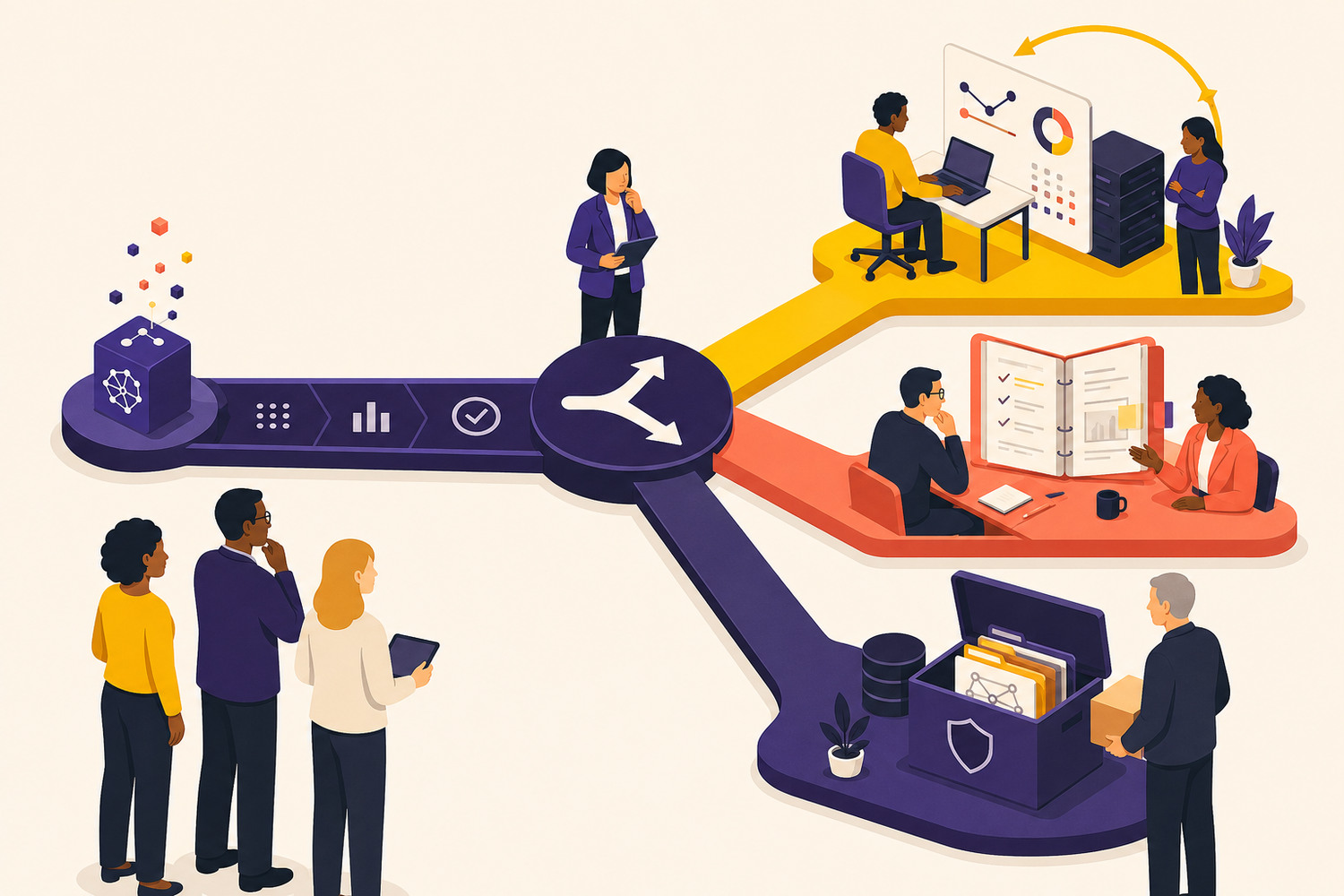
An AI pilot should not drift into production because people liked the demo, nor remain alive because nobody wants to declare it finished. Its last deliverable is a decision: scale, hold or stop. That decision needs evidence about the work, a named owner and a controlled next step. Without those, a promising test becomes an unmanaged service—or a forgotten experiment that still consumes accounts, data and attention.
The business rule
Set the decision date, evidence owner and three possible outcomes before the first pilot task begins.
Why a pilot needs an ending by design
A pilot answers a bounded question. Can this AI-assisted workflow improve one outcome under stated conditions? It does not prove that the workflow will remain useful, safe or affordable after the team, data or volume changes. NIST’s AI RMF Playbook recommends regularly weighing benefits against risks, documenting performance and monitoring systems throughout their lifecycle. It also treats safe decommissioning as a governance process, not a casual deletion.
The implication for business leaders is practical: treat closure as part of the pilot budget. Someone must prepare the evidence pack, identify dependencies, decide what happens to data and access, and explain the outcome to users. This is different from a workflow stop rule, which governs individual cases. The pilot decision governs the future of the whole operating arrangement.
Use one gate for scale, hold or stop
The CLOSE decision gate
C — Claim
Restate the business claim the pilot was meant to test. Name the outcome, users, task boundary and period. Do not replace it with a new claim after seeing the results.
L — Learning evidence
Bring the baseline, reviewed work samples, errors, corrections, user feedback and transfer test. Separate observed evidence from forecasts and enthusiasm.
O — Operating load
Estimate the continuing work: human review, exception handling, source maintenance, access administration, model changes, training refresh and incident response.
S — Safeguards
Check that data boundaries, human decisions, monitoring, escalation and accountability still fit the intended scale and affected people.
E — Exit path
Choose scale, hold or stop. Record the owner, date, conditions and actions for handover, review or decommissioning.
Make the three outcomes genuinely different
| Scale | Hold | Stop | |
|---|---|---|---|
| Evidence | The claim is supported in realistic work and the result transfers beyond the coached example. | The evidence is incomplete, mixed or dependent on a condition that can be tested. | The claim failed, the costs outweigh the benefit or the risk cannot be reduced acceptably. |
| Next move | Move into a named production service with monitoring, training and support. | Pause expansion. Run one targeted test by a fixed date; do not quietly continue as normal. | Remove access or automation, preserve required records, manage dependencies and communicate the replacement process. |
| Owner | An operational owner accepts performance, exceptions and change control. | A pilot owner accepts the next question, deadline and decision meeting. | A decommissioning owner confirms closure, retention, migration and user communication. |
“Hold” is not a softer word for “keep going.” It is a time-limited decision to answer one material question. For example, a customer-service pilot may draft accurate replies in a small team but fail during peak volume because review queues grow. Hold the rollout, test the queue at realistic volume and return to the gate on a named date. If there is no next question or deadline, the honest outcome is stop.
Reading is a start. Practice makes it stick.
Start learningWorked example: the service-reply pilot
A six-week pilot drafts replies from an approved knowledge base. Compared with the baseline, reviewers find fewer missing policy references and modestly faster first drafts. But one in five replies needs substantial rewriting when the customer describes an unusual case. The team has also not assigned anyone to maintain the source pack when policies change.
The decision is hold, not scale. The business claim is partly supported, but the operating load and ownership are unresolved. The next test uses 30 exception cases, records review time and requires the service-knowledge owner to define a source-update process. The group will decide again in two weeks. Existing pilot access remains limited; no extra team is added.
Close safely when the answer is stop
Stopping can be a sign of good management. NIST’s governance guidance notes that indiscriminate termination can create risk when systems have dependencies, retention duties or relevance to later investigations. A deliberate close should identify active users, integrations, stored inputs and outputs, records that must be retained, replacement steps and the person who confirms completion.
Pilot closure checklist
- Record the original claim, evidence, decision and approver.
- Remove or reduce accounts, API keys, automations and shared prompts that are no longer authorised.
- Preserve or delete data and records according to policy and legal requirements.
- Map dependent workflows and give users a replacement way to complete the task.
- Capture one reusable lesson for the next pilot without turning a failed test into a success story.
- Set the monitoring owner and review date for any workflow that scales.
A ten-minute decision preparation
- Write the pilot’s original claim in one sentence.
- List three pieces of observed evidence and one important unknown.
- Name the recurring operating load that a rollout would create.
- Circle scale, hold or stop. Add one owner and one date.
- Write the first action required tomorrow if that decision is approved.
A useful pilot does more than generate a result. It makes a better next decision possible. The discipline is simple: ask a bounded question, collect evidence, account for the operating load and close with an explicit path. That protects scarce attention and keeps adoption tied to work that remains worth owning.
Continue the learning
Use Bokili for leaders to connect AI practice with business decisions. Then compare Enterprise AI Training: Pilot Three Workflows Before You Scale, The AI Rework Ratio and Give Every AI Workflow a Stop Rule.
Sources
- AI RMF Playbook — Manage — NIST
- AI RMF Playbook — Govern — NIST
- AI RMF Core — NIST
Reading is a start. Practice makes it stick.
Bokili turns skills like this into ten-minute missions for your whole team, with instant feedback and progress you can see.
Start learningKeep reading

AI Training for Employees: Reset Skills After a Role Change
A completed course does not prove readiness for new tasks, data or authority. Use a narrow role-change reset to collect fresh evidence without restarting every course.
Report an AI Failure So Someone Else Can Reproduce It
“The AI got it wrong” is not a usable report. Capture five safe fields before changing the session so another person can reproduce, contain and learn from the failure.
AI Literacy Training for Business: Agreement Is Not Evidence
AI literacy training for business should teach people to trace claim origins, distinguish repeated answers from independent evidence, and match checks to consequences.