AI Literacy Training for Business: Agreement Is Not Evidence
AI literacy training for business should teach people to trace claim origins, distinguish repeated answers from independent evidence, and match checks to consequences.
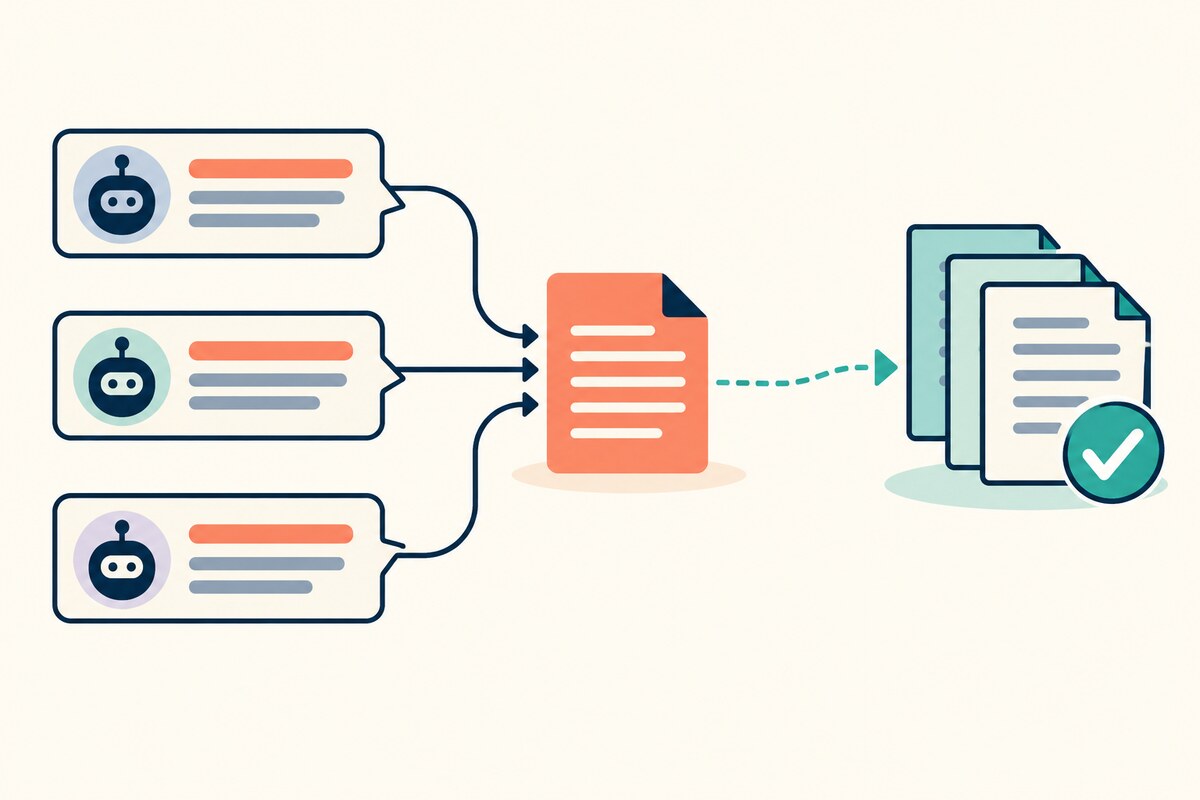
AI literacy training for business should teach a simple distinction: several matching AI answers are not several independent pieces of evidence. Models may reproduce the same widely repeated claim, cite the same article, or echo language that ultimately comes from one vendor page. Counting answers creates confidence without adding a new source.
The practical skill is source independence. Learners should trace where a claim came from, decide whether a second source has a genuinely different origin, and match the strength of verification to the consequence of being wrong. This turns “check the answer” into a visible workplace method.
Why agreement is a weak stopping rule
Three tools can agree because they were prompted with the same assumptions, rely on overlapping public material, or point to pages that copy one another. Agreement can still be useful as a clue: it tells you the claim is common. It does not tell you that the claim is current, complete, independent, or fit for your decision.
NIST’s Generative AI Profile treats confabulation and information integrity as risks to manage. NIST’s Measure Playbook asks organisations to use deployment-context evaluations and, where appropriate, independent assessors. The UK Government Data Quality Framework similarly stresses documenting data strengths, weaknesses, and known quality issues. Together, these ideas support a concrete lesson: inspect evidence lineage, not just surface consistency.
An evidence-independence ladder for AI literacy training
Four rungs from agreement to evidence
Repeated answer
Another AI gives the same claim. This is a repetition signal, not independent verification.
Cited answer
The output names a source. Open it and confirm that it actually supports the precise claim.
Independent source
A separately found source with a different origin supports the claim. Check whether both sources still depend on one press release, dataset, or vendor.
Authoritative evidence in context
A primary record, regulator, standard, official dataset, or other accountable authority supports the claim, including date, scope, and limitations.
Worked example: three recommendations, one origin
A procurement learner asks three AI assistants whether a training vendor has “the highest completion rate in Europe.” All three say yes. One links to the vendor’s blog. A second cites a comparison page that quotes the blog. The third gives no citation but uses the same percentage. The apparent three-way agreement resolves to one promotional claim.
The learner now applies the ladder. First, they open every cited page and record the original publisher, date, population, and measurement method. Next, they search separately for an audited report, customer-level evidence, or an official dataset. None supports a Europe-wide comparison. The correct conclusion is not that the vendor performs poorly. It is that the ranking claim remains unverified and should not carry the procurement decision.
Reading is a start. Practice makes it stick.
Start learning| Apparent corroboration | Independent verification | |
|---|---|---|
| Count | Number of agreeing answers | Number of genuinely separate evidence origins |
| Question | Do the outputs sound alike? | Do the sources arise independently and support the exact claim? |
| Context | Often omitted or compressed | Date, scope, method, limitations, and accountable publisher recorded |
| Decision | Confidence rises automatically | Verification effort rises with the consequence of error |
Teach the method on a real role task
The UK’s employer guide to AI upskilling recommends linking learning to real tasks, building judgement, and adapting practice to roles rather than teaching only tool features. That matters here. A marketer might trace a performance statistic, HR might verify a legal or policy claim, and procurement might test a vendor comparison. The ladder stays the same while the evidence standard changes with the decision.
Build an evidence-independence exercise
- 1
Choose one consequential claim
Use a realistic statement from a proposal, policy summary, research brief, or vendor comparison.
- 2
Collect three AI answers
Ask separate tools or sessions, but do not treat agreement as the result.
- 3
Trace every origin
Open citations and follow copied claims back to the earliest identifiable source.
- 4
Find a separate route
Search an official register, primary study, regulator, standard, or accountable dataset without reusing the AI wording.
- 5
Write the evidence verdict
Label the claim supported, partly supported, contradicted, outdated, or unverified, with the consequence of uncertainty.
Use a stopping rule, not endless research
Independent checking does not mean verifying every sentence forever. Match effort to consequence. A low-stakes draft may need one opened source. A hiring, safety, financial, or public claim may require primary evidence and a named reviewer. Stop when the evidence standard for the decision is met—or when the remaining uncertainty is clearly stated and accepted by the decision owner.
- Pick one claim from an AI-assisted document your team might act on.
- Ask two more AI tools or sessions for the answer and their sources.
- Draw one arrow from each answer to its earliest identifiable source.
- If the arrows converge, find one source through a separate search route.
- Write a one-sentence verdict that states both support and remaining uncertainty.
Connect evidence literacy to safe practice
Before prompting, audit the input pack so weak source material does not become hidden context. When a conclusion matters, write its reversal test. If recommendations depend on unstated premises, log the assumptions. These are complementary checks: source quality, evidence that could change the answer, and the premises connecting evidence to action.
Bokili turns these checks into short, role-based practice rather than a list of warnings. Its learning features support repeated exercises, progress, and team learning. The aim is not distrust of AI. It is calibrated trust: one claim, visible lineage, an appropriate evidence standard, and a decision that can explain why it proceeded.
Sources
- Artificial Intelligence Risk Management Framework: Generative Artificial Intelligence Profile — NIST
- AI RMF Playbook: Measure — NIST
- The Government Data Quality Framework — UK Government
- AI Skills for Life and Work: Employer Guide — UK Government
- Bokili Features — Bokili
Reading is a start. Practice makes it stick.
Bokili turns skills like this into ten-minute missions for your whole team, with instant feedback and progress you can see.
Start learningKeep reading

Use an Error-Cost Matrix Before You Set an AI Threshold
One accuracy score can hide two unequal mistakes. Price false accepts and false rejects separately before you choose an AI threshold or review route.

Corporate AI Training: Test for Obsolete Habits
Corporate AI training should test which old habit survives a tool, policy or workflow change—then practise the replacement on a fresh case.

AI Often Reveals the Broken Workflow Before It Improves It
An AI pilot can expose missing sources, rules, owners and skills before it creates speed. Diagnose the gap before prescribing more training.