
Personalised AI Missions Need a Fixed Evidence Bar
Adapt the role, tool and starting support—but keep one visible evidence standard so personalised AI practice still proves the same skill.
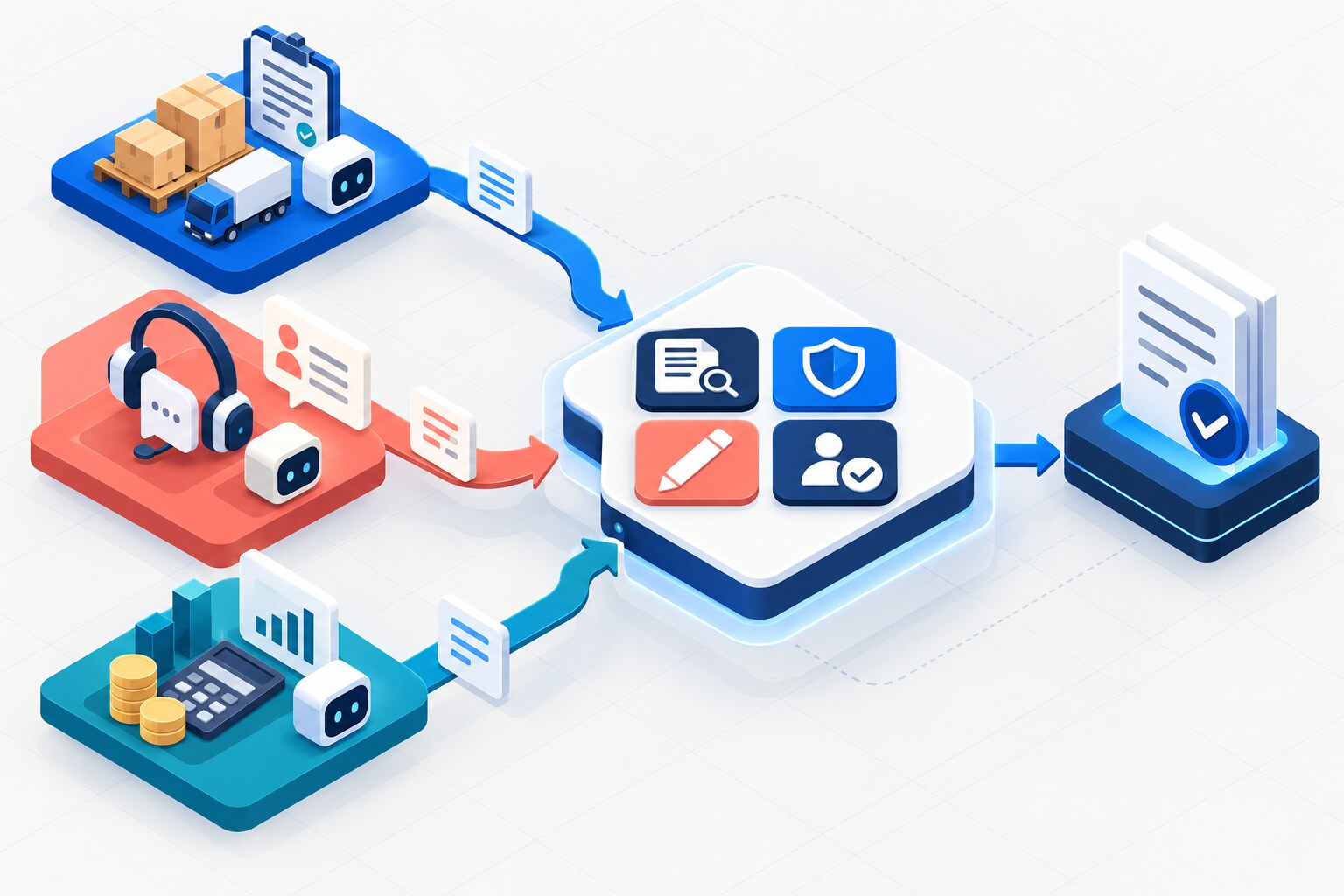
Personalised AI training can become inconsistent by accident. A procurement learner receives a supplier case, a support colleague receives a customer case and a finance learner receives a variance case. The surface details change, but so do the success criteria. One person is rewarded for fluent writing, another for source checking and a third for speed. The programme looks tailored; the evidence no longer means the same thing.
A better Bokili mission design separates what should adapt from what should stay fixed. Adapt the role, tool, starting support and decision context. Keep one evidence bar for the target behaviour. Personalisation should help each learner reach the skill from a relevant starting point, not create three different definitions of competence.
The design rule
Change the practice context. Keep the evidence required to prove the skill.
Personalisation needs a common reference point
Bokili publicly describes short missions adapted to a learner’s role, level and available AI tools. That is useful because the European Commission’s AI-literacy guidance says organisations should consider people’s knowledge, experience, training and the context in which the AI system is used. The same guidance allows different levels or learning approaches. Context-sensitive learning is not the problem; invisible changes to the evidence bar are.
The US Office of Personnel Management defines a training need as the gap between required and current performance. That definition implies two anchors: required performance must be clear, and the learner’s attempt must be compared with it. If the requirement changes every time the scenario changes, the programme cannot tell whether the learner improved or simply met an easier brief.
| Keep fixed | Adapt | |
|---|---|---|
| Target behaviour | The observable skill being practised | The role task that makes the skill meaningful |
| Evidence | What must be shown to pass | The sources, file types and scenario details |
| Safety | The non-negotiable data and authority boundary | The approved tool and workspace available to the learner |
| Support | The final independent evidence required | Examples, prompts, hints and difficulty at the starting point |
Use the ANCHOR evidence bar
One shared bar for role-adapted missions
A — Artefact
Name the useful result the learner must produce: a checked brief, a corrected draft, a classification or a decision record.
N — Named evidence
Require the source, calculation, policy line or acceptance criterion that supports each material choice.
C — Correction
Make one revision visible. A learner should show what changed after checking the first attempt.
H — Human decision
Require the learner to state what they approve, reject, escalate or leave unresolved.
O — Operating boundary
Keep the same rule for permitted inputs, approved tools and prohibited actions.
R — Repeat
Test the behaviour again on a fresh case so memory of one example is not mistaken for transfer.
ANCHOR is not a universal score for every AI skill. It is a design template for one programme. L&D should choose the observable behaviour and define what each field means before adapting the mission. A source-checking mission might require every material claim to trace to the supplied pack. A privacy mission might require the learner to reject a restricted field before any prompt is written.
Reading is a start. Practice makes it stick.
Start learningWorked example: one skill across three roles
Suppose the target behaviour is separating evidence from inference. The evidence bar is fixed: the learner must produce a short work artefact, label each material statement as supported or inferred, link supported statements to the supplied source, correct one unsupported sentence and name the person who owns the final decision.
Three missions, one standard
- 1
Procurement
Compare three fictional supplier updates and flag an unconfirmed delivery claim. The learner chooses what belongs in the buyer brief.
- 2
Customer support
Turn a fictional case history into an internal escalation note. The learner separates what the customer reported from the likely cause.
- 3
Finance
Explain a fictional budget variance from a small data pack. The learner distinguishes calculated differences from possible explanations.
- 4
Review
Score all three with the same ANCHOR bar. Do not compare writing style across roles; compare whether evidence, correction and human ownership are visible.
The mission cards should not be identical. Procurement may use a comparison table, support may use a case timeline and finance may use a small spreadsheet. A beginner may receive a labelled example while an experienced learner receives fewer hints. Those adaptations reduce irrelevant difficulty. The pass evidence remains comparable because the behaviour has not moved.
Watch for false consistency
Using the same prompt, timer or quiz for everyone can look fair while testing the wrong thing. A screen full of procurement language disadvantages a strong marketer without revealing anything about source checking. The reverse error is over-personalising until every learner has a private rubric. Good consistency sits in the evidence, not in identical surface detail.
Review a personalised mission set
- One observable behaviour is written in the same words for every variant.
- Every variant requires the same category of evidence.
- Role details change the context, not the pass standard.
- Tool-specific steps match what the learner can actually access.
- Hints reflect starting level but are removed before the final proof.
- Safety and decision boundaries do not weaken for familiar roles.
- A reviewer could explain why two different artefacts both pass.
- The next mission follows from the observed gap, not from job title alone.
This method extends Bokili’s existing guidance on role-based AI skills, multilingual training with one shared standard and guided missions that preserve a real decision. Bokili’s public features describe role-adapted missions and visible skill progress; a fixed evidence bar is the design discipline that makes those two ideas work together.
- Choose one behaviour that three roles need, such as checking a material claim.
- Write the artefact, evidence, correction and human decision required to pass.
- Create three one-sentence role scenarios without changing those requirements.
- Mark which tool, support and source pack may vary.
- Ask a reviewer whether the same evidence bar can judge all three attempts.
- Remove any role detail that changes the skill instead of the context.
Personalise the route, not the meaning of ready
Role relevance helps learners recognise the work. Level-appropriate support helps them begin. Tool adaptation keeps instructions usable. None of those choices should make competence impossible to compare. Keep one visible evidence bar, adapt the route to it and let the learner’s attempt reveal the next useful mission. That is how personalisation becomes progression rather than variation for its own sake.
Sources
- Features — AI training for teams — Bokili
- AI training for HR & L&D leaders — Bokili
- AI Literacy — Questions & Answers — European Commission
- Planning & Evaluating — Training Needs Assessment — U.S. Office of Personnel Management
Reading is a start. Practice makes it stick.
Bokili turns skills like this into ten-minute missions for your whole team, with instant feedback and progress you can see.
Start learningKeep reading
AI Training Platform for Companies: Run an Accessibility Rehearsal
Before choosing an AI training platform for companies, test one complete learning journey with keyboard, zoom, screen reader and error recovery.

ChatGPT Training for Employees: Treat Imported Text as Data
Teach employees to keep a stable task when an email, document or webpage contains instructions that the AI should analyse—not follow.
Finish the AI Task: Decide What to Keep, Record or Delete
Responsible AI practice includes a close-out decision for every prompt, source, draft and output—not just a check of the final answer.