

Set Bokili Mission Cadence From the Work, Not the Calendar
Use a four-signal cadence check to place short AI practice near the real task, then adjust the rhythm with feedback.
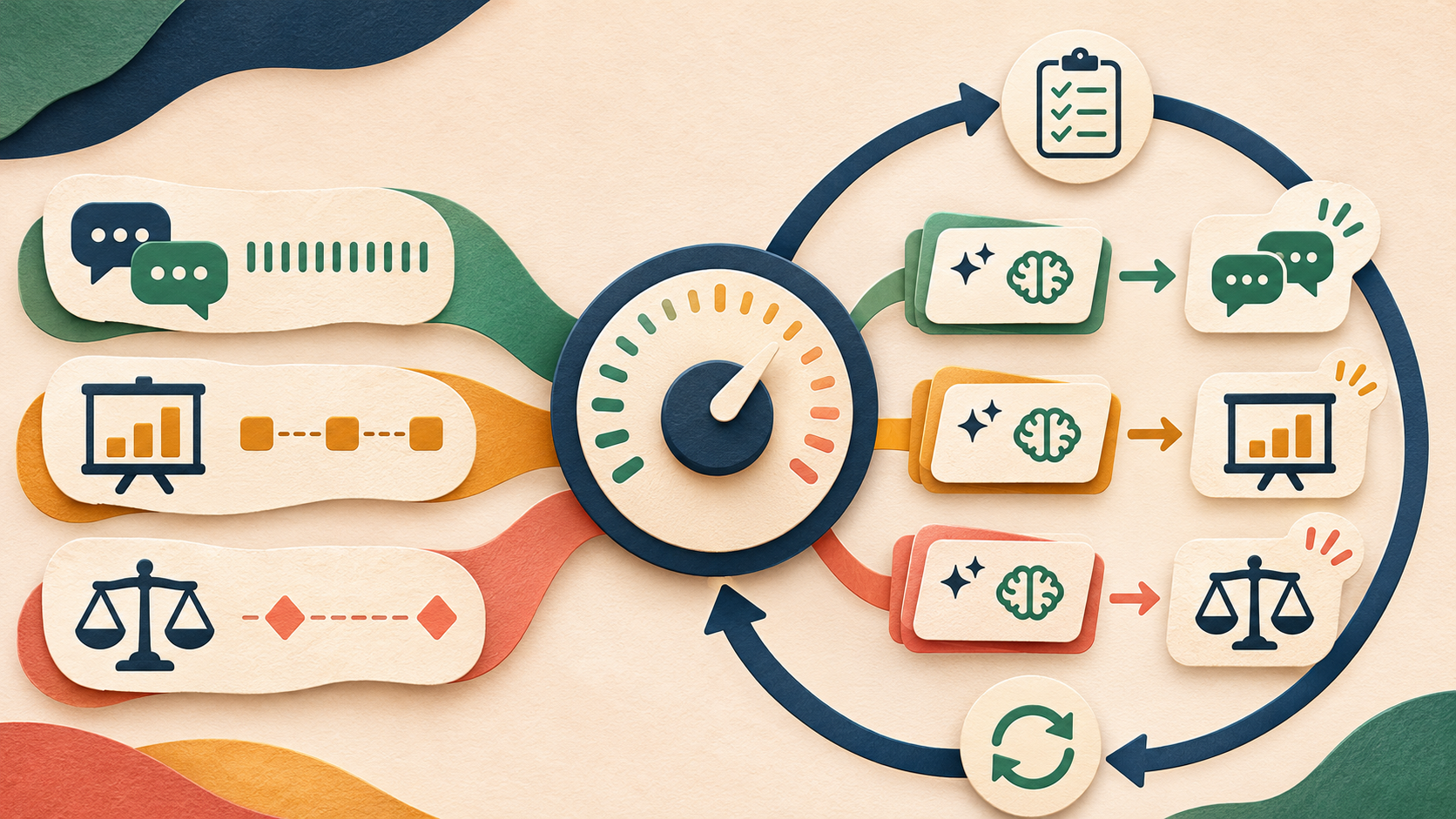
A weekly learning slot sounds tidy. Work is not tidy. Some AI-assisted tasks happen every morning, some arrive at month-end, and others appear only when a policy, tool or customer need changes. If every learner receives the same mission on the same rhythm, practice can land too early to be remembered or too late to help.
Bokili missions are designed as short, practical tasks with guidance and feedback. The scheduling question is therefore not “How many lessons fit in a month?” It is “When will this person next need the skill?” A useful cadence starts with the work pattern, then makes space for practice close enough to the real task that the learner can apply it.
Use PACE to read the work rhythm
The PACE cadence check
Pattern
How often does the task return? Daily work needs a different practice rhythm from quarterly work.
Attention
What happens if the task is done badly? Higher-consequence work deserves rehearsal before the moment of use.
Change
How quickly do the tool, policy or source material change? Fast change shortens the review cycle.
Ease
How much time does a learner need to practise, recover from an error and try again? Protect that space.
PACE is a planning aid, not a scoring system. Its value is the conversation it forces. A frequent, low-consequence task may need one strong mission plus a light follow-up. An occasional, high-consequence task may need a rehearsal before every cycle. A rapidly changing tool may need shorter refreshes even when the underlying job is stable.
| Work signal | Cadence response | Example | |
|---|---|---|---|
| Frequent and stable | Start with one focused mission, then space follow-ups as performance settles. | Drafting customer-support summaries. | |
| Periodic and visible | Place practice shortly before the reporting or planning cycle. | Turning weekly notes into a team update. | |
| Occasional and high consequence | Rehearse before the event and add a short debrief afterwards. | Reviewing a policy-sensitive HR or procurement draft. | |
| Fast-changing tool or rule | Run a short refresh when the change affects the workflow. | A new sharing control or company data rule. |
Plan the next useful practice moment
Start with one role and one recurring task. Ask the role holder when the task appears, what source material they use, where judgement matters and what a safe result looks like. Then place one mission before or near that moment. The UK Skills England employer guide recommends training that links to real tasks, fits existing work, uses short manageable units and creates room for reflection and repeat practice. That evidence supports a work-led cadence rather than a fixed course calendar.
A five-step scheduling cycle
- 1
Name the task
Choose one real decision or output, not a broad topic such as “prompting” or “AI basics”.
- 2
Mark the work moment
Record when the task returns and how much warning the learner has.
- 3
Choose the mission
Match the practice to the role, level, tool and expected output.
- 4
Place the follow-up
Schedule the next touchpoint from PACE: more often for change or risk, less often after stable performance.
- 5
Read the signal
Use completion, feedback and workplace evidence to adjust the next mission instead of defending the original calendar.
Reading is a start. Practice makes it stick.
Start learningDo not mistake frequency for progress
More missions can create more activity without improving work. A strong cadence gives learners enough time to use a skill, notice what changed and return with a better question.
Worked example: three rhythms in one team
Imagine a customer-operations team. Support agents summarise conversations every day. Team leads prepare a weekly quality note. The manager reviews a sensitive escalation process once a quarter. A single Friday lesson is a poor fit for all three.
For agents, begin with a mission on concise, evidence-based summaries, then check the skill after several real uses. For team leads, place a mission one day before the weekly note and ask them to compare the AI draft with their source records. For the manager, rehearse the escalation review shortly before the quarterly cycle and follow it with a debrief on judgement, evidence and any policy changes. The topic can be related, but the timing follows the work.
Cadence quality check
- Each mission names a real task or decision.
- The learner can practise close to the moment of use.
- High-consequence work receives rehearsal and review.
- Changes in tools or policy trigger a refresh.
- The follow-up date can move when feedback changes the need.
- Managers protect enough time for practice and reflection.
Make the cadence visible, then keep it adjustable
HR and L&D leaders still need a plan. Make the plan visible as a set of expected practice moments, not a promise that every person will move at the same speed. Bokili can personalise missions by role, level and tool while the organisation follows participation and progress. That gives administrators a shared view without flattening different jobs into one learning timetable.
A good first version can be small: one team, three tasks and four weeks. Watch where learners complete missions, where work interrupts them and where feedback shows that practice arrived too soon or too late. Keep the useful rhythm, change the weak one and document why.
- Pick one AI-assisted task performed by your team.
- Write how often it occurs and what goes wrong when it is weak.
- Rate its change speed as slow, moderate or fast.
- Choose one mission moment: before, during or just after the real task.
- Set one review date and name the evidence that would make you move it.
The simplest rule is also the most useful: let the work pull learning into place. A calendar should record that decision, not make it for you. For related implementation ideas, see Bokili’s guides on participation friction, busy-day rehearsal and maintaining an AI practice library.
Sources
- AI training for HR & L&D leaders — Bokili
- Employer guide: What works for AI upskilling in the UK — Skills England
Reading is a start. Practice makes it stick.
Bokili turns skills like this into ten-minute missions for your whole team, with instant feedback and progress you can see.
Start learningKeep reading

AI Training for Employees: Pause Before Recording a Meeting
Teach employees a five-part check for purpose, notice, sensitive data, approved tools and downstream use before an AI recorder joins.

Critical Thinking Is Not a Module in AI Training
Make judgement observable by adding one challenge question—and one correction—to every realistic AI practice task.

AI Training for Employees: Add Two New-Hire Checkpoints
Build AI training into onboarding with a safe first-week practice and a fresh transfer check after the new hire learns the workflow.