Blind the Tool Name Before You Review AI Work
A two-pass review lets teams judge AI-assisted work on its evidence first, then restore provenance, permissions and accountability before the final decision.
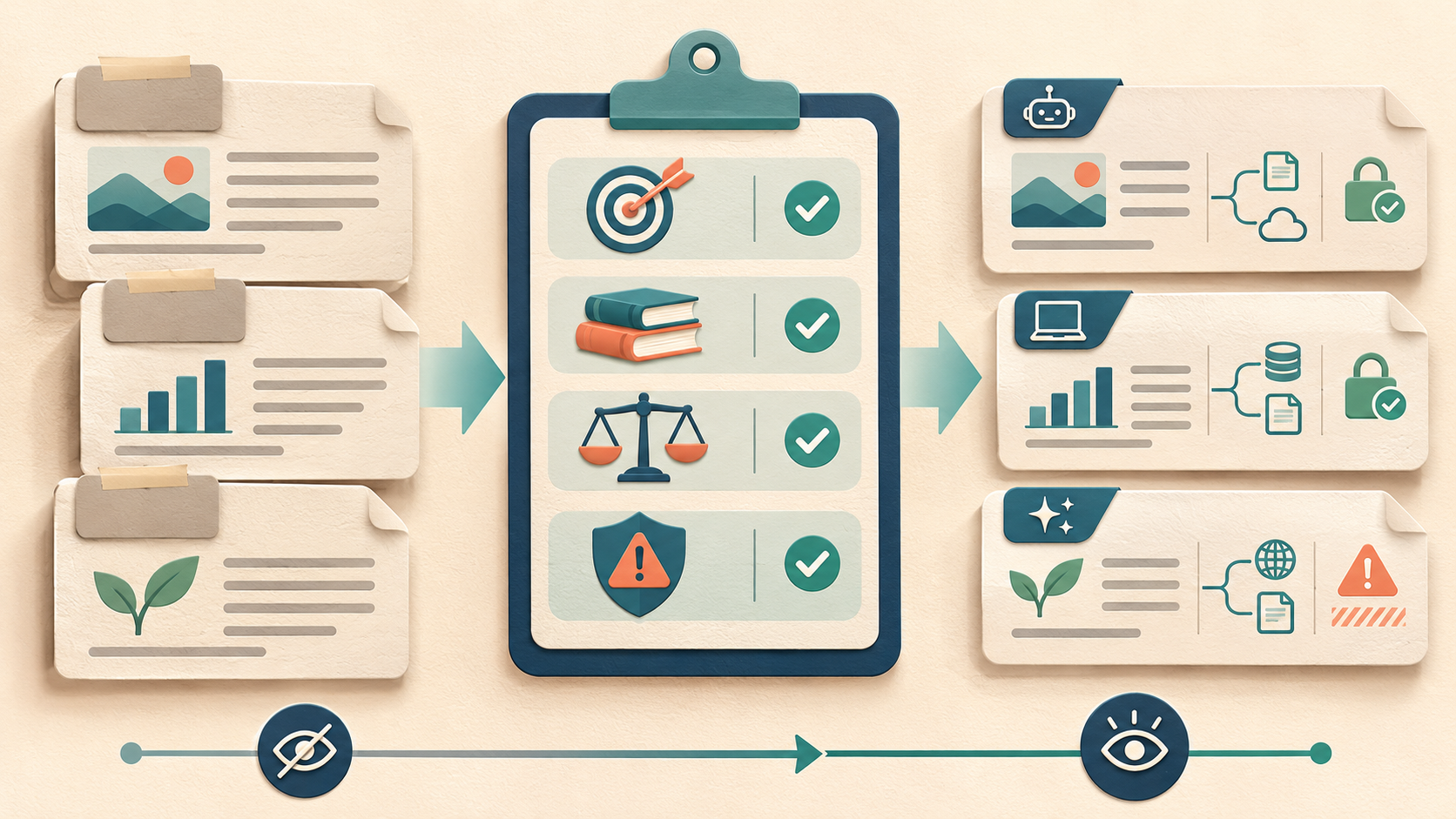
When reviewers can see the tool, model or author behind an AI-assisted document, that label can shape expectations before the work itself is judged. A familiar tool may receive extra trust. An unfamiliar one may face extra suspicion. A blind first pass removes one cue: reviewers score the work against the task, evidence and risk criteria before the source is revealed. A second, unblinded pass then checks provenance, permissions, known tool limits and accountability. The point is not to hide how work was made. It is to separate two questions that teams often blur: “Is this output good enough?” and “Was this process acceptable?”
Use BIND for a two-pass review
The BIND protocol
Blank the source cue
Replace tool, model, vendor and author labels with neutral identifiers. Keep the task brief, approved reference material and decision context visible.
Inspect the work
Score task fit, factual support, completeness, clarity and possible harm with the same rubric for every sample.
Note confidence and disagreement
Record reasons, not just scores. If reviewers differ, preserve both views before discussion so the loudest voice does not erase the evidence.
Disclose and govern
Reveal provenance only after the content score is locked. Then inspect data permissions, tool settings, source traceability, policy fit and the named human owner.
NIST’s AI Risk Management Framework playbook treats human-cognitive bias as part of the AI lifecycle and recommends making implicit decision processes explicit, examining how system output is presented and designing feedback methods that control subjectivity. A 2024 review of 142 healthcare LLM evaluation studies also identified blinding as a method for reducing preconception about the source of a response. That evidence comes from a specialised, high-stakes domain, so it does not prove that every workplace review should be blind. It does show why source labels deserve deliberate treatment when teams compare outputs.
| Blind content pass | Revealed governance pass | |
|---|---|---|
| Main question | Does the work meet the brief? | Was it produced and handled acceptably? |
| Visible information | Task, evidence pack and neutral sample code | Tool, model, prompts, data path and owner |
| Checks | Correctness, relevance, support, omissions and harm | Permissions, provenance, policy, known limits and audit trail |
| Decision | Content score with reasons | Approve, revise, restrict or reject the process |
A worked example: three policy summaries
Imagine an L&D team comparing three summaries of a new travel policy. One was written by a colleague, one by an approved AI tool and one by an external model that should not receive company text. The reviewer sees only Samples A, B and C, the approved policy and a short scoring rubric. Sample B is concise but invents a meal allowance. Sample C is accurate but omits the escalation route. Sample A is complete but hard to scan. The blind pass prevents tool reputation from rescuing the invented claim or punishing the accurate draft. After scores are locked, the source is revealed. Even if Sample C scored well on content, its process fails because the model was not approved for the data.
Reading is a start. Practice makes it stick.
Start learningRun the review without losing accountability
- 1
Prepare equivalent samples
Use the same task, reference pack, audience and output constraints. Remove source cues from filenames, comments and metadata.
- 2
Choose a short rubric
Define observable criteria before anyone sees the samples. Include a stop condition for unsupported claims or unacceptable harm.
- 3
Review independently
Have reviewers score first, then compare. Ask them to cite the exact sentence or missing evidence behind each judgement.
- 4
Freeze the first-pass record
Save scores and rationales before revealing the source. Do not rewrite history after learning which tool produced which sample.
- 5
Unblind and check the process
Confirm approved tools, data handling, provenance, version, human ownership and any domain-specific control.
- 6
Record both outcomes
Keep content quality and process compliance as separate fields. A strong draft can still have an unacceptable process, and a compliant process can still produce weak work.
Know what blinding cannot fix
Blinding does not make a weak rubric fair. It cannot remove clues embedded in writing style, guarantee independent judgement or replace domain expertise. It can also be wrong for a review where provenance must be known immediately, such as an incident response or a legal disclosure. The UK government’s generative AI guidance still expects teams to evaluate outputs with suitable metrics, validate them against ground truth or expert judgement and use human review where failure is costly. Treat the blind pass as a controlled comparison technique, not as permission to forget how the work was created.
Hard gates before you trust the result
- The task and evidence pack are identical for every sample.
- Review criteria were set before source identities were visible.
- At least one criterion tests factual support, not only style.
- Reviewers record reasons and uncertainty alongside scores.
- The source is revealed before the final operational decision.
- The second pass checks permissions, provenance, policy and ownership.
- Both pass records are retained for later audit or learning.
Do not publish a blind score alone
A blind pass can improve a comparison, but the final decision must restore provenance and accountability. Never use anonymity to conceal unapproved tools, restricted data use or unclear ownership.
Connect this method to your existing review controls
Use the blind pass alongside the four editorial review passes at https://bokili.com/en/learn/ai-employees-editors-four-review-passes. Choose the right review instrument with https://bokili.com/en/learn/checklist-rubric-example-ai-review. For high-stakes claims, add the verification workflow at https://bokili.com/en/learn/how-to-verify-ai-output-at-work. These controls answer different questions: setup, scoring and evidence.
- Choose two short outputs created from the same low-risk work brief.
- Remove tool, model and author labels and rename them Sample A and Sample B.
- Score each for task fit, evidence, correctness and risk; write one reason per score.
- Reveal the sources and add a separate check for permission, provenance and ownership.
- Compare what changed after unblinding and keep one rule for your next review.
Sources
- Measure — AI Risk Management Framework Playbook — NIST AI Resource Center
- AI Insights: Generative AI — UK Government
- A framework for human evaluation of large language models in healthcare derived from literature review — npj Digital Medicine / PubMed Central
Reading is a start. Practice makes it stick.
Bokili turns skills like this into ten-minute missions for your whole team, with instant feedback and progress you can see.
Start learningKeep reading
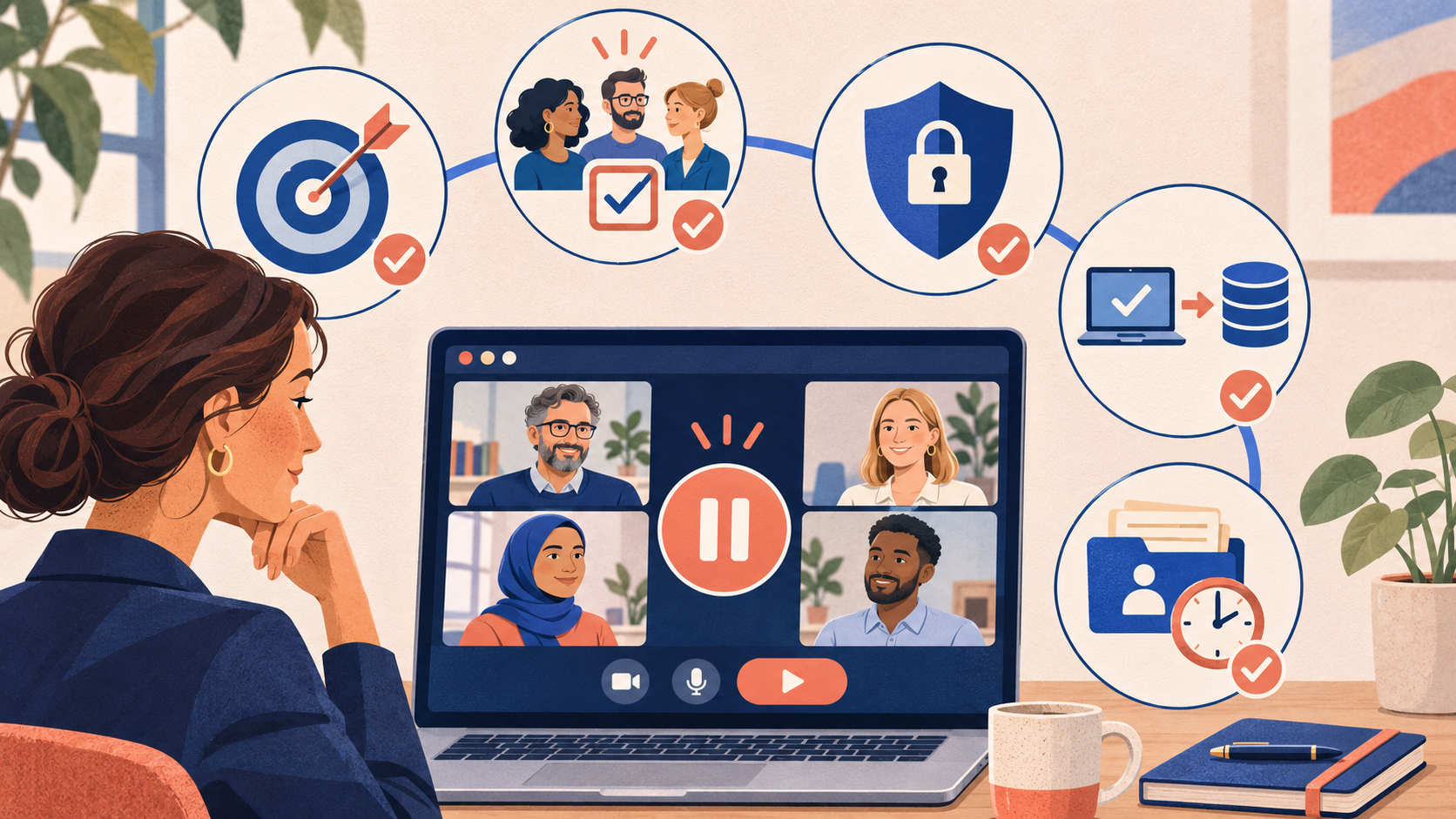
AI Training for Employees: Pause Before Recording a Meeting
Teach employees a five-part check for purpose, notice, sensitive data, approved tools and downstream use before an AI recorder joins.

Critical Thinking Is Not a Module in AI Training
Make judgement observable by adding one challenge question—and one correction—to every realistic AI practice task.
AI Training for Employees: Add Two New-Hire Checkpoints
Build AI training into onboarding with a safe first-week practice and a fresh transfer check after the new hire learns the workflow.