
AI Training Platform or LMS? Choose by the Learning Job
Use four learning jobs to decide whether an AI training platform for companies should replace, sit beside or integrate with your LMS.
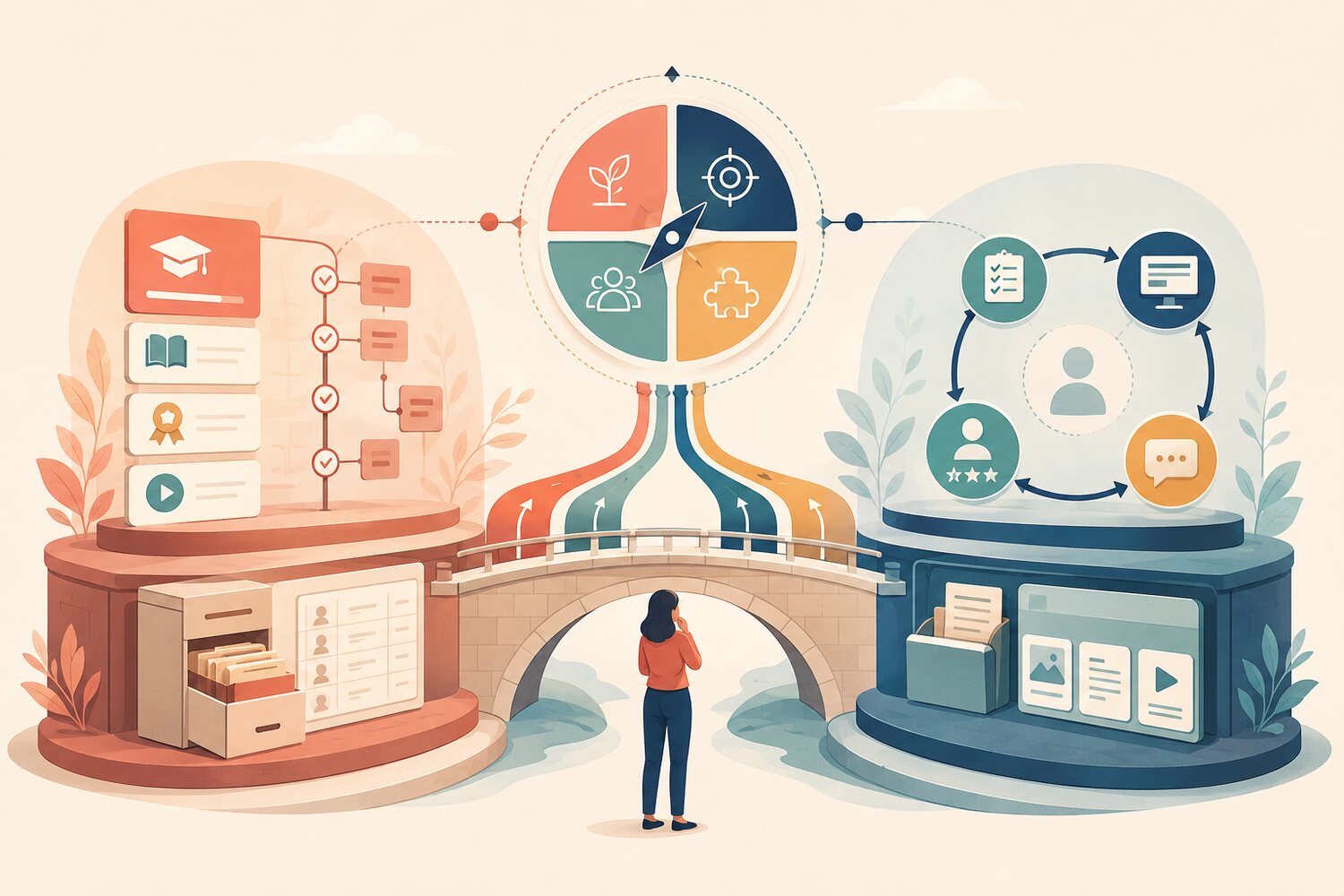
An AI training platform for companies and a learning management system can solve different parts of the same problem. The wrong starting question is “Which category is newer?” The useful question is “Which learning job must this system perform, and what evidence will prove it?”
This comparison is for HR, L&D, IT and transformation leaders deciding whether to use their LMS, add a specialised AI practice platform or connect both. It uses four jobs—coordinate, orient, rehearse and evidence—to prevent a feature list from becoming the architecture.
Start with four learning jobs, not two product labels
The US Office of Personnel Management frames training needs around the gap between required and current performance. The European Commission’s current AI-literacy guidance says actions should reflect people’s knowledge and experience, the AI systems used, their context and risk. Together, those sources support a job-first decision: define the behaviour and operating need before selecting the learning technology.
The CORE learning-architecture test
C — Coordinate
Assign learning, manage access, schedule cohorts and keep the records the organisation must retain.
O — Orient
Give everyone common policy, concepts, tool boundaries and role-specific guidance.
R — Rehearse
Let employees practise realistic AI tasks, receive feedback and retry in a safe setting.
E — Evidence
Show whether a skill appears in a fresh work sample and where the next learning action is needed.
How an AI training platform for companies fits the stack
SAP defines an LMS as software for creating, managing, delivering and tracking training programmes. Modern LMS products can personalise paths, run assessments and support many learning formats, so “LMS means passive library” is an unfair shortcut. A specialised AI practice platform has a narrower centre of gravity: workplace tasks using AI tools, feedback on an attempt, repeated practice and evidence of demonstrated behaviour.
Bokili, for example, publicly describes personalised ten-minute missions adapted to role, level and available AI tools, followed by immediate feedback and progress records. That does not make every LMS unnecessary. It means buyers should test where their current system already performs the CORE jobs and where a dedicated practice layer adds something observable.
| LMS as the main system | AI practice platform | Use both | |
|---|---|---|---|
| Coordinate | Strong when enrolment, compliance records and broad catalogues are central | May manage its own users and learning cadence | Keep the LMS as system of record; launch practice through an integration or clear hand-off |
| Orient | Good for shared policy, onboarding and structured knowledge | Good when orientation is embedded in tool-specific missions | Put stable common guidance in the LMS and apply it in practice missions |
| Rehearse | Works if realistic tasks, feedback and retry are genuinely supported | Usually the specialised job: repeated workplace attempts with feedback | Let the practice layer handle attempts while the LMS points people to it |
| Evidence | Often strong for attendance, completion and assessments; verify work-sample capability | Can focus on submitted work and demonstrated behaviours; verify reporting and governance | Decide which evidence belongs in which system and how managers will act on it |
Reading is a start. Practice makes it stick.
Start learningThe “use both” column is not a compromise by default. It is only justified when each system owns a clear job, employees do not face duplicate sign-ins or records, and managers know which evidence to trust. 1EdTech’s LTI standard shows one established way learning platforms can connect remote tools and content securely, but compatibility must be checked with the actual vendors and environment.
Worked example: one company, two systems
Consider a fictional 180-person consulting firm. Its LMS already handles onboarding, mandatory security training and completion records. The company now wants employees to practise checking AI-generated client summaries against approved source documents. Rebuilding onboarding in a new platform would duplicate the coordinate and orient jobs. Asking the LMS to assess source-tracing behaviour may require a capability it does not provide.
The firm keeps approved-tool rules and mandatory knowledge in the LMS. It adds short practice missions for the review task, with fictional documents, explicit input boundaries, feedback and a second attempt. The LMS records participation through an agreed hand-off; the practice platform retains the detailed work evidence under the company’s governance rules. After four weeks, a fresh sample is reviewed to test transfer.
Five questions before you connect or replace systems
- Which CORE job is currently failing, and what evidence proves the gap?
- Can the existing LMS support realistic AI work attempts, feedback and retry—not only quizzes?
- Which system will be the source of truth for enrolment, completion and demonstrated skills?
- Can employees move between systems without duplicate accounts, confusing records or unsafe data transfer?
- Who reviews the evidence and decides the next learning action?
Use the decision pages in sequence
If you are still comparing providers, start with the corporate AI training buyer scorecard. Once a platform is selected, use the pre-launch checklist. Define the proof with AI training effectiveness and work transfer, and map role needs with the AI skills matrix. These pages answer different decisions; this comparison focuses on system architecture.
- Write the one employee behaviour the programme must change.
- Mark which CORE jobs are needed before, during and after practice.
- Circle the jobs your current LMS can demonstrate today.
- Name the missing job and ask one provider to show it with a fictional task.
- Choose one source of truth for each record or evidence type.
- Write the hand-off employees and managers will follow.
An AI training platform should not win because its label sounds more current, and an LMS should not remain the default simply because it is already installed. Choose the smallest architecture that performs all four learning jobs clearly. Bokili’s company learning approach can then be assessed as a practice layer—or as the primary system for a focused rollout—against the same CORE test.
Sources
- What is a learning management system (LMS)? — SAP
- Learning Tools Interoperability (LTI) — 1EdTech Consortium
- Planning & Evaluating: Training Needs Assessment — U.S. Office of Personnel Management
- AI Literacy — Questions & Answers — European Commission
- Bokili — AI fluency training for companies and teams — Bokili
Reading is a start. Practice makes it stick.
Bokili turns skills like this into ten-minute missions for your whole team, with instant feedback and progress you can see.
Start learningKeep reading
AI Skills for Employees: Build a Prerequisite Ladder
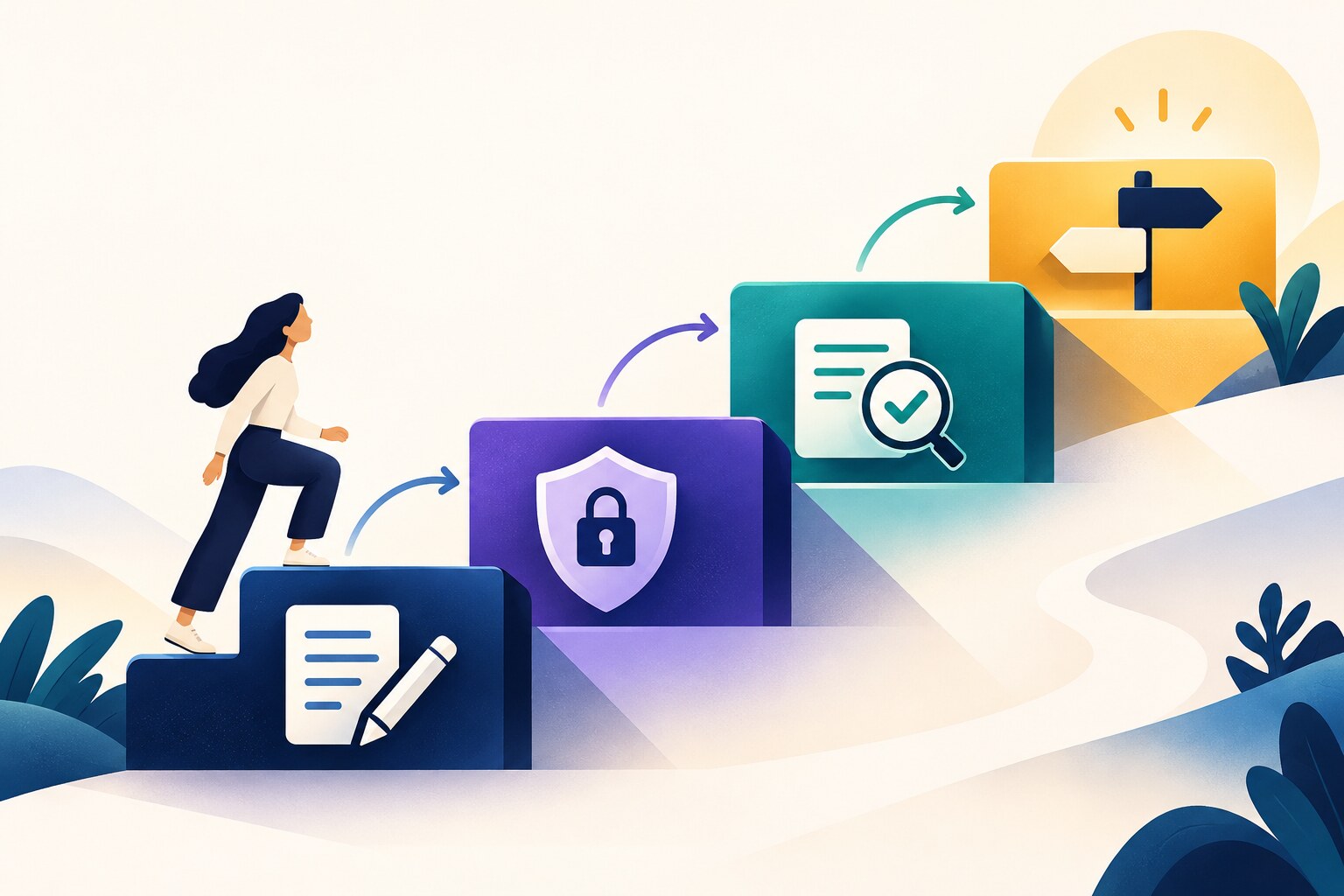
Build AI skills for employees in the right order: frame the task, set boundaries, check the result and decide what happens next.
Use AI to Draft Marketing Claims Without Losing the Evidence
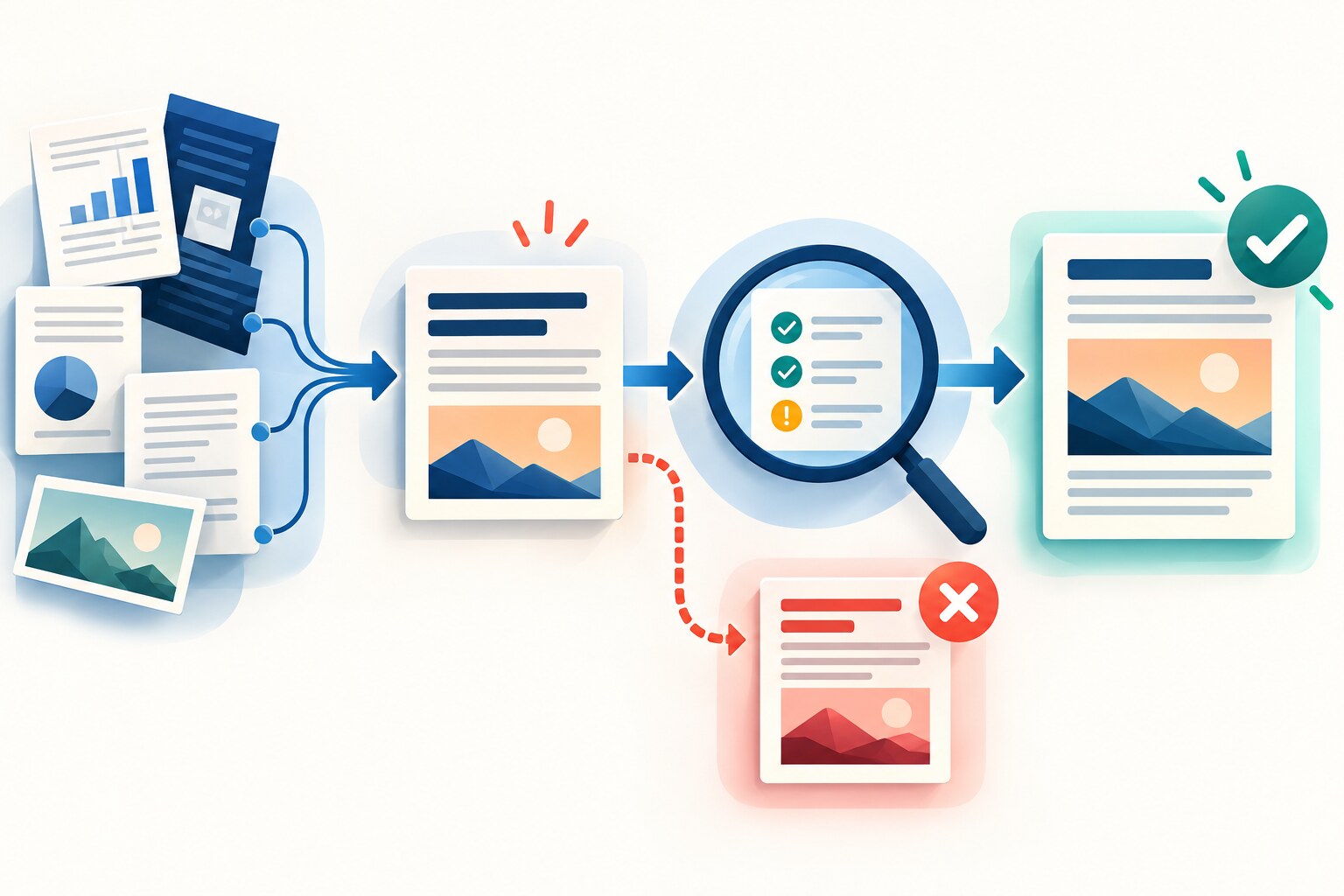
Create an evidence-bound claim sheet so AI-generated marketing copy keeps every promise tied to proof, scope and approval.
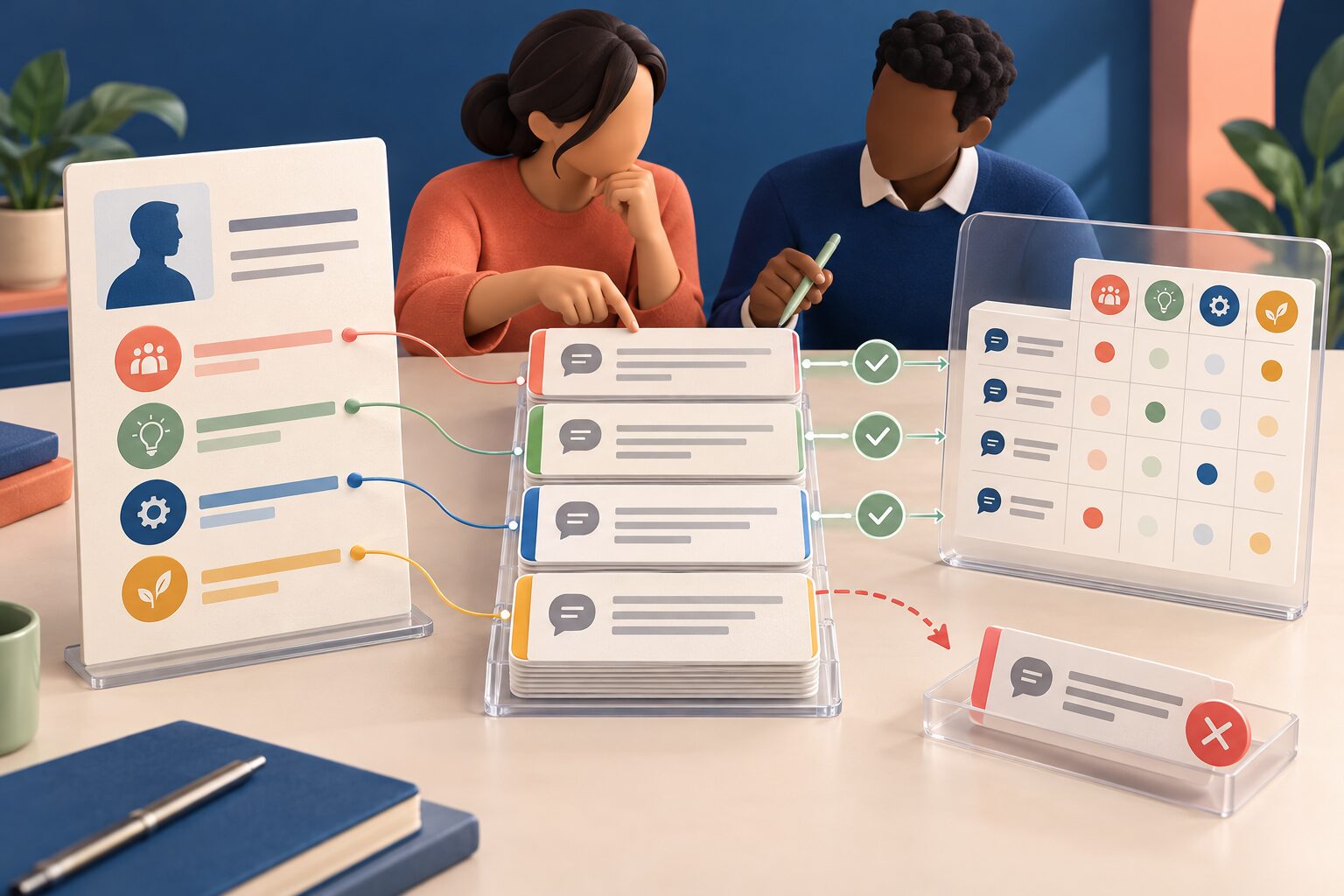
AI Training for HR: Test Interview Questions Against the Job
AI training for HR should teach a five-part test that links every interview question to the job, observable evidence and a consistent scoring rule.