
Use AI to Draft Marketing Claims Without Losing the Evidence
Create an evidence-bound claim sheet so AI-generated marketing copy keeps every promise tied to proof, scope and approval.
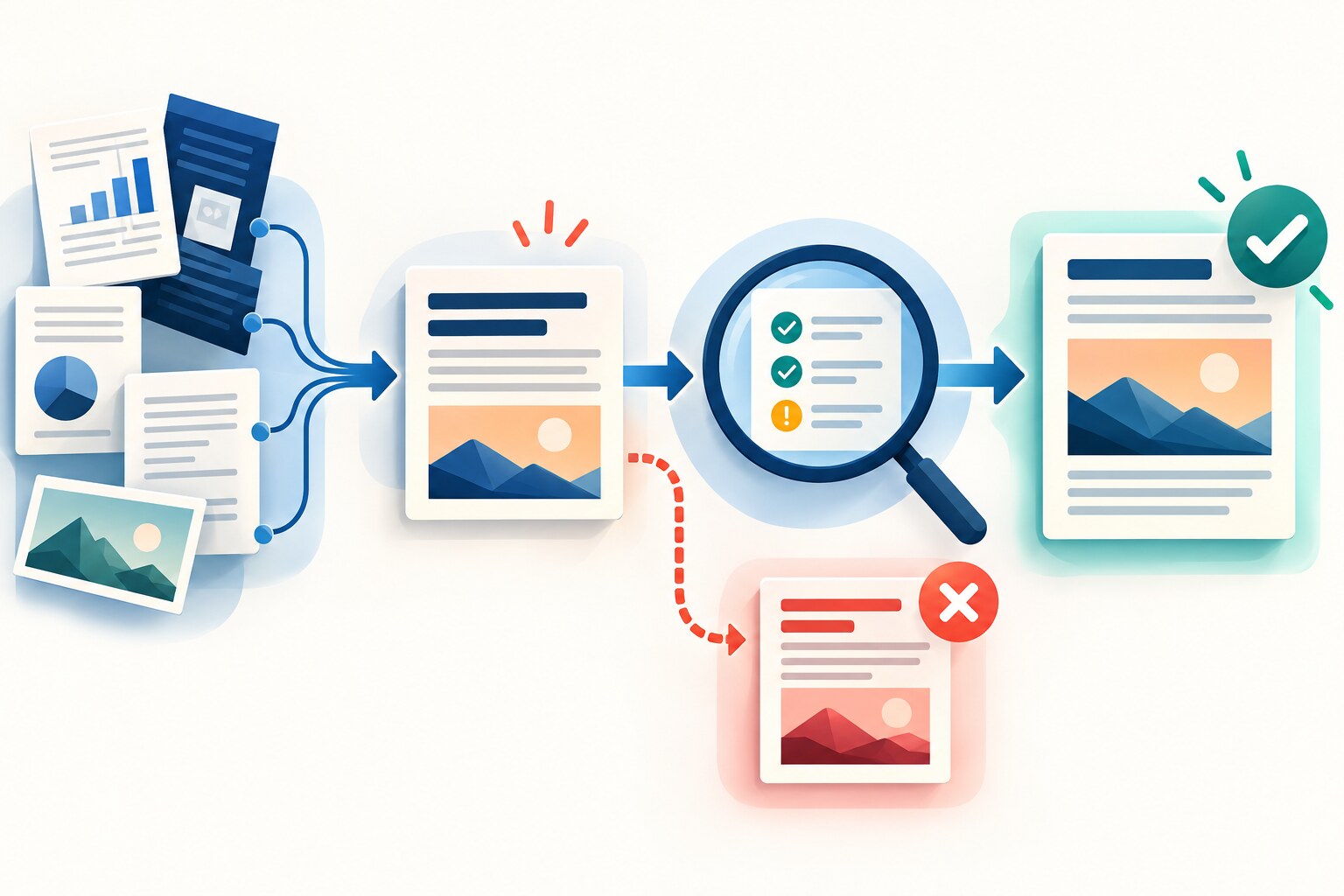
Generative AI can make a marketing claim sound finished before anyone has checked whether the evidence supports it. The danger is not only a false sentence. A model can quietly widen the population, remove a condition, turn a test result into a universal promise or imply a comparison that the source never made. A safer workflow keeps every objective claim attached to its evidence, scope and approval decision from the first draft.
Current UK advertising guidance makes that discipline concrete. The CAP Code says marketers should hold documentary evidence before publishing objective claims, present material qualifications clearly and avoid exaggerating a product’s performance. The CMA’s Green Claims Code adds that environmental claims should be accurate, clear, backed by current credible evidence and honest about relevant conditions and the wider story. The practical lesson applies beyond the UK: copy approval should inspect claims one by one, not judge only whether a paragraph sounds persuasive.
Treat AI output as draft copy, not approved evidence
This workflow supports internal review; it is not legal advice. Use the rules that apply to your market, product and audience, and route regulated or high-consequence claims to the appropriate specialist.
Build a five-field claim sheet before you prompt
The evidence-bound claim sheet
1. Proposed claim
Write one customer-facing claim per row. Split compound sentences so each objective promise can be reviewed on its own.
2. Evidence reference
Name the exact test, dataset, specification or approved source that supports the claim. A link to a general folder is not enough.
3. Scope and qualification
Record the population, product version, conditions, date and limitation that define what the evidence really proves.
4. Review owner
Name the person or function able to judge the evidence, such as product, legal, sustainability, clinical or finance.
5. Decision
Mark the row Supported, Revise or Remove. Keep the reason so the next draft does not reintroduce the same overclaim.
Give the model only the rows marked Supported or Revise, plus the required audience, tone and format. Ask it to preserve each qualification and to flag any sentence it cannot trace to a row. The model may help shape language; it should not invent a bridge between weak evidence and a stronger promise.
Worked example: a test result becomes an overclaim
Suppose a product brief contains a controlled test showing that one bottle model kept water below a stated temperature for 12 hours under specified conditions. A draft generator writes: “Keeps every drink ice-cold all day.” The sentence expands the evidence in four ways: every drink, ice-cold, all day and no test conditions. A fluent rewrite has become a different claim.
Reading is a start. Practice makes it stick.
Start learning| AI draft | Evidence-bound revision | |
|---|---|---|
| Claim | Keeps every drink ice-cold all day. | In the cited controlled test, this model kept water below the tested temperature for 12 hours. |
| Evidence link | None in the draft. | Named test report, version and test date. |
| Qualification | Conditions removed. | Liquid, model and test conditions remain visible. |
| Decision | Looks publishable. | Product owner checks; marketing records Supported, Revise or Remove. |
The revision may be less dramatic, but it is reviewable. If the exact temperature or conditions would make the sentence cumbersome, the sheet gives the team a clear choice: shorten the claim without changing its meaning, add an accessible qualification or remove the claim. It does not invite the model to hide uncertainty in smoother prose.
Run claim-level review, not paragraph-level approval
A practical drafting loop
- 1
Extract the objective claims
Highlight performance, comparison, price, environmental, health and quantified statements in the source pack.
- 2
Create one row per claim
Attach the evidence and its boundaries before asking for campaign copy.
- 3
Generate within the rows
Tell the model to use only supported content and to preserve material qualifications.
- 4
Challenge the draft
Ask which words broaden population, duration, certainty, superiority or environmental impact beyond the source.
- 5
Approve and retain the receipt
Record the reviewer, decision and final wording so later edits can be checked against the same evidence.
Before a claim leaves review
- The exact claim appears as one reviewable row.
- A current source supports the claim, not merely the topic.
- Scope, conditions and important limitations remain visible.
- Any comparison has a fair, clear and verifiable basis.
- The reviewer has authority to approve this type of claim.
- The final wording and decision are stored together.
- Unsupported alternatives have been removed from the working draft.
This method fits a broader discipline: keep generated text in a draft state until it has been checked and approved. Bokili Learn’s guide to separating drafts from records explains that lifecycle: https://bokili.com/en/learn/ai-training-employees-drafts-records. For a compact verification habit, see https://bokili.com/en/learn/how-to-verify-ai-output-at-work. To catch conclusions that change when one assumption flips, use https://bokili.com/en/learn/ai-conclusion-reversal-test.
- Choose one live draft and underline three objective claims.
- For each claim, paste the exact supporting evidence into a separate row.
- Add the population, conditions, date and limitation that bound the evidence.
- Mark each row Supported, Revise or Remove and name the reviewer.
- Rewrite only one Revise row, preserving every material qualification.
- Save the final wording beside the evidence reference and decision.
Make traceability part of the copy
AI is useful when it reduces the work of exploring language, not when it dissolves the link between a promise and its proof. A small claim sheet gives writers room to iterate while giving reviewers something precise to inspect. The durable rule is simple: if a claim cannot point to evidence, scope and an owner, it is not ready for publication.
Sources
- CAP Code — Misleading advertising — Advertising Standards Authority / CAP
- The Green Claims Code checklist — Competition and Markets Authority
- AI Playbook for the UK Government — UK Government
Reading is a start. Practice makes it stick.
Bokili turns skills like this into ten-minute missions for your whole team, with instant feedback and progress you can see.
Start learningKeep reading

AI Skills for Employees: Build a Prerequisite Ladder
Build AI skills for employees in the right order: frame the task, set boundaries, check the result and decide what happens next.
AI Training for HR: Test Interview Questions Against the Job
AI training for HR should teach a five-part test that links every interview question to the job, observable evidence and a consistent scoring rule.

Price the Exception Queue Before You Automate With AI
AI automation creates a human exception queue. Price its volume, expertise, delay and resolution work before you approve the business case.