AI Training for HR: Test Interview Questions Against the Job
AI training for HR should teach a five-part test that links every interview question to the job, observable evidence and a consistent scoring rule.
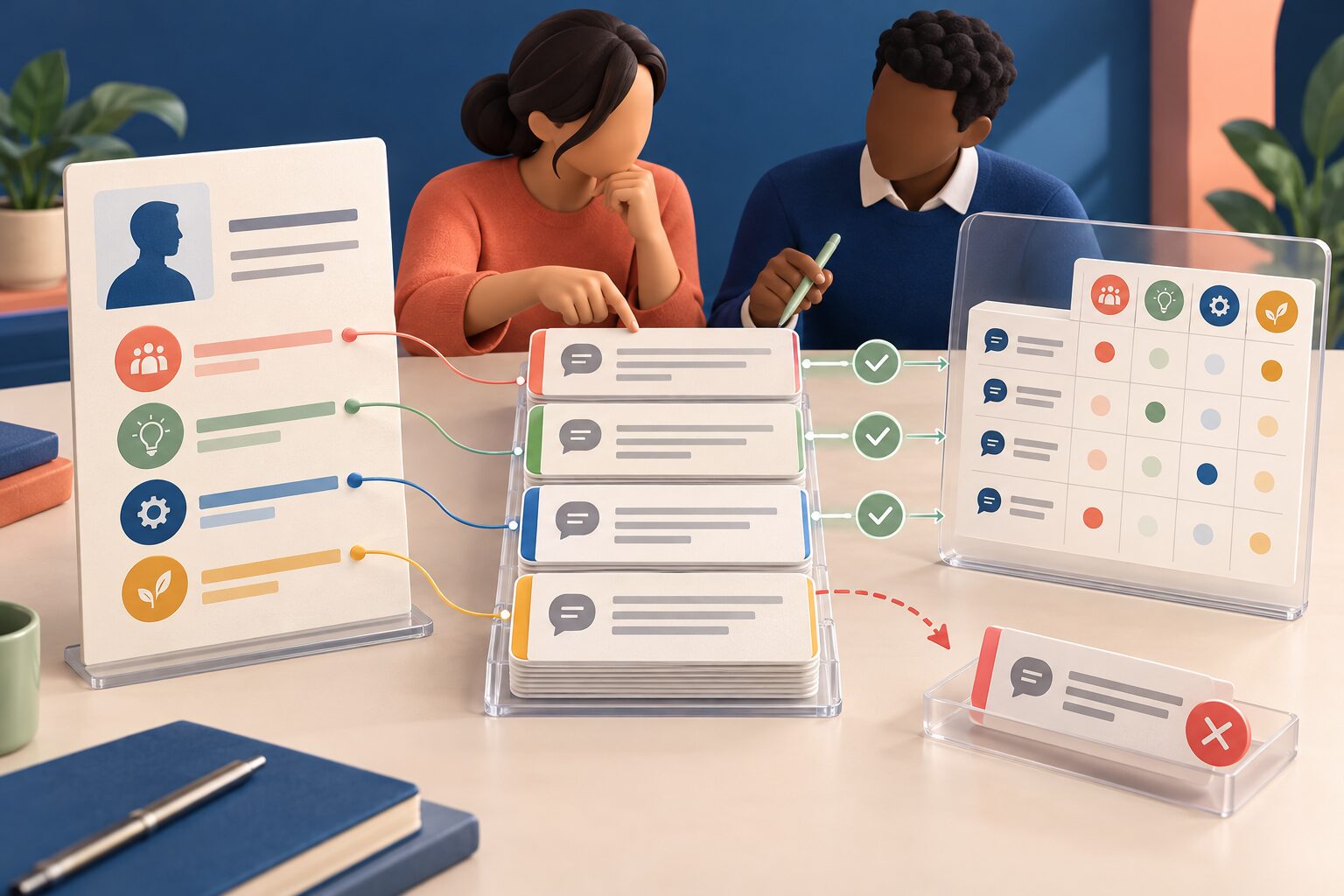
AI training for HR should teach a simple rule for interview design: every question must trace to the job and every answer must be judged against the same standard. An AI tool can produce a polished list in seconds, but fluency is not evidence that the questions are relevant, fair or scorable.
Treat AI-drafted interview questions as candidates, not approved material. Test each one against the job analysis, the competency it is meant to reveal, the evidence a strong answer should contain and the consistency rule for asking and scoring it. Keep human ownership of the final interview pack and follow the law and policy that apply in your organisation and location.
A plausible question can still be a poor assessment
If you cannot name the job requirement, expected evidence and scoring anchors, remove or rewrite the question before it reaches a candidate.
Why AI training for HR needs a question test
The US Office of Personnel Management describes job analysis as the foundation of assessment and selection. It connects job tasks with the competencies required to perform them. OPM’s structured-interview guidance says candidates should receive the same predetermined questions in the same order and their responses should be evaluated with the same rating scale and standards.
Acas gives compatible practical guidance for UK employers: prepare questions, avoid discrimination, ask applicants the same questions where possible and base decisions on how each applicant met the job description and person specification. AI does not replace those disciplines. It makes it easier to generate options, so HR needs a visible acceptance test before any option becomes part of the process.
The TRACE interview-question test
T — Task link
Name the job task, responsibility or condition the question relates to. Reject interesting questions that do not help assess the role.
R — Required competency
State the knowledge, skill, ability or behaviour the question is intended to reveal.
A — Answer evidence
Write what observable evidence would strengthen an answer, without scripting one preferred personality or background.
C — Common scoring
Create shared anchors for weak, acceptable and strong evidence. Use the same standards for every candidate.
E — Equal use
Confirm when and how the question will be asked, what follow-ups are permitted and which adjustments may be needed.
Worked example: a customer-success role
Suppose an HR partner asks an approved AI tool for interview questions for a customer-success manager. The draft includes: “Tell us about a time you persuaded a difficult customer to accept your solution.” It sounds usable, but it quietly rewards persuasion and assumes the company’s proposed solution should win.
The job analysis instead names a relevant task: diagnose an at-risk account and coordinate an appropriate response. The competency is evidence-based problem solving with clear communication. The question can be rewritten: “Tell us about a time you identified that a customer account was at risk. What evidence did you use, which options did you consider and how did you decide the next step?”
Reading is a start. Practice makes it stick.
Start learning| Unverified AI draft | TRACE-tested question | |
|---|---|---|
| Job link | General idea of customer persuasion | At-risk account diagnosis and response |
| Evidence | Confidence and influence | Signals used, options considered and decision rationale |
| Scoring | Interviewer impression | Shared anchors tied to the required competency |
| Consistency | Free-form follow-up | Same core question and defined probing boundaries |
A scoring guide might treat an answer as weak when it relies on assumption and offers no evidence; acceptable when it identifies relevant signals and a proportionate action; and strong when it checks multiple sources, explains trade-offs and names a clear follow-up. These are examples for practice, not a universal hiring standard. The organisation must validate criteria for the actual role and its local requirements.
Use AI to widen options, then narrow with evidence
From draft list to approved interview pack
- 1
Prepare the source pack
Provide the approved job analysis, competency definitions, interview format and prohibited or sensitive areas. Remove personal applicant data from the drafting step.
- 2
Generate question candidates
Ask for several behavioural and situational options for one competency at a time. Require a proposed job link and evidence target beside each question.
- 3
Run TRACE
Review each question with an HR owner and a role expert. Reject questions with no direct task link, unclear evidence or inconsistent scoring.
- 4
Pilot the scoring
Use fictional answers that vary in quality. Check whether trained reviewers apply the anchors consistently and whether the question produces relevant evidence.
- 5
Freeze and control the pack
Record the approved version, owner and review trigger. Interviewers should not improvise new AI-generated questions during a live interview.
Common failure modes
Reject or revise the question when…
- It tests a preference or personal style rather than a job requirement.
- It assumes a credential, career path or life circumstance that the job does not require.
- The expected evidence cannot be distinguished from polished storytelling.
- The scoring anchors repeat vague labels such as ‘good communicator’.
- Different interviewers could ask materially different versions.
- The prompt or draft contains applicant data that should not have been shared.
- Nobody is named as the human owner of the final interview pack.
Do not ask the AI to decide whether a question is lawful or fair and accept the answer as authority. Use it to organise candidate wording and expose assumptions for human review. HR, legal and equality specialists should apply the organisation’s rules and relevant law. Keep records according to approved recruitment and data-protection processes.
- Choose one approved role and one job competency.
- Take one AI-drafted interview question.
- Write the exact job task it should help assess.
- List two pieces of observable evidence a useful answer could contain.
- Draft weak, acceptable and strong scoring anchors.
- Check that every candidate would receive the same core question.
- Ask an HR owner and role expert to approve, rewrite or reject it.
Build the skill around traceability
Start with the job-description audit so unsupported criteria do not enter the source pack. Use the four-part policy answer when recruiters need clear limits and escalation routes. A safe practice pack helps teams rehearse without live applicant data.
Bokili’s HR and L&D pathway turns these checks into short, role-relevant practice. The useful skill is not asking AI for more questions. It is proving that each approved question belongs to the job, produces assessable evidence and can be used consistently.
Sources
- Job Analysis — U.S. Office of Personnel Management
- Structured Interviews — U.S. Office of Personnel Management
- Interviewing job applicants — Acas
- Employer guide: What works for AI upskilling in the UK — UK Government
Reading is a start. Practice makes it stick.
Bokili turns skills like this into ten-minute missions for your whole team, with instant feedback and progress you can see.
Start learningKeep reading

Price the Exception Queue Before You Automate With AI
AI automation creates a human exception queue. Price its volume, expertise, delay and resolution work before you approve the business case.

AI Training for Employees: Separate Drafts From Records
Teach a four-state path—Draft, Checked, Approved, Recorded—so polished AI output never becomes organisational fact by accident.
Use Gemini Notebook Mind Maps to Turn Policy Into Questions
Use a Gemini Notebook mind map as a question index for a long policy—then open the cited source before you trust any answer.