

Role, Tool or Risk? Choose the Right AI Training Cohort
A simple framework for deciding when AI learners should be grouped by role, tool or risk—without multiplying the programme.
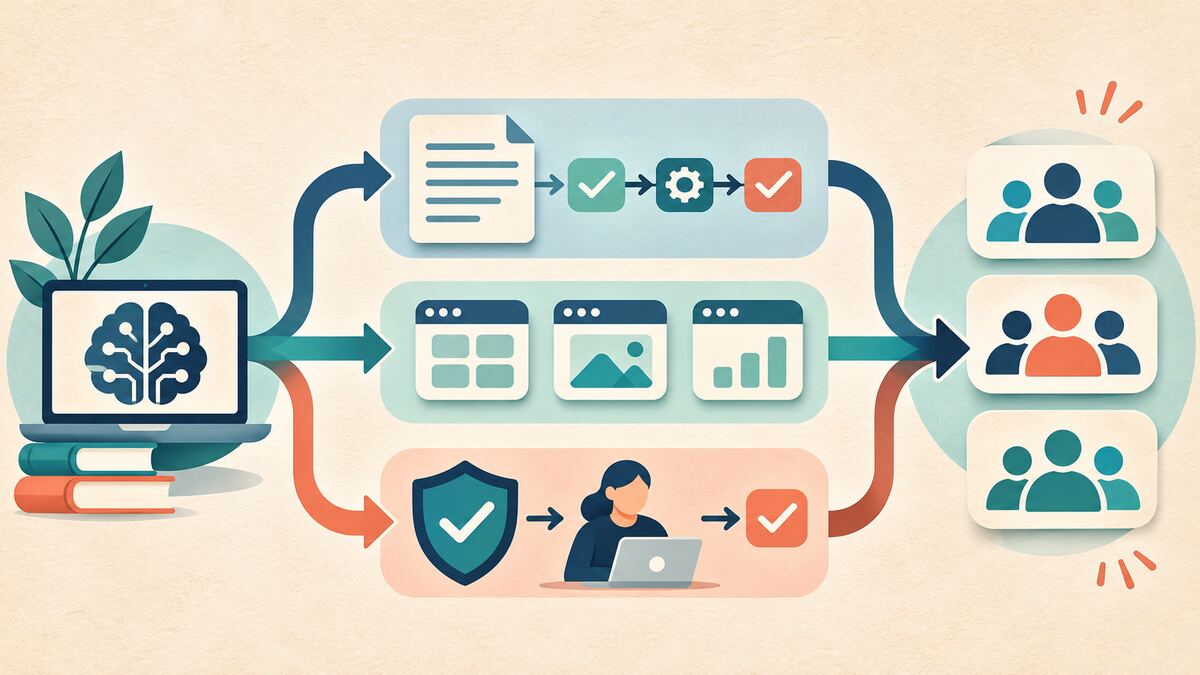
Most AI training plans start with a list of people and end with a list of modules. The awkward decision in between is how to group learners. Put everyone together and the practice becomes generic. Split every role, tool and risk level and the programme becomes impossible to run. A better answer is to choose the cohort around the behaviour people must learn. Use a shared foundation for language, limits and evidence. Then choose one primary cohort axis: role when the work task changes, tool when the interface changes, or risk when the consequence and oversight duty changes. The other two axes become overlays, not new programmes.
The cohort rule
Group learners by the difference that changes the practice activity. Keep everything else in a shared foundation or a short overlay.
Role, tool or risk: what actually changes?
Role-based cohorts work when learners need to practise different work artefacts or decisions. A recruiter reviewing a candidate summary and a finance analyst checking a variance explanation may use the same model, but their source material, quality tests and escalation points differ. Tool-based cohorts work when success depends on a particular interface, permission model or workflow. Risk-based cohorts work when the cost of a weak output changes the review standard: drafting an internal agenda is not the same as preparing material that informs a regulated or safety-critical decision.
| Role-led cohort | Tool-led cohort | Risk-led cohort | |
|---|---|---|---|
| Choose it when | The work task or artefact changes | The interface or operating steps change | The consequence or oversight duty changes |
| Practise | A role-specific decision and deliverable | A repeatable workflow in one approved tool | Verification, escalation and human judgement |
| Keep shared | AI limits, evidence and safe data use | The business task and evidence standard | Core terminology and basic tool handling |
| Watch for | Too many tiny job-title groups | Training that becomes a product tour | Risk labels without realistic practice |
Use the CORE cohort design
CORE: a small hybrid, not a cohort explosion
Common foundation
Give everyone the same baseline for safe data use, model limits, verification and the organisation's rules.
One primary axis
Choose role, tool or risk from the difference that most changes the practice task.
Relevant overlay
Add a short briefing for a secondary difference, such as one tool permission or one higher-risk escalation rule.
Evidence in common
Ask every cohort to produce a work artefact plus a brief note showing what was checked and what still needs human judgement.
This hybrid follows a useful design principle in the UK government's 2026 employer guide: shared foundations can stay consistent while role-based modules and use-case libraries adapt only where needed. It also fits the European Commission's AI literacy guidance, which asks organisations to consider people's knowledge and experience as well as the context in which an AI system is used. The point is not to invent a perfect taxonomy. It is to make the practice recognisable, while preserving a common standard.
A worked example: redraw six planned cohorts as three
Reading is a start. Practice makes it stick.
Start learningImagine an organisation preparing training for 60 people in HR, marketing and operations. Some use a conversational assistant; others use an assistant embedded in office software. A few activities influence hiring or customer eligibility, while most involve low-consequence drafts. The first plan creates six cohorts by crossing department and tool. That looks precise but duplicates most of the foundation and still hides the higher-consequence work.
Redraw the plan
- 1
Name the behaviour
Write one sentence for the behaviour learners must demonstrate, such as producing a checked work artefact from approved source material.
- 2
Find the largest practice difference
Compare role, tool and risk. Choose the axis that would force you to rewrite the exercise, not merely the examples.
- 3
Create a light overlay
Handle a secondary difference with a short tool walkthrough, role example or escalation card.
- 4
Set one evidence standard
Require the artefact, the source used, two checks and the unresolved judgement call from every cohort.
The revised plan uses two role-led cohorts for low-consequence work: one for people producing employee or customer communications, and one for people turning operational material into summaries and actions. A third, risk-led cohort covers hiring and eligibility-related uses, regardless of department or tool. Each cohort receives a short tool overlay where the interface matters. All three submit the same evidence bundle. The result is fewer groups, clearer practice and a stronger comparison of learning across the programme.
Before you approve the cohort map
- Can each cohort practise with a believable work artefact?
- Would changing the primary axis materially change the exercise?
- Is a secondary difference small enough for a short overlay?
- Does higher-consequence work have an explicit human oversight step?
- Can every cohort meet the same evidence standard?
Link cohort design to the rest of the programme
Cohorts are only one design layer. Use an AI skills matrix to set depth by role (https://bokili.com/en/learn/ai-skills-for-employees-matrix), a risk-based literacy plan to calibrate oversight (https://bokili.com/en/learn/risk-based-ai-literacy-training), and a three-task baseline to identify existing practice before training (https://bokili.com/en/learn/ai-training-employees-three-task-baseline). Bokili's HR and L&D page describes how role, level and tool preferences can shape learning paths without removing shared organisational visibility: https://bokili.com/en/for-hr.
- Take one planned cohort and write its real practice task.
- Score role, tool and risk from 0 to 2 for how much each would change that task.
- Choose the highest score as the primary axis.
- Turn the second-highest difference into a short overlay.
- Write the common evidence bundle every learner must submit.
A cohort is a practice decision
A cohort should not merely describe who sits in the room. It should explain why those learners need the same practice. Start together, split only where behaviour changes, and reunite around a common evidence standard. That is enough structure to make AI training relevant without building a separate curriculum for every job title, tool and risk label.
Sources
- Employer guide: What works for AI upskilling in the UK — Skills England / GOV.UK
- AI Literacy – Questions & Answers — European Commission
- AI training for HR & L&D leaders — Bokili
Reading is a start. Practice makes it stick.
Bokili turns skills like this into ten-minute missions for your whole team, with instant feedback and progress you can see.
Start learningKeep reading

AI Training for Employees: Pause Before Recording a Meeting
Teach employees a five-part check for purpose, notice, sensitive data, approved tools and downstream use before an AI recorder joins.

Critical Thinking Is Not a Module in AI Training
Make judgement observable by adding one challenge question—and one correction—to every realistic AI practice task.
AI Training for Employees: Add Two New-Hire Checkpoints
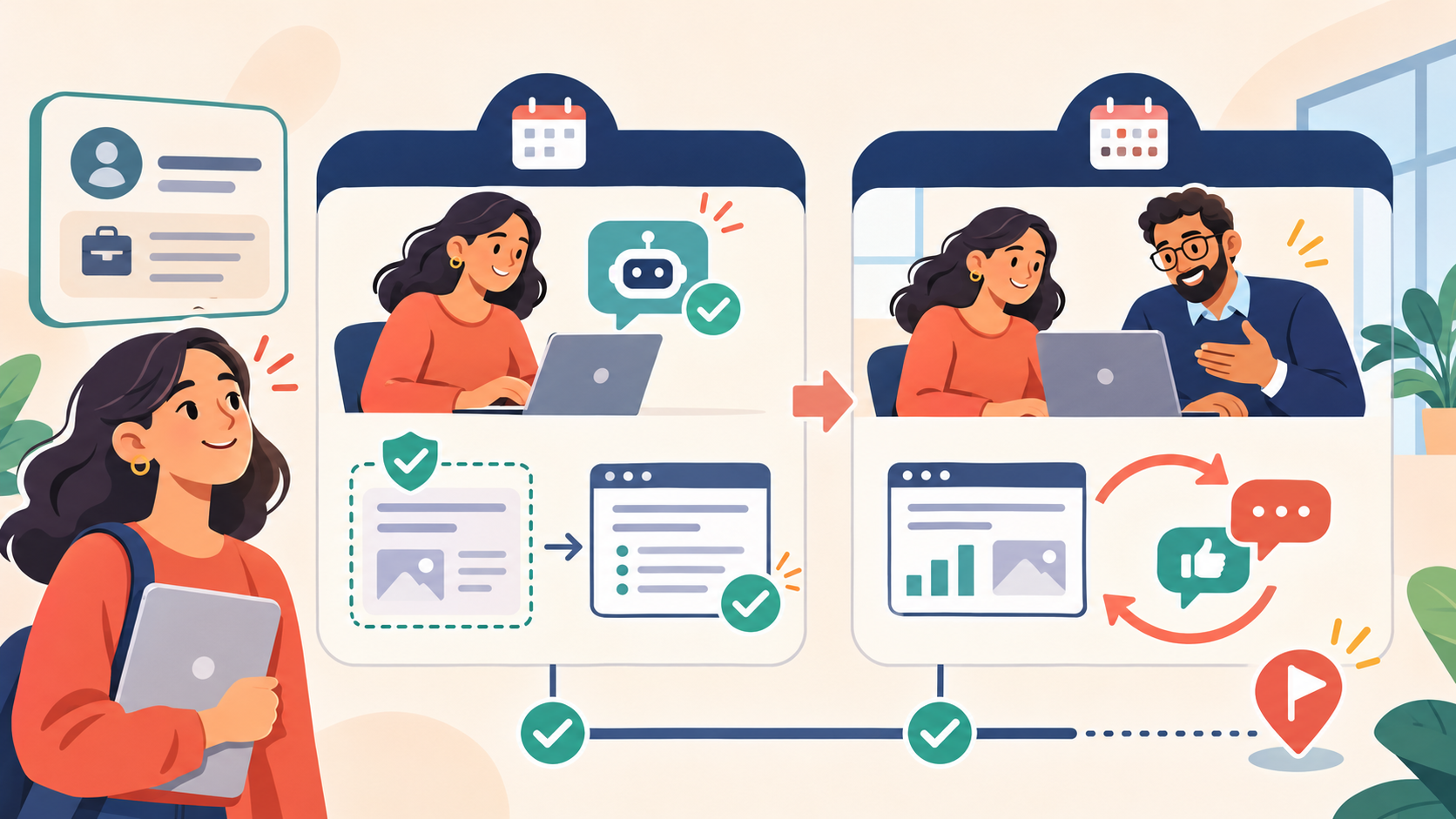
Build AI training into onboarding with a safe first-week practice and a fresh transfer check after the new hire learns the workflow.