
Redact Before You Prompt: Run a Reidentification Check
Removing names is not enough. Use a four-pass reidentification check before approved AI tools receive workplace text.
Redaction is not the same as anonymity
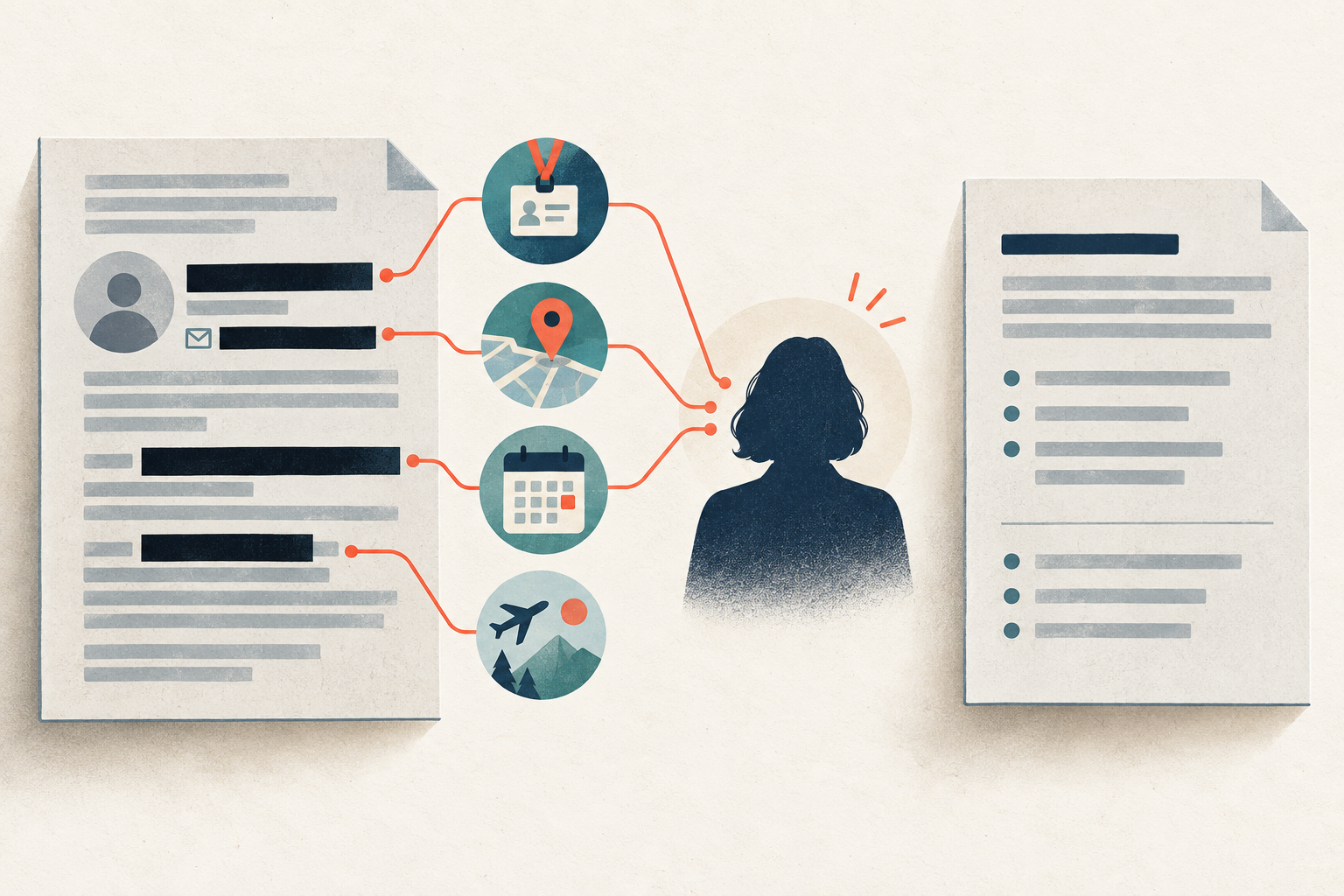
Removing a name or email can still leave a combination of role, place, date and rare event that points to one person.
Before you paste a workplace document into an approved AI tool, ask a harder question than “Did I remove the names?” Ask whether a colleague with ordinary background knowledge could still identify someone from the remaining clues. A redacted note can preserve enough context to reveal a customer, employee or case.
Current ICO guidance distinguishes direct identifiers from indirect combinations such as location, age, dates and distinguishing traits. It also treats pseudonymised information as personal data when another key can reconnect it to a person. NIST makes the same practical point: de-identification reduces risk, but some data can be reidentified, including free text and images. This guide is a workplace safety method, not legal advice.
Run four passes before AI sees the text
The reidentification check
1. Strip direct identifiers
Remove names, email addresses, phone numbers, account numbers, precise addresses, employee IDs and other obvious labels.
2. Combine indirect clues
Read role, location, dates, age, shift, rare events, relationships and free-text details together. A harmless clue can become identifying in a bundle.
3. Test the motivated colleague
Imagine a colleague who knows the team, calendar and recent events. Could they narrow the text to one person without special access?
4. Keep only task-essential facts
Delete or generalise anything the AI does not need. Preserve the decision-relevant meaning, not the story’s full detail.
The third pass adapts the ICO’s “motivated intruder” idea to everyday work. The tester does not need secret databases or specialist hacking skills. They use information that is public, widely known inside the organisation or reasonably obtainable. The purpose is not to prove zero risk; it is to expose combinations that a simple find-and-replace misses.
Worked example: the name is gone, the person is still visible
An HR partner wants an AI tool to group themes from survey comments. One note originally names a supervisor. The name is removed, but the text still says: “the only night-shift supervisor in Lyon, after Tuesday’s loading-bay incident, who returned from parental leave last month.” Every clue may look ordinary. Together they describe one person.
Reading is a start. Practice makes it stick.
Start learning| Name-only redaction | Task-essential version | |
|---|---|---|
| Role | Only night-shift supervisor | A supervisor |
| Place | Lyon site | One operational site |
| Time | Tuesday after the loading-bay incident | After a recent operational incident |
| Personal detail | Returned from parental leave last month | Removed |
| Useful meaning | A specific person is exposed | The comment concerns support after an incident |
The safer version still supports theme analysis: it preserves the workplace issue and removes details that do not affect the classification. If the exact shift, site or chronology is necessary, do not quietly keep it. Escalate to the data owner and use the approved process for that higher-risk task.
Redaction choices that fail under context
Check every release, not just the first draft
- Search document properties, comments, tracked changes, hidden sheets and filenames for identifiers.
- Check free text for rare events, unusual job titles, precise dates and personal circumstances.
- Read all rows or passages together; separate fragments can combine into one identity.
- Confirm the AI task needs each retained detail and generalise anything it does not.
- Ask a second reviewer who knows the context to attempt identification.
- Stop and escalate when the required context cannot be made proportionate.
The UK Government AI Playbook recommends minimising personal data and applying appropriate techniques such as redaction or pseudonymisation. It also warns that hidden information can remain in office documents. That makes redaction a process, not a black marker: inspect the file, the visible text, the context and the approved destination.
- Choose a fictional or already approved paragraph; do not use live sensitive material for practice.
- Underline direct identifiers and remove them.
- Circle indirect clues: role, place, date, rare event, relationship and personal circumstance.
- Read the circled clues as one bundle and ask who a knowledgeable colleague would infer.
- Generalise or delete every clue that the AI task does not require.
- Record the task, the retained facts and the reviewer’s decision.
Use less context—and keep responsibility visible
A useful AI brief does not need every detail of the original case. It needs the smallest set of facts that supports the requested work, plus a named person who owns the decision. If minimisation destroys the task, the answer may be a controlled workflow, a different tool or no AI use at all.
Build the practice with a safe fictional pack, map what a learning platform retains with the learner-data guide, and keep evaluation independent with the acceptance-test guide. Bokili’s learning features support short, workplace-based practice with safety and review built in.
Sources
- Introduction to anonymisation — Information Commissioner's Office
- How do we ensure anonymisation is effective? — Information Commissioner's Office
- De-Identification of Personal Information — NIST
- Artificial Intelligence Playbook for the UK Government — UK Government
Reading is a start. Practice makes it stick.
Bokili turns skills like this into ten-minute missions for your whole team, with instant feedback and progress you can see.
Start learningKeep reading

Learn AI by Mapping the Work You Already Do
Learn AI by mapping one recurring work task, its useful outcome, stakes and human review before choosing a tool or course.

AI Skills: Build an Evidence Portfolio, Not a Prompt Folder
Make AI skills visible through useful outputs, documented judgement, verification and transfer to a fresh workplace task.

The AI Workflow Friction Test: Remove, Preserve or Strengthen?
Do not remove every step from an AI workflow. Classify friction as waste, learning, safety or coordination before changing it.