
AI Training Platform for Companies: Map Learner Data Before You Buy
Before choosing an AI training platform for companies, map learner identity, work inputs, feedback, access, retention, export and deletion.
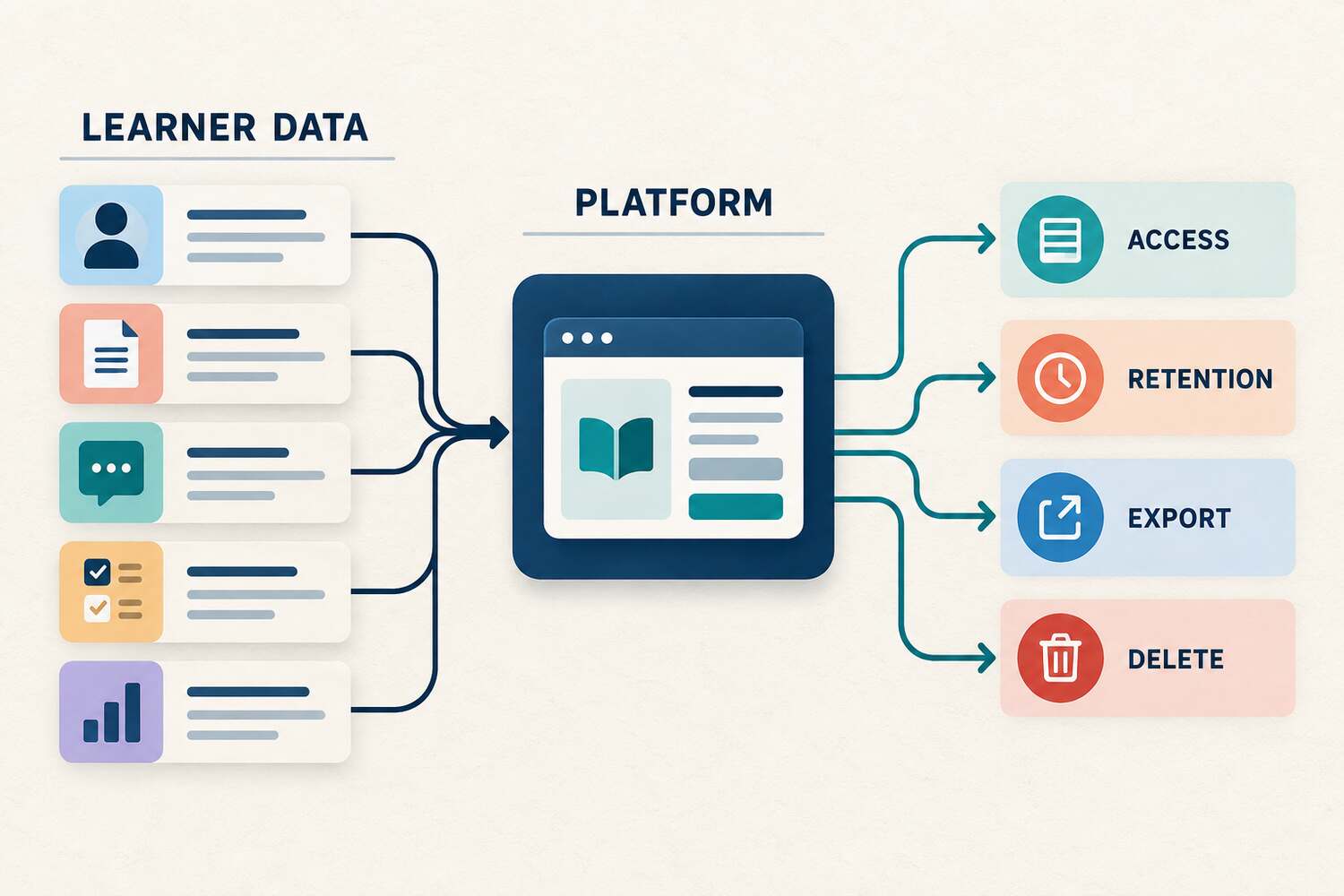
An AI training platform for companies can collect more than course completions. Depending on its design and configuration, it may handle learner identity, prompts, uploaded documents, generated outputs, feedback, assessments and progress records. Buyers who compare only content and interface quality can miss the data lifecycle that sits underneath the learning experience.
This guide is for L&D, HR, IT, procurement and privacy colleagues evaluating a platform. Its purpose is commercial investigation: create a learner-data map before a pilot, so the team can ask vendors precise questions about purpose, access, retention, export and deletion. The map does not replace legal or security review. It makes that review concrete.
What data can an AI training platform for companies hold?
Start with fields, not assurances. “We take privacy seriously” is not a data map. List what the learner supplies, what the platform creates, what managers can see and what leaves the service. A realistic map may include an email address and role, practice inputs, an AI-generated draft, coach feedback, rubric scores, retry history and an evidence record used in reporting.
NIST’s Privacy Framework is designed to help organisations identify and manage privacy risk while building products and services. The UK Government’s AI Playbook similarly recommends mapping personal-data sources and flows, defining purpose, identifying involved processors, limiting data to what is needed and being clear about retention and third parties. Those are governance principles, not a vendor verdict.
The European Commission’s current AI-literacy guidance adds a learning reason for context. It says literacy actions should reflect people’s knowledge and experience, the systems they use, the context and the risk. A platform may need some role and progress information to adapt practice. That does not mean every raw prompt or work document must be retained indefinitely. Purpose should determine the minimum useful record.
The six-line learner-data map
1. Field
Name the exact item: email, role, prompt, upload, output, feedback, score, retry or progress record.
2. Purpose
State why the item is needed for learning, support, reporting or administration. Avoid a catch-all purpose.
3. Flow
Record where it comes from, which service processes it and whether any subprocessors or connected AI tools receive it.
4. Access
Name who can view the raw item and who sees only an aggregate or status.
5. Retention
Set how long the item remains, what triggers deletion and whether backups follow a different schedule.
6. Exit
Confirm what can be exported, in which format, and how the organisation can delete or retrieve records when the contract ends.
Worked example: compare two pilots with the same learning task
Reading is a start. Practice makes it stick.
Start learningA fictional 120-person services company wants employees to practise checking AI-written client summaries against approved source documents. It asks two platform providers to demonstrate the same fictional task. Both deliver useful feedback. The difference appears only when the buying team completes the learner-data map.
| Provider A | Provider B | |
|---|---|---|
| Practice input | Raw prompt and upload retained with the learner record | Prompt deleted after feedback; approved evidence fields retained |
| Manager view | Full prompt, output and score | Skill status, rubric result and flagged support need |
| Retention | Standard account lifetime | Separate periods for raw practice data and progress evidence |
| Exit | Summary report only | Documented export plus deletion workflow |
This fictional comparison does not make Provider B universally better. Provider A may support a justified use case that requires detailed artefacts, while Provider B may remove evidence a regulated team needs. The point is that the buyer can now assess each design against a declared purpose instead of choosing on vague comfort.
Questions to take into the vendor demonstration
- Which learner fields are required, optional or created automatically?
- Are practice prompts, uploads and outputs stored separately from progress evidence?
- Which administrators, managers, coaches and suppliers can see raw learner work?
- Can role-based access hide raw work while showing support or progress signals?
- What retention period applies to each data category, and who can change it?
- Which connected AI services or subprocessors receive learner content?
- Can the organisation export records in a usable format without vendor help?
- What happens to active data, backups and derived records when a learner or customer account is deleted?
- Can the pilot use synthetic or approved material while governance questions are resolved?
Keep the map proportional
A map is useful when it supports a real buying decision. Involve privacy, legal and security specialists where personal, confidential or regulated information may be processed; this article is not legal advice.
Connect the data map to the rest of the buying decision
Use the map beside the corporate AI training buyer scorecard, not instead of it. Decide whether the system should sit beside or replace an LMS with the learning-job comparison. Once selected, run the pre-launch checklist and teach learners a prompt data boundary. Bokili’s public features page can be assessed with the same questions.
- Write one target learning task and the evidence needed to judge it.
- List identity, input, output, feedback, assessment and progress fields in six rows.
- For each row, add purpose, destination and who can view it.
- Add the retention period or mark it as an unanswered vendor question.
- Add export and deletion actions for the end of the pilot.
- Circle every field that is collected but has no clear learning or operating purpose.
A platform should make practice visible without turning every learner action into an unexplained permanent record. The learner-data map gives buyers a small, testable artefact: six lines that reveal what the system needs, who benefits from each field and what control the organisation retains. Complete it before the pilot, then verify the answers in the contract and the configured product.
Sources
- Privacy Framework — NIST
- Artificial Intelligence Playbook for the UK Government — UK Government
- AI Literacy — Questions & Answers — European Commission
- Features — AI training for teams — Bokili
Reading is a start. Practice makes it stick.
Bokili turns skills like this into ten-minute missions for your whole team, with instant feedback and progress you can see.
Start learningKeep reading
AI Makes Options Cheap. Your Team Still Pays to Consider Them
AI can generate options faster than a team can judge them. Set decision criteria, an option cap and a selector before asking for more.
Corporate AI Training Needs an Exception Library
Corporate AI training should rehearse recurring boundary cases, so employees know when to proceed, pause for evidence or escalate.

Turn Customer Interviews Into Testable Product Hypotheses With AI
A four-stage evidence ladder helps product teams use AI without confusing interview observations, interpretations, hypotheses and tests.