
A Ten-Minute AI Mission Should Leave a Reusable Work Artefact
Short AI practice becomes more useful when the learner leaves with a checked prompt pattern, workflow card or decision aid that can support the next real task.
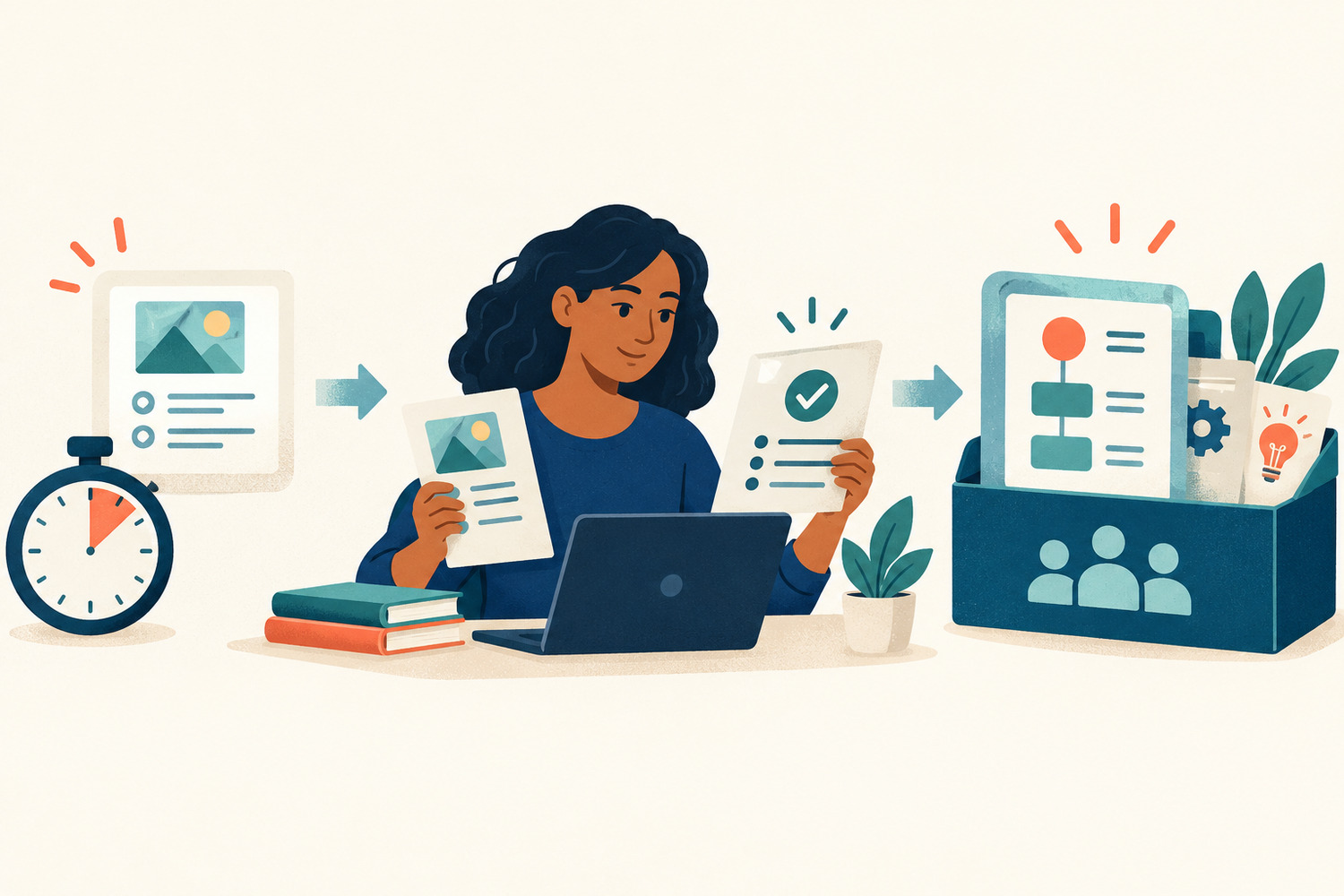
A short AI lesson can end with a correct answer and still disappear from the learner’s work. The prompt stays in the chat, the checklist is not saved, and the next real task begins from zero. A stronger ten-minute mission leaves one small, checked work artefact behind: a prompt pattern, workflow card, decision aid or review checklist that the learner understands and can adapt.
Bokili’s public product pages describe guided, scenario-based missions that take around ten minutes and end with something usable. That promise should shape the learning design. The useful output is not a trophy for finishing. It is a compact bridge from practice to the next real task, with enough evidence and context to prevent blind reuse.
Reusable does not mean ready for every use
Save the pattern, the boundary and the check—not confidential practice data or an unchecked answer. The learner must still judge whether the next task fits.
Separate the learning artefact from the practice answer
The answer solves one exercise. The artefact captures the behaviour worth repeating. If a learner turns fictional meeting notes into a decision brief, the answer is that one brief. The reusable artefact might be a four-field template: decision needed, evidence, open question and owner. It should work with a fresh set of notes without carrying over names, facts or conclusions.
This distinction keeps practice safe and useful. It also makes feedback easier to act on. The learner can revise the artefact after a weak attempt, then use the improved version on a different example. The related Bokili guide on feedback and the second attempt explains why correction should reopen the task. The artefact is what preserves that correction after the exercise ends.
SAVE: turn practice into a reusable asset
S — Safe input
Use fictional, public or explicitly approved material. Remove the exercise data before anything is saved for reuse.
A — Artefact
Name the smallest item worth keeping: a prompt pattern, workflow card, acceptance checklist or decision template.
V — Verification
Attach the check that made the practice acceptable, such as source tracing, an omission check or a named approval rule.
E — Explicit next use
State where the artefact may be used next, what must change, and when the learner should stop or ask for review.
Worked example: from meeting notes to a decision card
Imagine a learner receives fictional project notes. The mission asks for a short decision brief. The first AI draft mixes confirmed facts with assumptions and turns one unresolved question into a recommendation. Feedback identifies the gap: evidence and uncertainty are not separated. The learner corrects the draft and produces a decision card with four fixed fields.
Reading is a start. Practice makes it stick.
Start learning| Practice answer | Reusable work artefact | |
|---|---|---|
| Content | Facts and people from one fictional meeting | Four empty fields and the instruction for filling them |
| Evidence | Source lines attached to this answer | A rule requiring every material claim to point to a source |
| Boundary | Valid only for the exercise | Use for low-stakes internal briefs; escalate decisions affecting people, money or commitments |
| Next use | Exercise complete | Copy the blank card, add fresh approved inputs and run the same check |
The reusable item is not the polished decision brief. It is the blank structure plus its acceptance check and boundary. The learner can now bring a fresh, approved set of notes, complete the card and ask a reviewer to inspect the material claims. That produces a new attempt rather than a copied answer.
Make the artefact small enough to maintain
A mission should not produce a thirty-page playbook when the trained behaviour fits on one card. Large artefacts go stale, hide the critical rule and discourage updates. The US Office of Personnel Management’s training guidance starts with desired outcomes and critical behaviours, then asks what organisational drivers will sustain them. A small artefact can be one such driver when it sits close to the task and has a clear owner.
Maintenance matters because tools, policies and work conditions change. Give every shared artefact an owner, a last-checked date and a trigger for review. Bokili’s workflow change-log method shows how to record a change, test it and preserve a rollback point. The work-transfer guide shows how to test the same behaviour on a fresh sample rather than assuming that completion proves capability.
- Write the one observable behaviour the mission is meant to build.
- Circle the smallest prompt pattern, checklist, workflow card or decision aid worth keeping.
- Remove all names, facts and sensitive material that belong only to the practice case.
- Add the acceptance check that made the corrected attempt good enough.
- Write one allowed next use and one stop or escalation condition.
- Assign an owner and a date or event that will trigger a review.
Design the finish before writing the lesson
Start mission design by completing this sentence: “After ten minutes, the learner can reuse this ___, because it includes this ___ check, for this ___ kind of task.” If the blanks stay vague, the mission is probably teaching a topic rather than a behaviour. Narrow the task until the artefact, evidence and next use are visible.
Bokili’s mission format is well suited to this discipline because it combines short, scenario-based practice with feedback and role-adapted content. The design standard is still demanding: the mission should not merely feel relevant. It should leave a safe object that makes the next attempt easier to begin and harder to accept without evidence.
Sources
- Bokili Features — Bokili
- Bokili for Leaders — Bokili
- Planning & Evaluating Training — U.S. Office of Personnel Management
Reading is a start. Practice makes it stick.
Bokili turns skills like this into ten-minute missions for your whole team, with instant feedback and progress you can see.
Start learningKeep reading
AI Skills for Employees: Budget the Review Work
AI skills for employees should include the work that happens after generation: choosing the right review path, attaching evidence and knowing when specialist approval is required.

Corporate AI Training After an Incident: Rehearse the Failed Decision
Corporate AI training after an incident should rehearse the human decision that failed, test a fresh case and update the workflow—not stop at a reminder.

Before AI Ranks People, Test Whether the Order Is Stable
A neat AI ranking can hide a fragile order. Change only irrelevant presentation details, repeat the task and stop if the result moves.