
Corporate AI Training: Build a Remediation Path
When an employee fails a workplace practice check, use a targeted recovery path instead of repeating the whole course.
Completion is not recovery
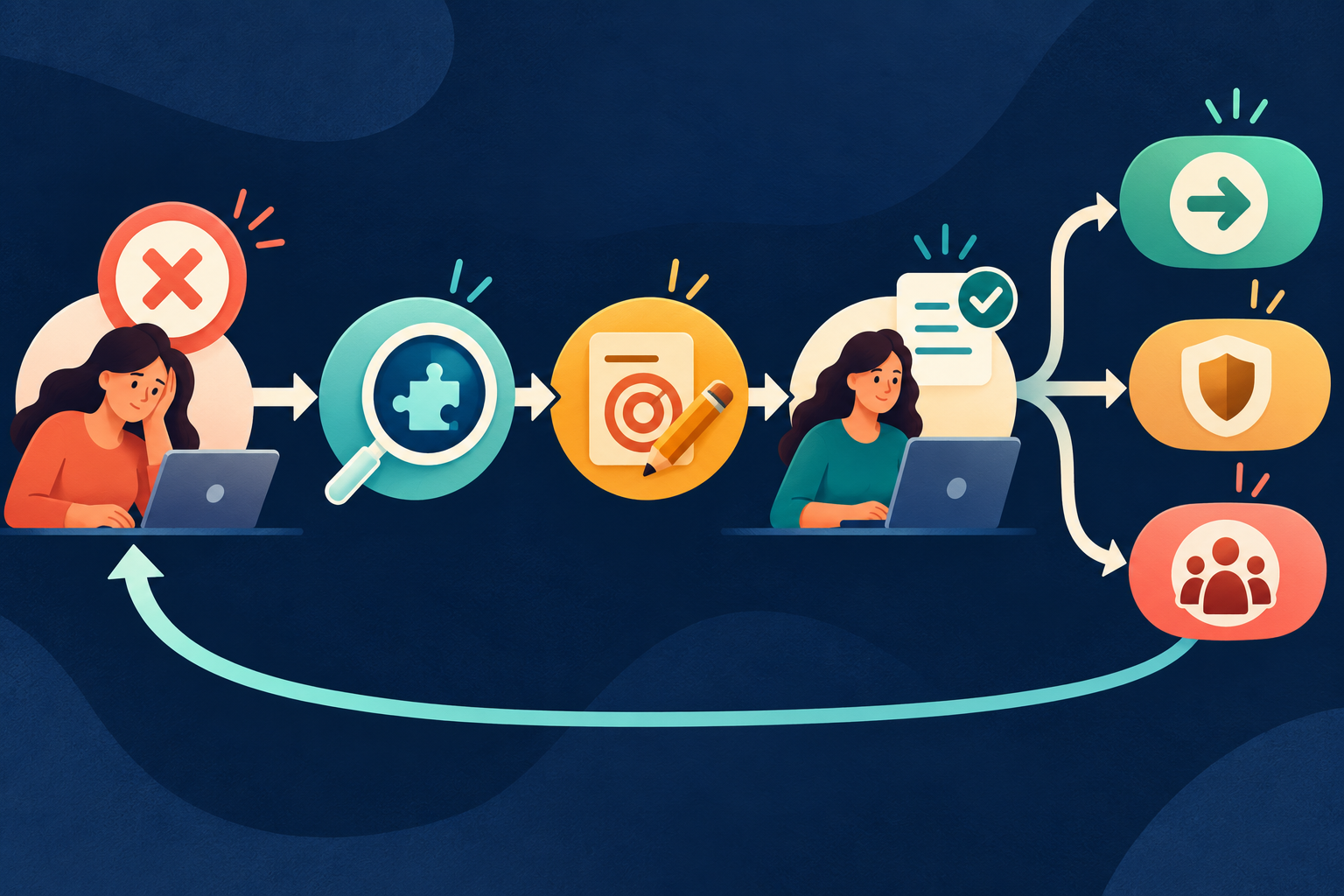
A failed practice check should not send an employee back through the same content. It should reveal one behaviour to improve, one focused practice task and one fresh test.
Corporate AI training often has a clear start and a clear completion record. The weak point comes after someone cannot demonstrate a required workplace behaviour. A quiz score or rejected task may show that something went wrong, but it rarely tells the employee what to practise next or tells the manager when the person is ready to proceed.
A useful remediation path closes that gap. It connects the failed behaviour to a diagnosis, a small corrective exercise, a fresh check and a practical decision. The goal is not to punish a learner or repeat an entire course. It is to restore safe, observable performance with the smallest useful intervention.
Corporate AI training needs a five-stage remediation path
The US Office of Personnel Management defines a training need as a gap between required and current performance and advises teams to examine the causes, consequences and methods for closing it. The European Commission’s AI-literacy guidance similarly rejects a one-size-fits-all approach: appropriate measures depend on people’s knowledge, experience and context. Together, those principles point towards targeted recovery rather than blanket retraining.
The five-stage path
1. Name the failed behaviour
Describe what the employee needed to do in observable terms. Avoid labels such as “poor prompting” or “low AI literacy” that hide the actual gap.
2. Diagnose the cause
Find out whether the person lacked knowledge, missed a process step, misunderstood the task, used unsafe data or could not judge the result.
3. Assign one corrective practice
Give a short exercise that targets the diagnosed gap. Keep the task close to real work but use safe, fictional or approved material.
4. Retest with a fresh case
Check the same behaviour with new content. Reusing the original case can reward memory rather than improved judgement.
5. Decide and record
Choose whether the learner may proceed, needs a restriction or requires specialist support. Record the evidence and the next review point.
Do not confuse another attempt with remediation
| Repeat the same test | Run a remediation path | |
|---|---|---|
| Diagnosis | The score is treated as the problem | The failed behaviour and its cause are identified |
| Practice | The learner repeats broad material | The learner practises one missing behaviour |
| Retest | The same case may be memorised | A fresh case checks transfer |
| Decision | Pass or fail | Proceed, restrict or escalate with a reason |
This matters because two employees can fail the same task for different reasons. One may not know how to trace a claim to its source. Another may understand evidence but upload information that should never enter the tool. Sending both people through the same lesson wastes time and can leave the real risk unchanged.
Reading is a start. Practice makes it stick.
Start learningWorked example: a supplier-risk summary
A procurement analyst receives a fictional supplier dossier and uses an approved AI tool to produce a risk summary. The result mixes sourced facts with plausible assumptions. The analyst presents every sentence as confirmed.
Turn the failure into a recovery loop
- 1
Name
The failed behaviour is not “using AI badly”. It is failing to separate source-backed claims from inference.
- 2
Diagnose
A short discussion shows that the analyst can find sources but does not label uncertainty in the final output.
- 3
Practise
Give a new five-paragraph dossier. Ask the learner to tag each statement as supported, inferred or unknown, then remove unsupported recommendations.
- 4
Retest
Use a fresh fictional supplier case. Require source references beside every material claim and a clear list of missing evidence.
- 5
Decide
If the evidence check passes, the analyst may continue with normal manager review. If it fails again, restrict unsupervised use and assign coaching focused on evidence tracing.
Build the path before the first cohort
Remediation design checklist
- Each practice check names an observable workplace behaviour
- Every common failure has a short diagnostic question
- Corrective exercises use safe and approved material
- Retests use a fresh case at the same difficulty
- Proceed, restrict and escalate decisions have named owners
- Records capture evidence without collecting unnecessary learner data
A ten-minute design exercise
- Choose one important behaviour in your current AI training, such as checking sources or protecting sensitive data.
- Write the exact evidence that would show the behaviour was performed.
- List three plausible reasons an employee might miss it.
- Design one five-minute corrective practice for the most likely cause.
- Write a fresh retest case and define who decides whether the person may proceed, must work under restriction or needs specialist support.
A remediation path should sit inside the programme, not beside it as an exception. Pair it with an exception library so recurring boundary cases become practice material. Use independent acceptance tests to define what good performance looks like. Give managers a simple practice loop so the new behaviour appears in real work. Bokili’s HR and L&D approach supports short, role-relevant learning and visible progress.
Good corporate AI training does not assume that everyone succeeds at the same speed. It gives people a fair, precise route back to competent practice. Name the behaviour, diagnose the gap, practise one thing, retest with new evidence and make a clear decision. That is how a failed check becomes learning rather than paperwork.
Sources
- Planning & Evaluating — U.S. Office of Personnel Management
- AI Literacy – Questions & Answers — European Commission
- AI RMF Playbook: Measure — NIST
- AI RMF Playbook: Manage — NIST
- Bokili for HR & L&D — Bokili
Reading is a start. Practice makes it stick.
Bokili turns skills like this into ten-minute missions for your whole team, with instant feedback and progress you can see.
Start learningKeep reading
AI Turns More Employees Into Editors. Editing Is Not One Skill
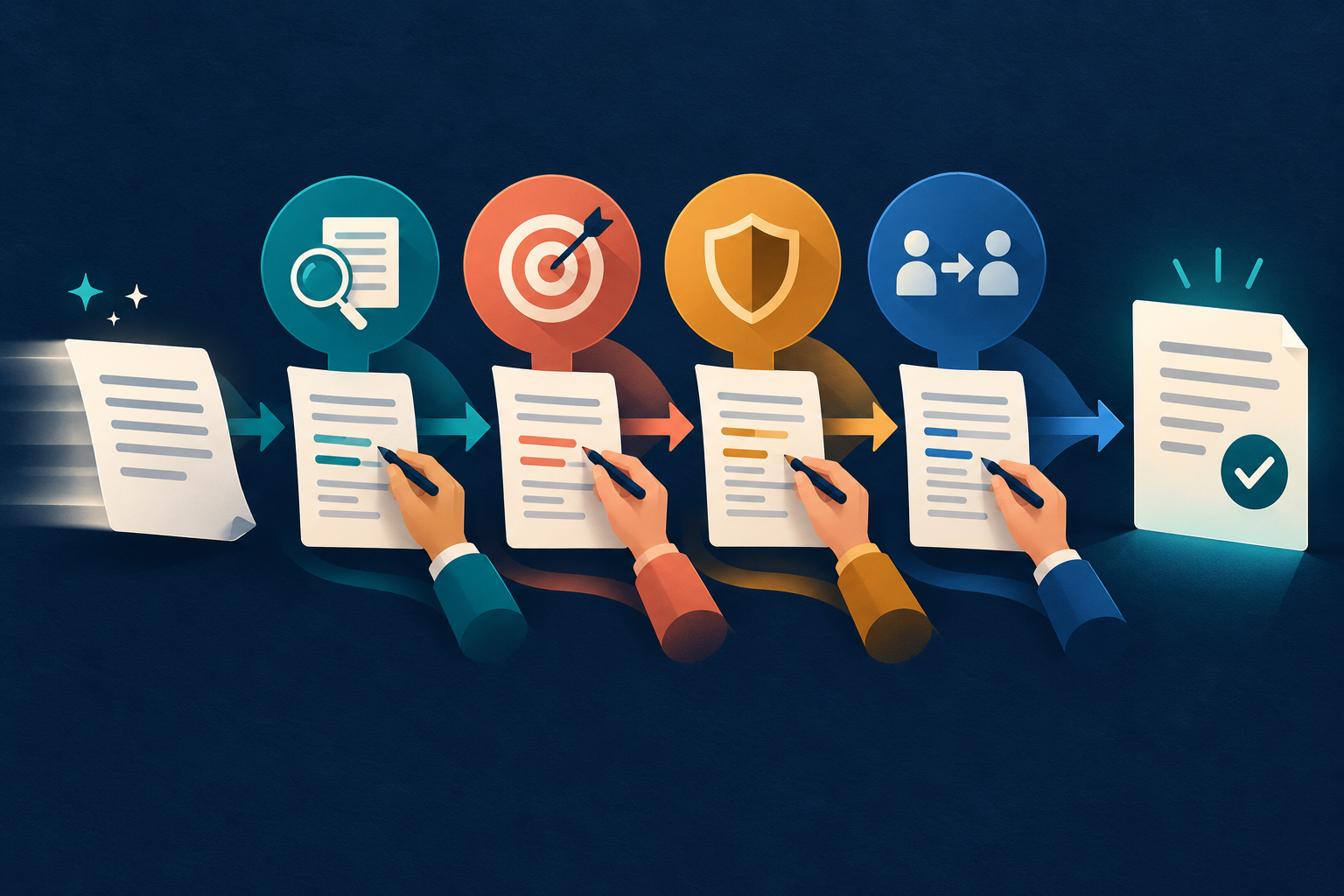
As AI drafts more workplace content, “human review” becomes four distinct jobs: checking truth, task fit, risk and ownership.
Enterprise AI Training: Give Managers a Practice Loop
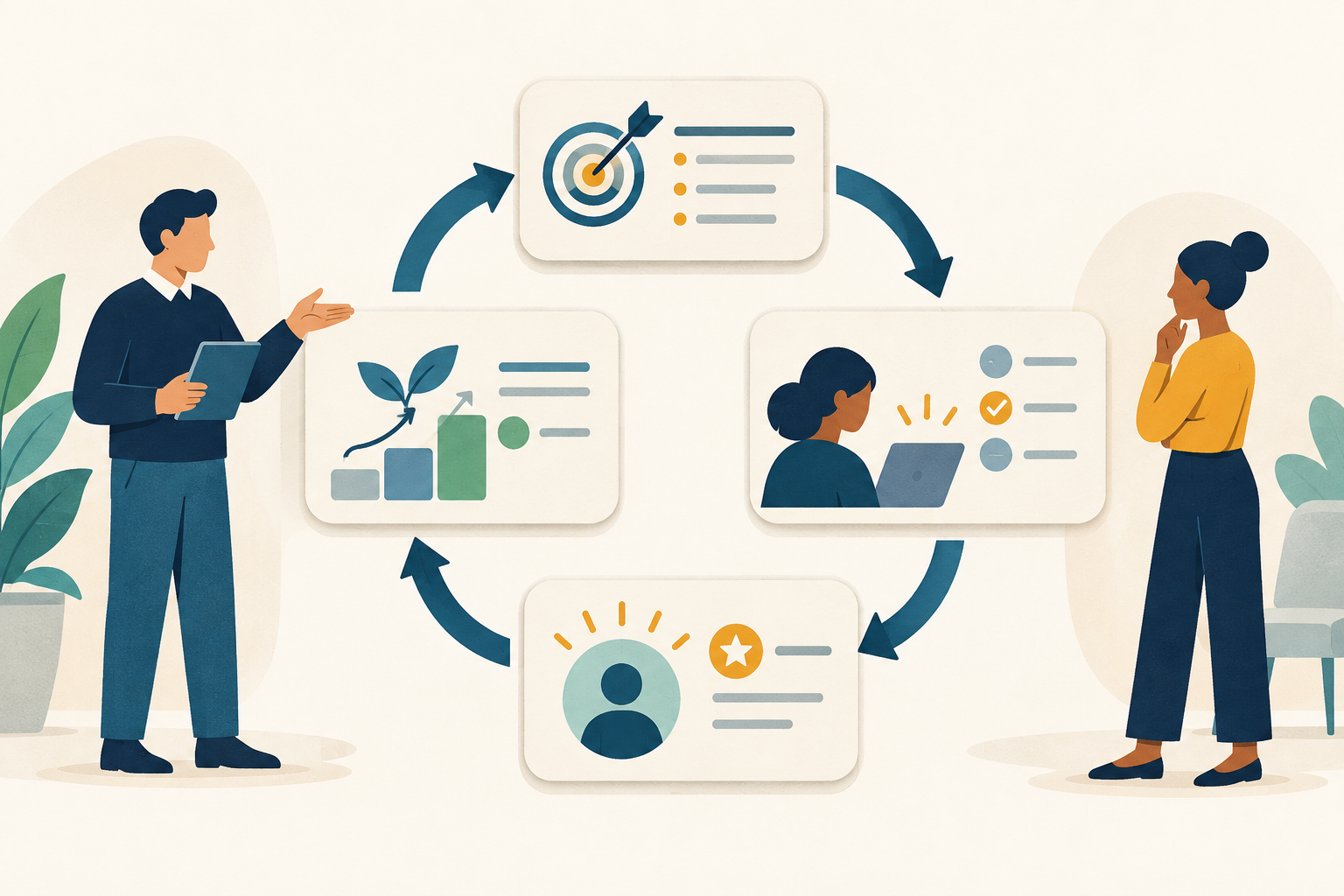
Turn enterprise AI training into observable work with a four-part loop that managers can run around one bounded task.
Turn a Budget Variance Table Into Evidence-Tagged Commentary With AI
Use AI to structure budget commentary without letting a plausible guess become a financial explanation.