
Use Claude Research to Build a Contradiction Map
Turn Claude Research into a decision aid by separating source agreement, disagreement and open questions before you write a recommendation.
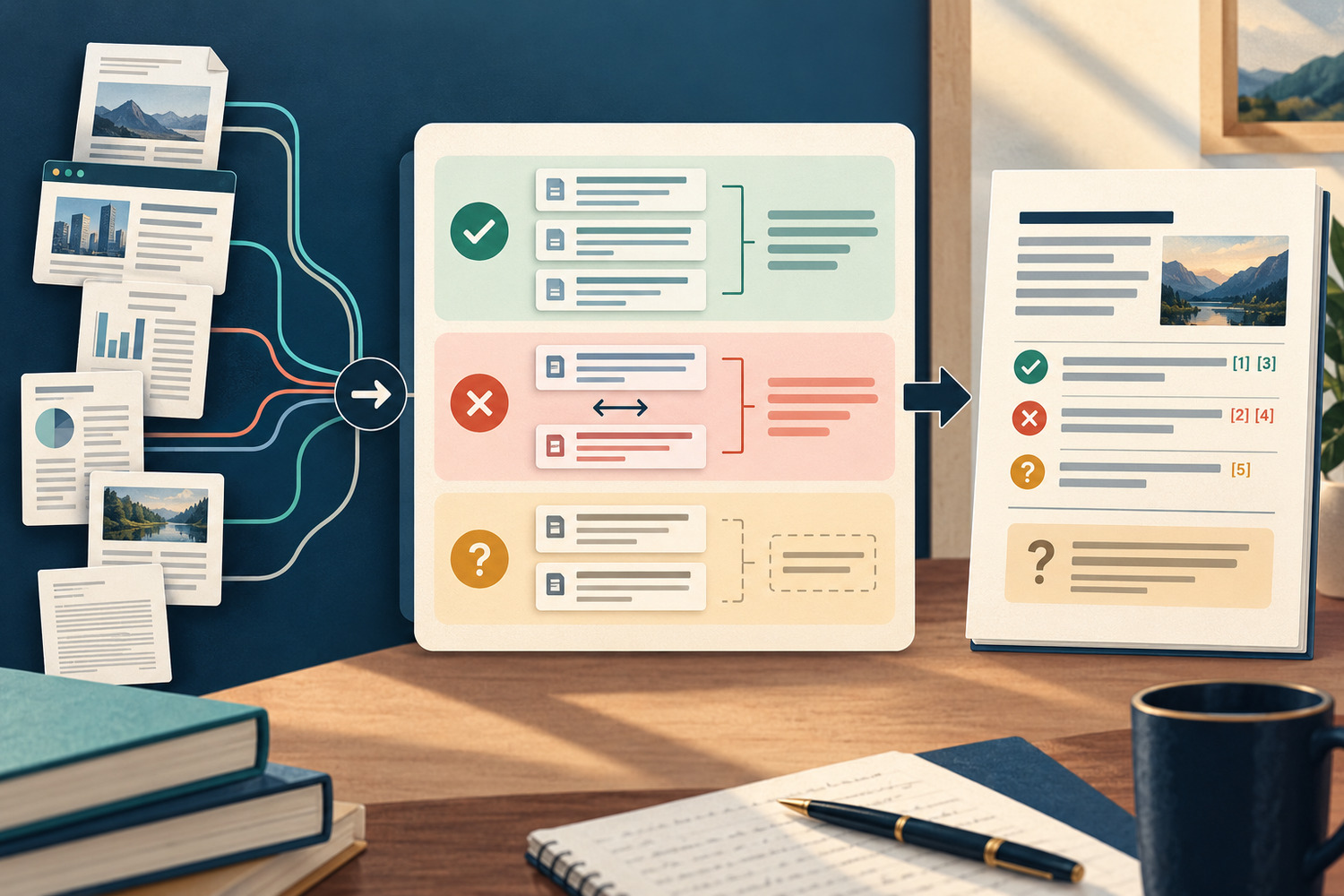
Research becomes risky when a polished summary hides where sources disagree. Claude Research can gather widely and cite its findings, but the useful output for a real decision is not a longer answer. It is a contradiction map: a compact view of what the evidence supports, where it conflicts and what remains unresolved.
This lesson is for people who compare public evidence before writing a recommendation: procurement analysts, project leads, consultants and researchers. The thesis is simple: ask Claude to separate agreement, disagreement and uncertainty before it drafts a conclusion. That structure makes verification visible and stops a confident synthesis from flattening an important conflict.
Use Claude Research when disagreement could change the decision
Anthropic’s current help describes Research as a paid-plan feature on the web, desktop and mobile. It conducts multiple searches that build on one another and returns citations. Web search must be enabled. Anthropic also distinguishes Research from ordinary web search: use Research for a question that needs broad, multi-source investigation rather than one or two factual look-ups.
Citations are a route back to evidence
A citation makes a claim easier to inspect. It does not make the claim correct. Open the source, check the passage and record what the source actually supports.
The three-lane contradiction map
Agreement
Claims supported in materially the same way by two or more independent sources. Record scope and date, not only the shared conclusion.
Disagreement
Claims that conflict because of different data, definitions, time periods or interests. State the reason for the conflict when you can verify it.
Open question
A decision-relevant point that the available sources do not answer. Give it an owner or a next source rather than filling the gap with inference.
A repeatable Claude Research workflow
From broad question to checked map
- 1
1. State the decision
Name who will decide, the date, the options and the evidence that could change the choice.
- 2
2. Set source boundaries
Ask for primary or authoritative sources first, a defined date range and explicit publication dates. Exclude sources that cannot support the claim.
- 3
3. Request three lanes
Require separate sections for agreement, disagreement and open questions. Ask for a citation beside every material claim.
- 4
4. Inspect the decisive claims
Open the sources behind the few claims that would change the recommendation. Check wording, scope, date and whether Claude inferred more than the source says.
- 5
5. Draft after verification
Only then ask for a decision brief that distinguishes verified facts, reasoned interpretation and unresolved risk.
Use Research to help me prepare a decision, not a general summary.

Decision: [state the decision, owner and deadline].
Scope: [countries, products, time period and exclusions].
Prioritise primary and authoritative sources.

Build a table with: claim; agreement; disagreement; likely reason for the difference; source and publication date; what remains unknown; decision impact.

Put a citation beside every material claim. Do not resolve a conflict unless the evidence supports the resolution. Finish with the five claims I should verify manually before drafting a recommendation.
A useful result keeps conflicts visible. It might show that two current policy sources agree on a requirement, one vendor page uses a broader definition, and an implementation deadline is still unclear. The open point remains open until a source resolves it.
Replace the bracketed fields with a real, non-confidential decision. Follow your organisation’s rules before connecting or searching internal sources.
Reading is a start. Practice makes it stick.
Start learningWorked example: compare supplier claims without inventing a winner
Imagine a fictional procurement lead comparing three software suppliers’ public claims about data retention. The decision is not “Which supplier sounds safest?” It is “Which offer meets the company’s twelve-month retention limit and deletion requirements?” The lead asks Claude Research to collect current product documentation, contract terms and relevant regulator guidance.
A normal summary could produce three tidy profiles. The contradiction map does something more useful. It records that two supplier pages describe customer-controlled deletion, while one contract defines a longer backup period. It flags that “deletion” and “inaccessible to users” may not mean the same thing. It also leaves one question open: whether the stated period covers support logs. No winner is declared until those decisive claims are checked in the original documents and confirmed through the procurement process.
| Fast summary | Contradiction map | |
|---|---|---|
| Structure | One narrative per option | Agreement, disagreement and open questions |
| Uncertainty | Often absorbed into smooth prose | Kept visible and linked to the decision |
| Verification | Many claims appear equally important | The few decision-changing claims are prioritised |
| Next action | Draft the recommendation | Resolve or accept each material gap |
Avoid three common mistakes
Before you use the map
- Do not ask for an exhaustive web review when the decision only turns on three or four criteria.
- Do not treat two pages repeating the same underlying announcement as independent agreement.
- Do not let a newer source automatically outrank a primary source; compare authority, scope and date.
- Do not paste confidential material or enable internal connectors without the permissions and data controls your organisation requires.
- Do not ask Claude to choose before you have checked the claims that could reverse the choice.
- Choose a low-risk public question with two plausible answers.
- Write the decision, deadline, scope and three criteria.
- Enable Research and run the contradiction-map prompt.
- Open the citations for the two most decision-relevant claims.
- Mark each as supported, overstated or still open.
- Write one sentence explaining what evidence would change your current view.
Keep the conflict visible until the evidence earns closure
Claude Research is valuable because it can investigate a broad question across several sources in minutes. Its speed is most useful when your structure resists premature certainty. Build the contradiction map first, verify the decisive claims and draft the recommendation last.
For a related research setup, use the Perplexity Projects research brief. Then test what a summary may have missed with the omission check and expose hidden premises with the assumption log. Bokili’s tool-specific learning approach turns workflows like these into short, role-aware practice.
Sources
Reading is a start. Practice makes it stick.
Bokili turns skills like this into ten-minute missions for your whole team, with instant feedback and progress you can see.
Start learningKeep reading
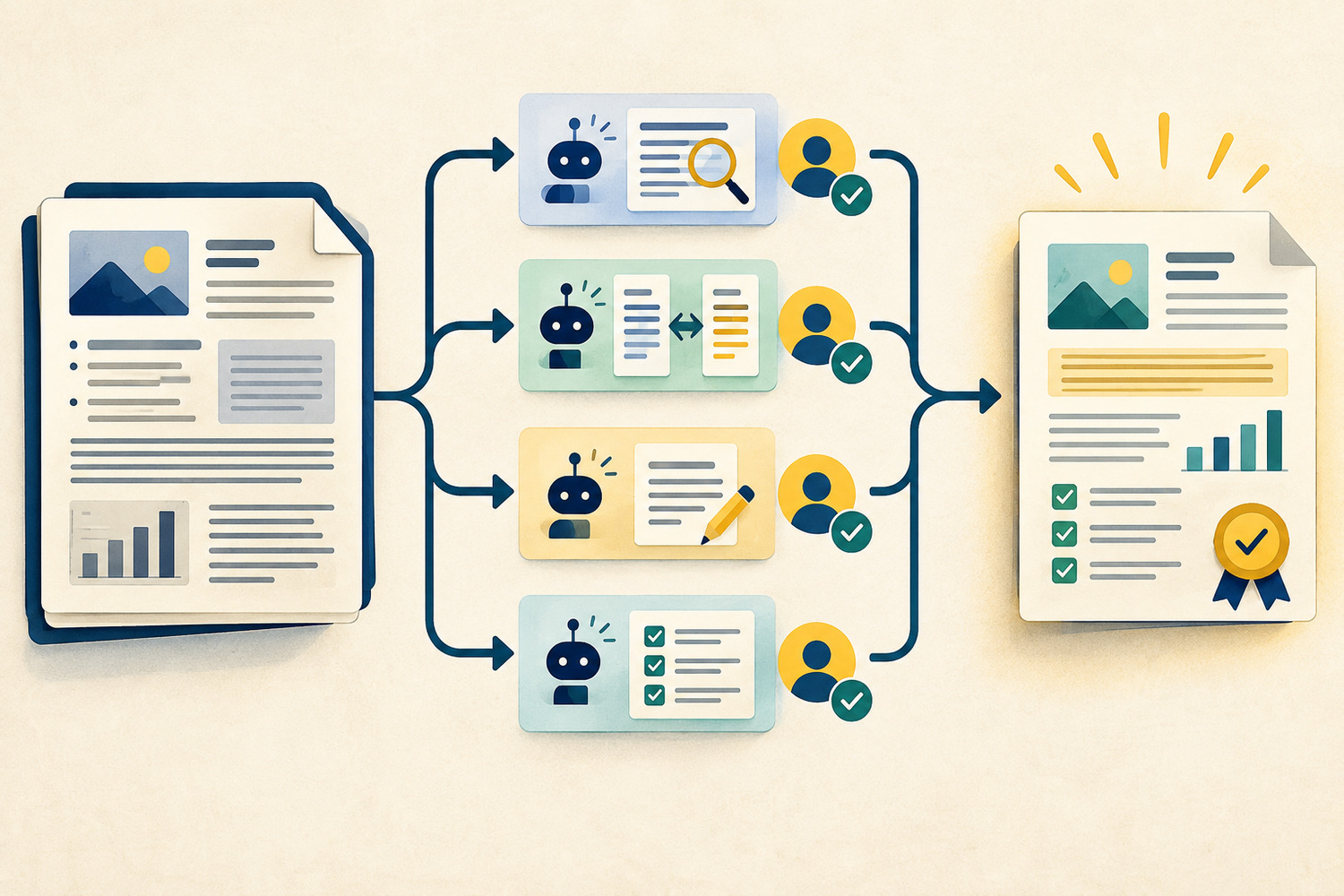
AI Training for Employees: Teach Task Decomposition
Teach employees to split complex work into small AI-assisted passes with explicit human checks before recombining the final output.

AI Skills for Employees: Budget the Review Work
AI skills for employees should include the work that happens after generation: choosing the right review path, attaching evidence and knowing when specialist approval is required.

A Ten-Minute AI Mission Should Leave a Reusable Work Artefact
Short AI practice becomes more useful when the learner leaves with a checked prompt pattern, workflow card or decision aid that can support the next real task.