

Use Claude Organisation Instructions to Set a Plain-Language Standard
Set one concise writing baseline across Claude Team or Enterprise, then test it on real document types before wider use.

A team can ask Claude for clear writing in every prompt. In practice, people forget, copy different wording or accept dense output because the deadline is close. Claude organisation instructions offer admins a way to set one baseline across the organisation—for example, short sentences, active voice and explicit next actions.
Anthropic says organisation instructions are available to Admins, Owners and Primary Owners on Team and Enterprise plans. They apply across the organisation’s conversations and take precedence when an individual instruction directly conflicts, although Anthropic also advises testing because instruction behaviour can vary in rare edge cases.
Use the feature for defaults, not final approval
Organisation instructions can make the first draft more consistent. They cannot guarantee accuracy, enforce every policy or replace a human review of important work.
Choose rules that should apply everywhere
The strongest organisation instructions describe behaviour that is genuinely common across teams. Plain language is a good candidate: it improves emails, summaries, briefs and explanations without pretending every document needs the same detailed template.
CLEAR: a plain-language standard Claude can apply
C — Common words
Prefer familiar words. Keep necessary technical terms, then explain them once in plain language.
L — Lead with the point
Put the answer, decision or requested action before background detail.
E — Evidence visible
Separate facts, assumptions and suggestions. Never invent a source, result or policy.
A — Active and short
Use active voice where natural. Keep most sentences focused on one idea.
R — Reader action
End operational content with the owner, action and timing when those details are provided.
Write instructions that can be tested
| Vague instruction | Observable instruction | |
|---|---|---|
| Clarity | Write clearly. | Lead with the main answer. Use common words and explain necessary technical terms. |
| Length | Be concise. | Use short paragraphs. Remove repeated context and filler. |
| Evidence | Be accurate. | Label assumptions. Do not invent facts, sources, policies or results. |
| Action | Make it useful. | When the input provides them, state the owner, next action and timing. |
Reading is a start. Practice makes it stick.
Start learningAnthropic’s current guidance allows up to 3,000 characters, but recommends concise, specific instructions because they are included with every message. Treat the limit as a ceiling, not a target.
Write in plain English. Lead with the main answer or requested action. Use common words, active voice and short paragraphs. Keep necessary technical terms, but explain them once. Separate facts, assumptions and suggestions. Never invent a source, result, customer, policy or deadline. When the input provides an owner, action or date, make them easy to find. Preserve required legal or technical wording. If clarity conflicts with precision, keep the precise meaning and explain it simply.
A consistent first-draft standard for conversations across the organisation.
Have legal, compliance and communications owners review the wording before an admin saves it.
Test the standard before rolling it out
A five-document test
- 1
1. Collect representative inputs
Use a fictional email, project update, technical explanation, policy summary and executive brief.
- 2
2. Record the baseline
Run each task in a new conversation without the proposed instruction and save the output.
- 3
3. Add the instruction
An authorised admin enters the reviewed text under Organisation settings and saves it.
- 4
4. Re-run the cases
Start new conversations and compare the output for clarity, meaning, evidence and action.
- 5
5. Test a conflict
Add a user request for jargon or unnecessary length. Confirm the organisation standard still shapes the answer.
- 6
6. Revise one rule at a time
Change only the instruction that caused the failure, then rerun the same case pack.
Before you save
- Each rule applies to most teams and conversations.
- The instruction describes visible behaviour rather than taste.
- Required legal, policy and technical language can still be preserved.
- The text does not contain confidential information.
- The rules do not contradict one another.
- Five different task types have been tested in new conversations.
- A named owner will review the standard after tool or policy changes.
- Users know that important outputs still need human checking.
- Choose one dense but non-sensitive paragraph.
- Ask Claude to rewrite it under the proposed CLEAR standard.
- Check whether every fact and qualification survived.
- Ask a colleague to identify the main action in five seconds.
- Revise one instruction if the action or meaning is unclear.
A shared default is valuable when it removes repeated prompting without removing judgement. Keep the organisation instruction small, testable and boring enough to work in many contexts. Put specialised workflows in project instructions or skills instead of forcing them into a global rule.
Bokili helps employees practise the other half of the workflow: choosing the right task, providing enough context, checking the output and revising it for the real reader. A good default improves the starting point; practice still determines whether the work is ready to use.
Sources
- Set organization instructions — Claude Help Center
- Understanding Claude's personalization features — Claude Help Center
Reading is a start. Practice makes it stick.
Bokili turns skills like this into ten-minute missions for your whole team, with instant feedback and progress you can see.
Start learningKeep reading

AI Training for Employees: Separate Drafts From Records
Teach a four-state path—Draft, Checked, Approved, Recorded—so polished AI output never becomes organisational fact by accident.

Use Gemini Notebook Mind Maps to Turn Policy Into Questions
Use a Gemini Notebook mind map as a question index for a long policy—then open the cited source before you trust any answer.
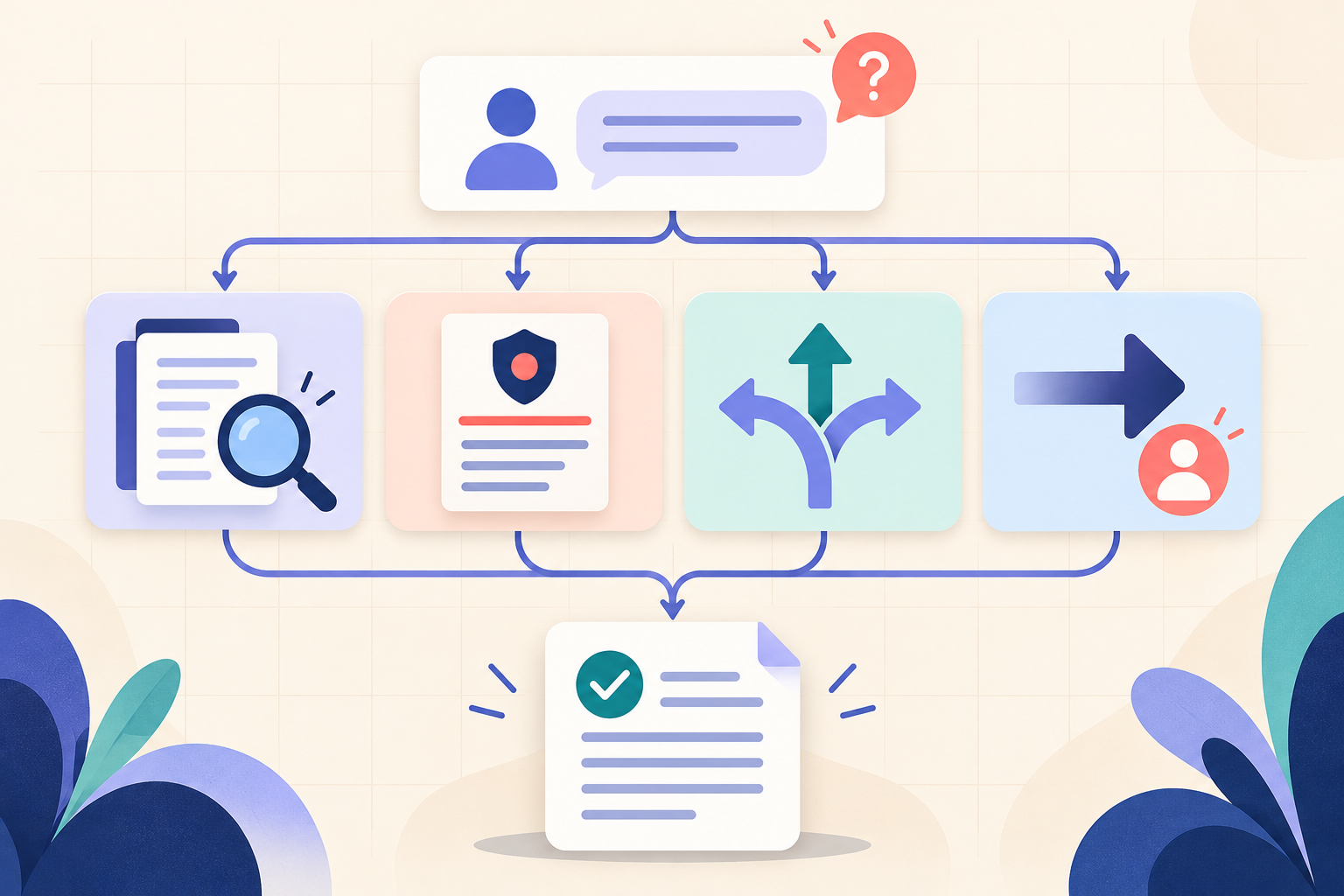
AI Training for HR: Build a Four-Part Policy Answer
Teach HR teams to separate the source, written rule, human discretion and next step before turning an AI draft into employee guidance.