ChatGPT Training for Employees: A Practical Four-Week Curriculum
A ready-to-use four-week ChatGPT training plan that moves employees from safe first use to verified, repeatable workflows for real work.

ChatGPT training for employees often starts with a feature tour and ends with a list of prompts. That is not enough. Employees need to know what they may share, how to frame a task, how to check an answer and how to turn a useful experiment into a repeatable way of working.
This four-week curriculum is designed for HR, L&D and team leaders who want a practical starting point. It uses three short practice sessions per week. Each session should work with realistic but non-sensitive material from the employee’s role. The goal is not to master every ChatGPT feature. It is to build four reliable behaviours.
The curriculum in one line
Week 1: use it safely. Week 2: ask clearly. Week 3: verify the answer. Week 4: build one repeatable workflow.
Why a four-week progression works
OpenAI’s current workplace analysis shows that early use commonly centres on writing, research, programming and analysis, while the mix of features and tasks differs by role. That points to a simple training principle: teach a shared foundation first, then practise on role-specific work.
The European Commission’s current AI-literacy guidance also says organisations should consider people’s technical knowledge, experience, education, training and the context in which they use AI systems. A single generic webinar cannot cover those differences. A short progression with real practice makes it easier to adapt the same core behaviours to sales, HR, finance, operations or marketing.
Week 1 — Safe and scoped use
Session 1: learn the company’s approved tools, data rules and prohibited uses. Session 2: sort example inputs into safe, restricted and uncertain. Session 3: complete one low-risk task with approved material and record what a human must still decide.
Week 2 — Clear prompts and iteration
Session 1: define the task, audience and desired output. Session 2: add useful context, constraints and a clear format. Session 3: review the first answer and improve the prompt instead of accepting or discarding it immediately.
Week 3 — Verification and judgement
Session 1: separate claims, suggestions and assumptions. Session 2: check names, dates, calculations and source links against trusted evidence. Session 3: compare the answer with the employee’s own expertise and decide what to keep, change or reject.
Week 4 — One repeatable workflow
Session 1: choose a frequent role-specific task. Session 2: document inputs, prompt, review steps and stop conditions. Session 3: run the workflow on a second example, improve it and share the method with the team.
Week 1: set the boundary before teaching prompts
Start with the organisation’s real rules. Employees should know which ChatGPT workspace is approved, which information must stay out, when they need permission and where to report a mistake. Product settings matter, but policy comes first. OpenAI states that Business workspace data is excluded from model training by default and that users’ chats are not automatically visible to colleagues. Those product facts do not decide what your employees may upload; your organisation still needs clear rules for confidential, personal and regulated information.
Use examples rather than a long policy recital. Ask learners whether they may paste a public product description, an internal draft, a customer complaint, a payroll file or unpublished financial figures. The useful learning moment is often the uncertain case: the employee should pause and ask, not guess.
Week 2: teach a useful prompt, not prompt theatre
OpenAI’s current guidance recommends clear, specific prompts with enough context, followed by iterative refinement. Turn that advice into one reusable pattern: task, context, constraints and output. Employees do not need elaborate prompt syntax. They need to explain the work clearly and improve the request after reviewing the result.
Reading is a start. Practice makes it stick.
Start learningHelp me turn these approved meeting notes into a decision summary for the project team. Audience: colleagues who were not in the meeting. Include: decisions, owner, due date, unresolved question and source note. Keep it under 250 words. Do not invent missing owners or dates; mark them as [TO CONFIRM]. Notes: [paste approved, non-sensitive notes].
A structured first draft that makes missing information visible instead of filling the gaps.
The employee still checks the draft against the original notes before sharing it.
Week 3: make verification part of the task
Do not teach verification as a warning placed at the end of training. Build it into every exercise. Learners should open cited sources, redo important calculations, check whether the answer used the requested evidence and notice when confident wording hides uncertainty.
A useful review routine has four moves: identify the material claims; match each claim to evidence; apply professional judgement; and record any uncertainty that remains. The final question is not “Does this sound good?” It is “What can I support, and what still needs a person to decide?”
Week 4: convert one success into a workflow
The final week moves beyond one-off prompting. Each employee chooses a frequent task with a clear input and output: drafting a meeting summary, comparing supplier responses, preparing interview questions or turning research notes into a brief. They document the approved inputs, the prompt, the checks, the stop rule and the final owner.
Test the workflow on a second example. If it works only on the original case, it is a clever prompt, not a reliable process. The second run often reveals hidden assumptions, missing context or review steps that need to be added.
What every employee should be able to do after four weeks
- Choose the approved ChatGPT workspace and follow company data rules.
- Turn a work task into a clear prompt with context, constraints and an output format.
- Improve a prompt after reviewing the first answer.
- Check material claims, calculations and sources against trusted evidence.
- Spot missing information and ask for human judgement instead of letting ChatGPT guess.
- Document one role-specific workflow with a review step and a named owner.
Measure behaviour, not attendance
Completion tells you who attended. It does not show who can use ChatGPT well. Use a simple before-and-after task instead. Score whether the employee respected data rules, framed the task clearly, checked the answer, corrected a problem and produced a usable output. Ask managers whether the workflow is being reused and whether its review steps are still followed.
Keep the curriculum narrow. One verified workflow is a stronger result than a tour of twenty features. After the four weeks, extend practice by role and risk level. Employees handling public marketing copy need different examples and controls from people working with contracts, customer data or financial decisions.
- Choose a team and one low-risk task they repeat every week.
- Write the safe-use boundary in five plain-language rules.
- Select one practice example for each of the four weekly behaviours.
- Define a short final task and a six-point scoring checklist.
- Schedule three short practice moments per week and one manager review at the end.
Bokili is built around this kind of focused practice: short missions adapted to a person’s role, level and tools. Whether you use Bokili or build the programme yourself, keep the standard clear—employees should leave training with a safer, checked and reusable way to do real work.
Sources
- Prompt engineering best practices for ChatGPT — OpenAI Help Center
- ChatGPT usage and adoption patterns at work — OpenAI
- Managing data, sharing, and privacy in ChatGPT Business — OpenAI Help Center
- AI Literacy - Questions & Answers — European Commission
Reading is a start. Practice makes it stick.
Bokili turns skills like this into ten-minute missions for your whole team, with instant feedback and progress you can see.
Start learningKeep reading

AI Training for Employees: Separate Drafts From Records
Teach a four-state path—Draft, Checked, Approved, Recorded—so polished AI output never becomes organisational fact by accident.
Use Gemini Notebook Mind Maps to Turn Policy Into Questions
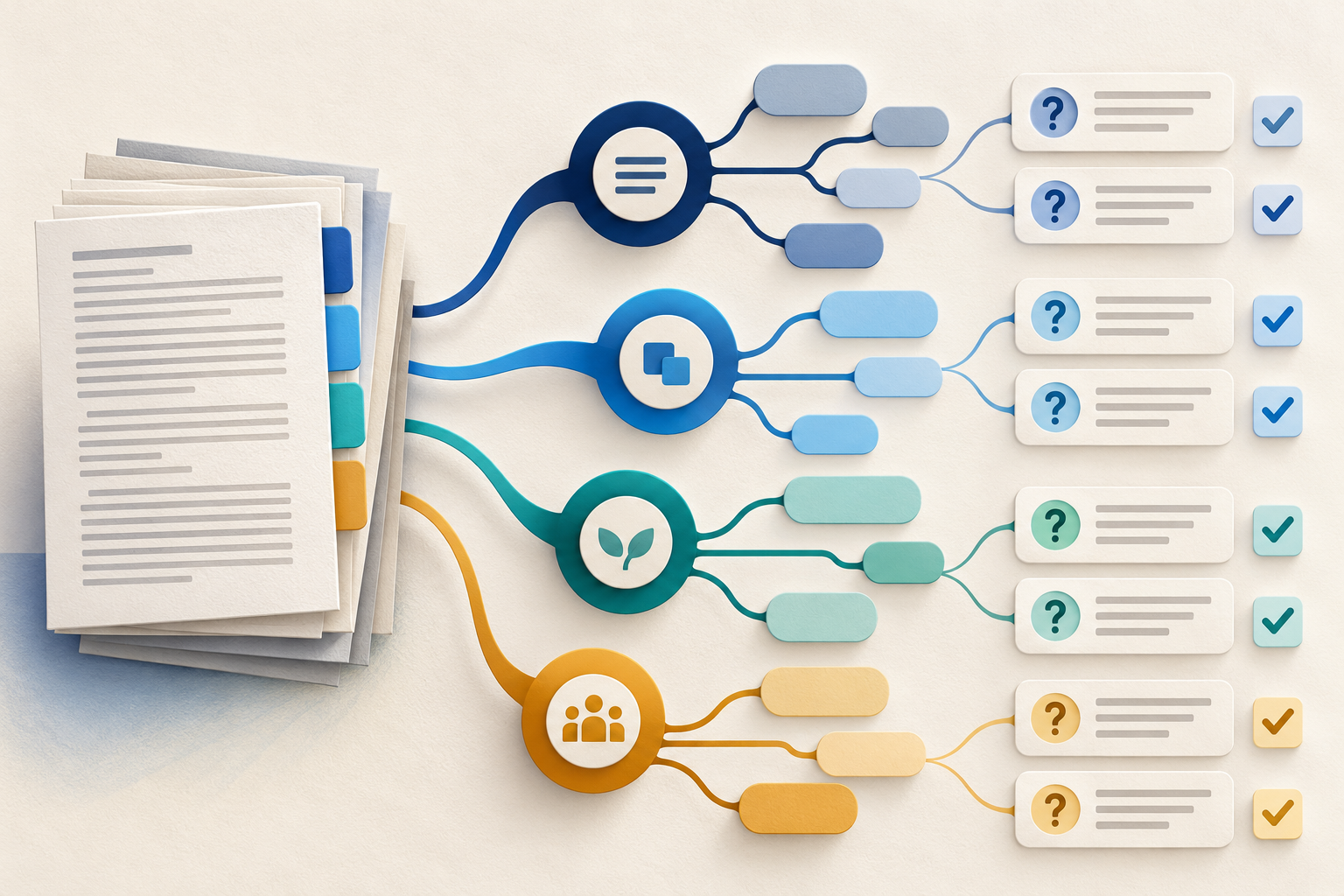
Use a Gemini Notebook mind map as a question index for a long policy—then open the cited source before you trust any answer.
AI Training for HR: Build a Four-Part Policy Answer
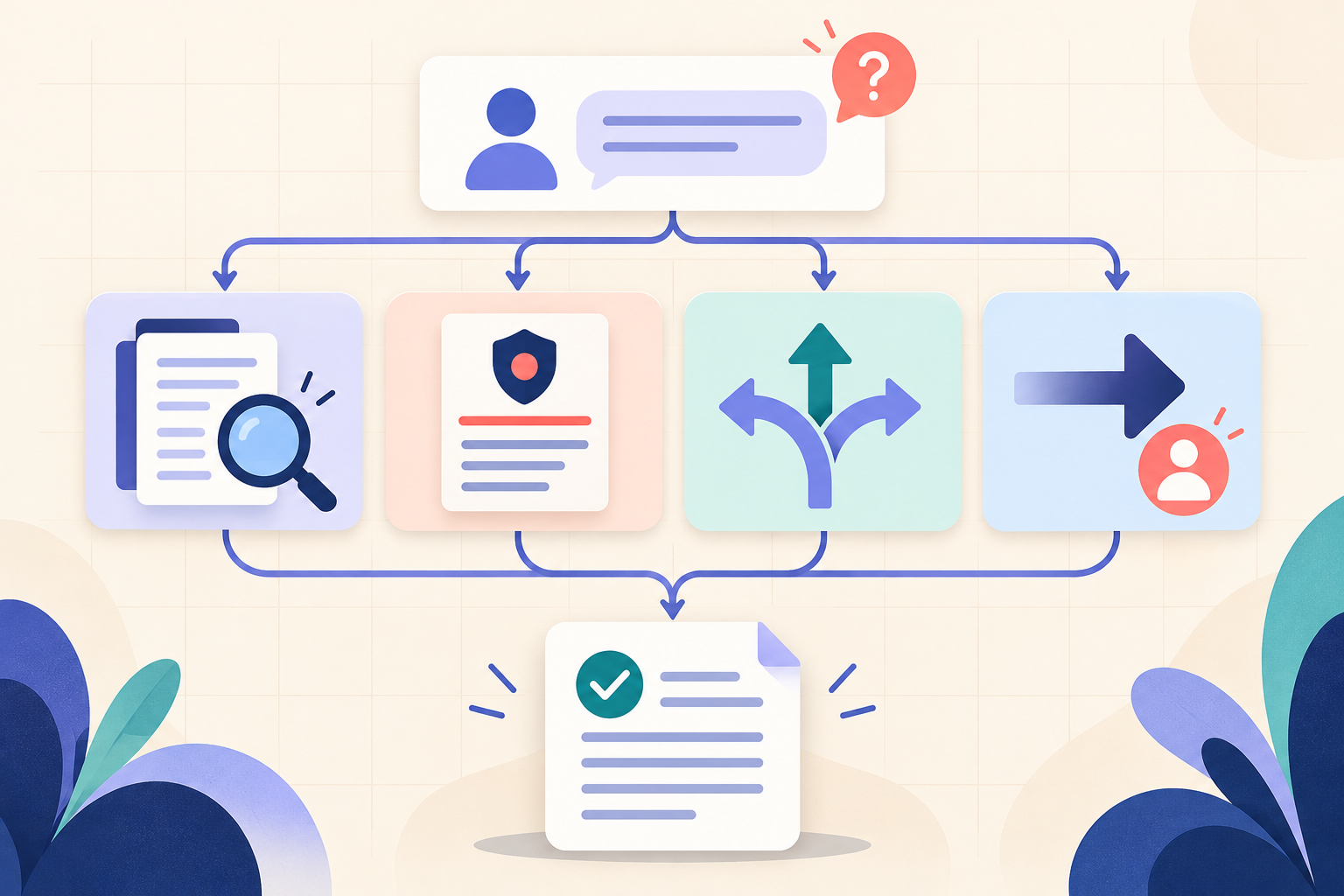
Teach HR teams to separate the source, written rule, human discretion and next step before turning an AI draft into employee guidance.