

AI Changes the Task Mix Before the Job Title
A role can keep its name while AI reshapes the work inside it. Map what is delegated, augmented, protected and newly created before redesigning jobs or training.
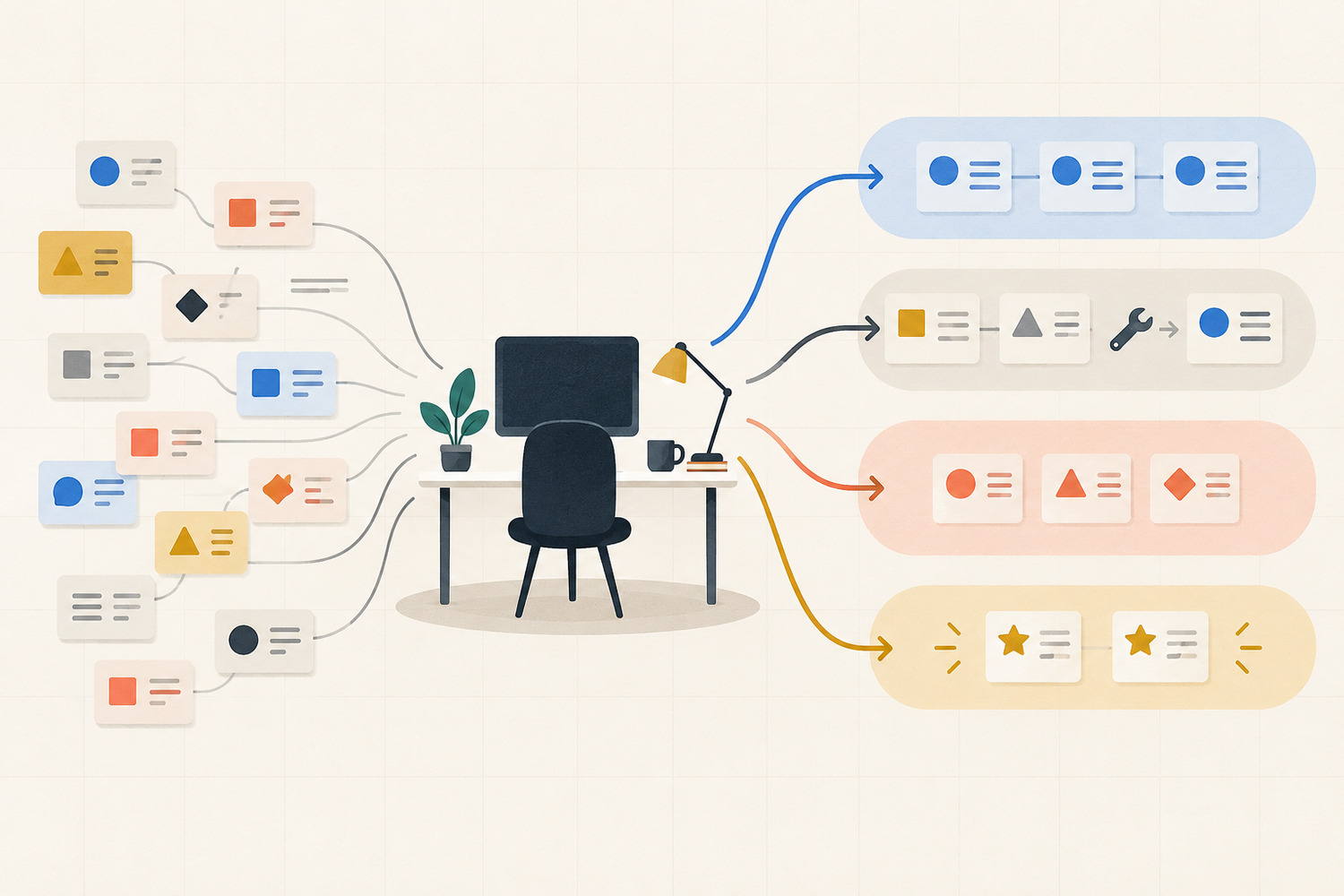
A job title can stay unchanged while the work inside it moves. One task becomes a first draft made with AI. Another needs more checking. A third remains a human decision because trust, consequences or accountability matter. New tasks appear around evidence, escalation and monitoring. If leaders watch only headcount or job titles, they see the change late.
The useful unit of AI change is often the task. That does not mean every task will be automated, or that task exposure predicts a specific employment outcome. It means a role should be treated as a changing bundle of activities, decisions and relationships. Map that bundle before promising efficiency, redesigning a role or commissioning training.
Exposure is not the same as disappearance
The International Labour Organization’s 2025 global index assesses generative-AI exposure using task-level data, expert input and model predictions. Its conclusion is deliberately cautious: because most occupations contain tasks that still require human input, transformation is the more likely effect than wholesale replacement. Exposure shows where change may occur; it does not by itself tell an organisation what should be automated.
NIST’s AI Use Taxonomy starts with human goals and outcomes, then describes how AI contributes to a task. That order matters. A tool capability is not a work decision. Leaders still need to define the desired result, the activities involved, the people affected and the consequences of a weak output.
OECD research on workplace AI users also reports both task automation and task creation. The balance varies across settings. The practical lesson is not to copy a general forecast into a local workforce plan. Inspect the work people actually do, then revisit the map as tools and operating choices change.
Map four movements in the task mix
Delegate
AI produces a bounded first pass or handles a repetitive transformation. A person still defines the task, inputs and acceptance criteria.
Augment
A person and AI iterate together. The human supplies context, challenges the output and decides when it is useful.
Protect
Keep human authority where consequences, relationships, legal duties or hard-to-reverse judgments require it.
Create
Add the work that responsible use introduces: source preparation, verification, exception handling, monitoring and learning.
A job-first forecast hides the operating choices
| Job-first question | Task-mix question | |
|---|---|---|
| Scope | Will this role disappear? | Which activities and decisions are changing? |
| Evidence | What can the model do in a demo? | What happened on representative work with review? |
| People | How many jobs are exposed? | Who gains work, loses work or carries new responsibility? |
| Control | Where can we automate? | Where must a person approve, explain or stop? |
| Learning | Who needs an AI course? | Which new behaviour does each role need to practise? |
Reading is a start. Practice makes it stick.
Start learningThe second column turns a distant prediction into choices the organisation can inspect. It also exposes trade-offs. A faster draft may create a slower review queue. A helpful summary may move more responsibility to the person who must detect omissions. A role may lose routine production but gain difficult conversations with customers or colleagues.
Worked example: a customer-service team leader
Imagine a team leader who prepares a weekly view of recurring customer issues. An approved AI tool can group redacted case notes and draft themes. The job title remains the same, but the task mix does not. Manual sorting shrinks. Source preparation and exception review grow. The leader still decides which issues need action and must explain the evidence to service owners.
Recompose the role in five passes
- 1
Name the outcome
Produce a defensible weekly view of service problems, not simply a polished summary.
- 2
List the current tasks
Collect notes, remove sensitive details, group cases, check themes, escalate serious issues and agree actions.
- 3
Mark the four movements
Delegate initial grouping, augment theme drafting, protect escalation decisions and create an omission check.
- 4
Assign authority
Name who approves the source set, signs off conclusions and stops the workflow when evidence is weak.
- 5
Choose one learning need
Practise tracing every reported theme to cases before expanding tool access or rewriting the whole role.
This map gives the employee something more useful than a prediction. It shows what is changing now, what remains theirs, what new support is required and which choices are still open. It also gives leaders a better basis for consultation: employees can correct the map because they know the hidden steps and failure cases.
Use the task map to connect work, learning and governance
For honest conversations about changing work, use AI Training for HR: Lead Honest Job-Change Conversations. Turn the task map into observable capability with the role-based AI skills matrix. If one review point limits the whole flow, train the workflow constraint. When an AI recommendation carries hidden premises, add an assumption log. Bokili’s leader path connects these practices to short, role-aware learning.
- Choose one role affected by an active AI pilot.
- Write the work outcome and six to ten tasks that produce it.
- Mark each task Delegate, Augment, Protect or Create.
- Name the evidence for every Delegate or Augment choice.
- Circle any new review, explanation or escalation load.
- Choose one task to practise and one question to take back to employees.
AI may change a role profoundly without removing its title. The responsible response is neither denial nor a sweeping forecast. It is a visible task map, built with the people who know the work, tied to evidence from real use and revised when the work changes again.
Sources
- Generative AI and Jobs: A Refined Global Index of Occupational Exposure — International Labour Organization
- AI Use Taxonomy: A Human-Centered Approach — NIST
- Preparing for the impact of AI on job quantity and skills needs — OECD
Reading is a start. Practice makes it stick.
Bokili turns skills like this into ten-minute missions for your whole team, with instant feedback and progress you can see.
Start learningKeep reading
AI Training Platform for Companies: Run an Accessibility Rehearsal
Before choosing an AI training platform for companies, test one complete learning journey with keyboard, zoom, screen reader and error recovery.
Personalised AI Missions Need a Fixed Evidence Bar
Adapt the role, tool and starting support—but keep one visible evidence standard so personalised AI practice still proves the same skill.
ChatGPT Training for Employees: Treat Imported Text as Data
Teach employees to keep a stable task when an email, document or webpage contains instructions that the AI should analyse—not follow.