The Best Next AI Lesson Starts With the Last Attempt
A useful AI learning path should respond to demonstrated work, not keep serving the same sequence after every learner takes a different route.
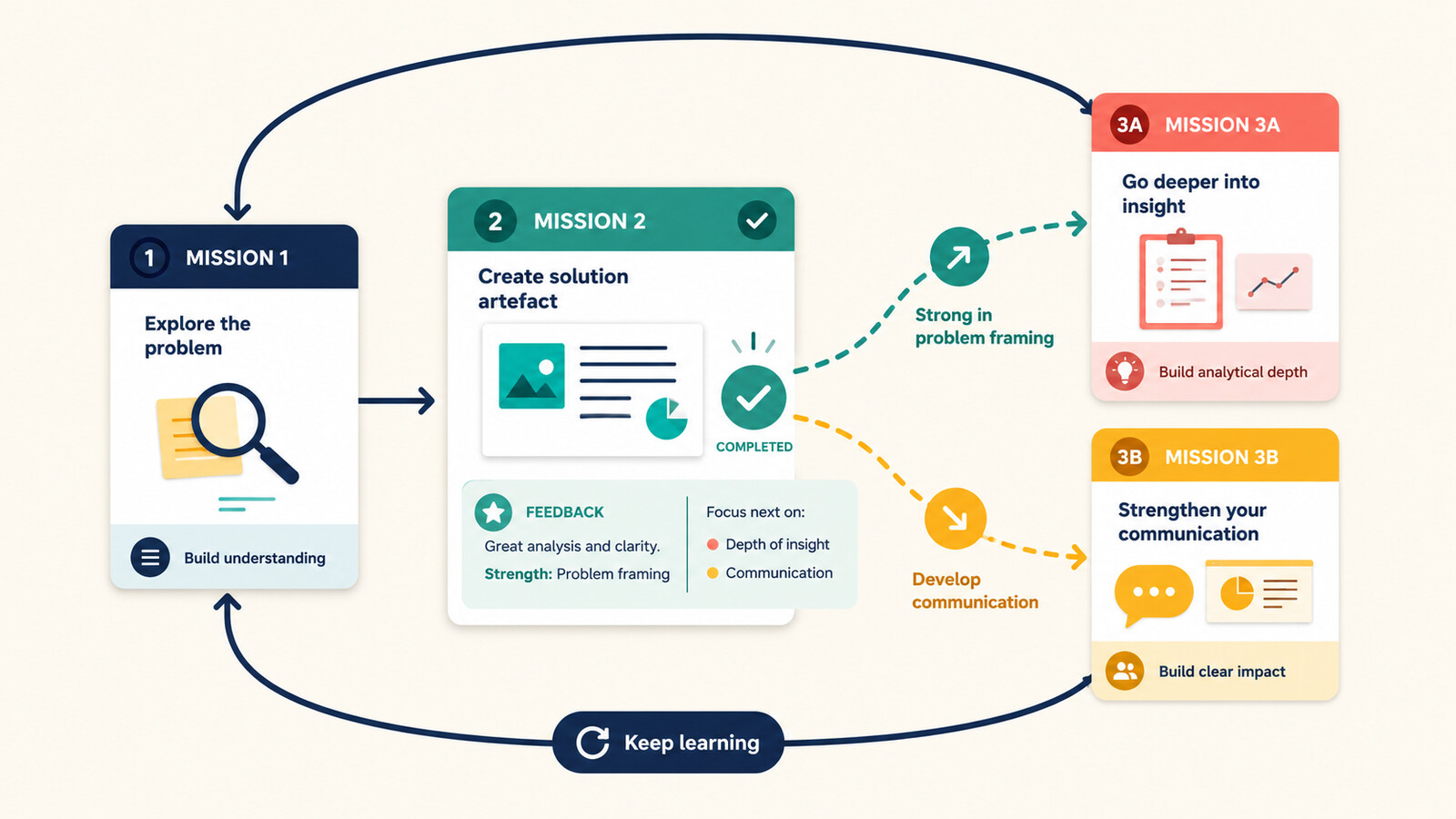
Two employees can finish the same AI exercise and need completely different next lessons. One writes clear instructions but accepts weak evidence. The other checks facts carefully but cannot define the audience or output format. Sending both people to “module three” is convenient administration. It is poor learning design.
A useful AI learning path should treat each completed task as evidence. The question after a mission is not simply whether the learner finished. It is: what did the work show, and which small challenge would improve the next attempt?
The next lesson is a decision
Completion tells you that an activity ended. The attempted work tells you what should happen next.
Why a fixed sequence loses useful information
A role and a self-declared level are good starting signals. They help avoid sending a finance beginner an advanced marketing workflow. But they are only a first estimate. Once the learner produces work, the learning system has stronger evidence: the choices made, the quality of the output and the feedback that was needed.
The National Academies’ synthesis of learning research emphasises that prior knowledge, individual variability and the structure of the learning environment affect learning. That does not prove one product’s recommendation method. It supports a more modest design principle: teaching should respond to what the learner already knows and what their performance reveals.
The Evidence-to-Next loop
Observe
Look at the attempted behaviour, not only the completion flag. What did the learner specify, verify, revise or decide?
Interpret
Separate a demonstrated strength from the most important gap. Do not turn every imperfection into a new lesson.
Route
Choose one next mission that fits the learner’s role, current level and available AI tools while targeting that gap.
Recheck
Use a different work situation to see whether the improved behaviour transfers beyond the original example.
A worked example: the same mission, two routes
Imagine Maya and Louis complete a mission about comparing two supplier proposals. Maya frames the decision well, states the commercial constraints and asks for a clear comparison table. However, she repeats two unsupported claims from the AI output. Louis verifies every important claim against the proposals, but his request never states who will read the result or which trade-off matters most.
Reading is a start. Practice makes it stick.
Start learning| Maya’s next mission | Louis’s next mission | |
|---|---|---|
| Evidence from the attempt | Strong framing; weak source checking | Strong verification; weak audience and decision context |
| Next practice target | Identify the claim that could change the decision and verify it | Rewrite the request with audience, decision and constraints |
| Transfer check | Verify a claim in a budget recommendation | Frame a short recommendation for an operations leader |
Neither learner needs to repeat the whole supplier exercise. Neither needs a broad “intermediate AI” module. Each needs one adjacent challenge. The route remains coherent because the next mission still fits the person’s work, level and tools; it simply uses the latest evidence to sharpen the choice.
What evidence is useful—and what is not
Use evidence that a learner can understand
- Name the specific behaviour shown in the submitted work.
- Distinguish an important skill gap from a stylistic preference.
- Explain why the next mission follows from that gap.
- Keep sensitive work content out of learning records.
- Let a learner revisit or challenge feedback when context was misunderstood.
- Measure transfer with a new example, not a repeated answer.
A recommendation should never become a hidden verdict about a person. “This response omitted a source check” is actionable. “This employee has poor judgement” is a sweeping inference. Good adaptive learning stays close to observable work and makes the route legible.
- Choose one completed AI exercise from a course or workshop.
- Write the single behaviour that its output makes visible.
- Invent two plausible attempts: one strong in framing, one strong in verification.
- Design a different next task for each attempt.
- Check that both routes fit the same role, level and approved tool set.
- Add one later task that tests whether the behaviour transfers.
Personalisation should become more precise over time
Bokili’s public product flow begins with role, current level and available tools, then uses completed work and feedback to recommend what comes next. The point is not to create a mysterious algorithm. It is to make the learning path more useful after every attempt.
A static library asks the learner to find the right lesson. An adaptive practice loop accepts a harder responsibility: learn enough from the last attempt to make the next ten minutes count.
Sources
- Bokili — AI fluency training for companies and teams — Bokili
- How People Learn II: Learners, Contexts, and Cultures — National Academies of Sciences, Engineering, and Medicine
Reading is a start. Practice makes it stick.
Bokili turns skills like this into ten-minute missions for your whole team, with instant feedback and progress you can see.
Start learningKeep reading
AI Training for Employees: Separate Drafts From Records
Teach a four-state path—Draft, Checked, Approved, Recorded—so polished AI output never becomes organisational fact by accident.
Use Gemini Notebook Mind Maps to Turn Policy Into Questions
Use a Gemini Notebook mind map as a question index for a long policy—then open the cited source before you trust any answer.
AI Training for HR: Build a Four-Part Policy Answer
Teach HR teams to separate the source, written rule, human discretion and next step before turning an AI draft into employee guidance.