
Turn a Customer Complaint Into an Evidence-First AI Brief
Use AI to structure complaint evidence without blurring customer claims, documented facts, commitments or human decisions.
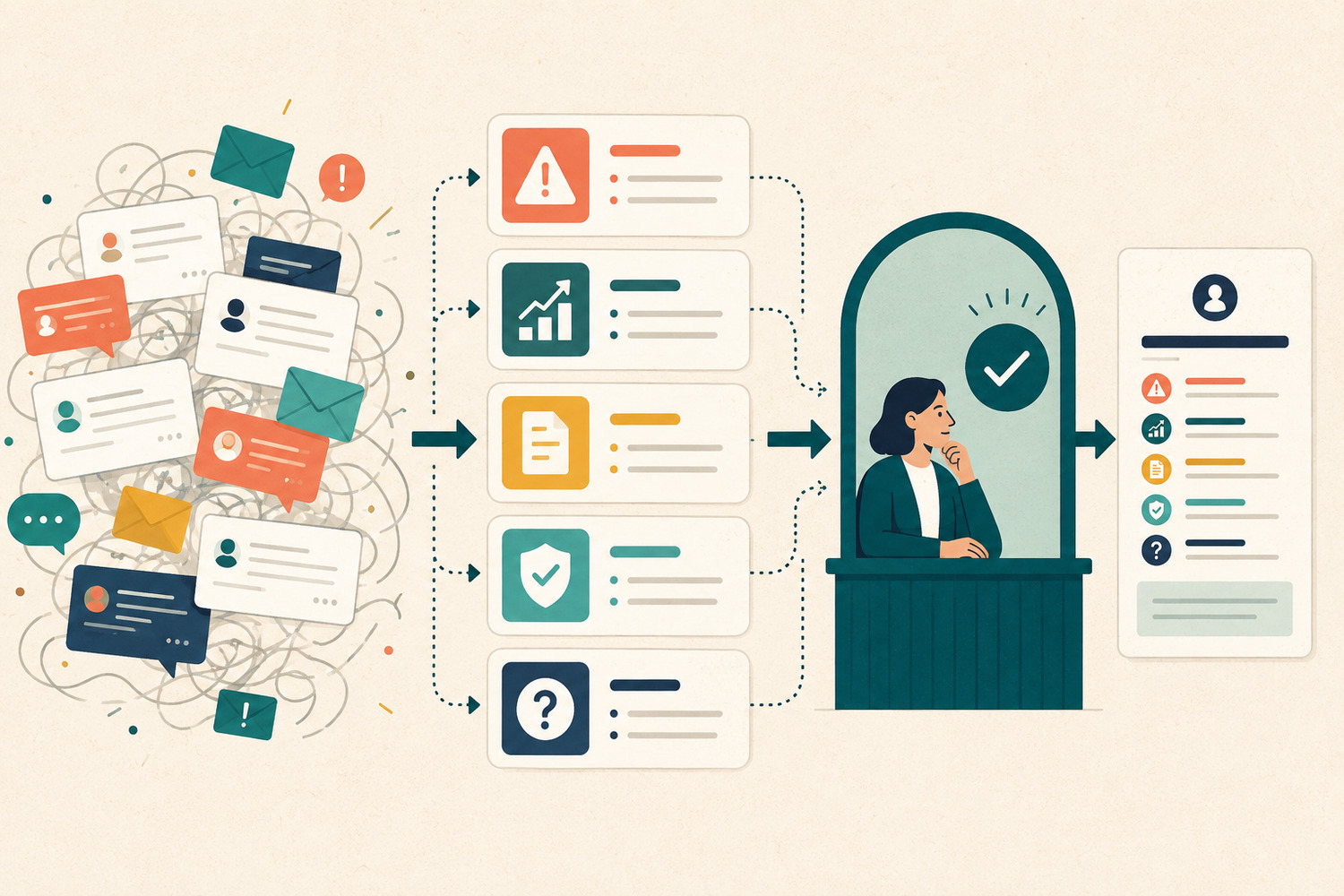
A customer complaint rarely arrives as a neat case file. It arrives as an email, a chat transcript, an order history, internal notes and several promises made at different times. When the case escalates, the support lead must understand what happened without confusing the customer’s account, the organisation’s records and an AI-generated interpretation.
AI can help organise that material, but it should not decide whether the complaint is valid or what remedy is due. The useful role is narrower: turn an approved, privacy-safe evidence set into a brief that lets a human reviewer see the issue, impact, evidence, commitments and unknowns.
The real risk is mixed status, not long text
A polished summary can hide the most important distinction in complaint handling: what is alleged, what is documented and what still needs to be checked. It can also flatten the customer’s requested outcome into a generic phrase such as “wants a refund”, even when the thread shows a more specific need: an explanation, a correction or a deadline the organisation can actually meet.
The Parliamentary and Health Service Ombudsman’s complaint guidance asks handlers to clarify the issues, impact and desired outcome, explain what evidence will be considered, identify who owns the final response and set realistic timescales. Its accountability principles also emphasise evidence-based explanations and reliable records. Those are useful design requirements for any escalation brief, even outside the public sector.
Use the CLEAR brief
CLEAR: five fields that preserve evidence status
C — Complaint
State each issue in the customer’s terms. Keep separate issues separate; do not convert them into one broad sentiment.
L — Lived impact
Record the reported effect and the outcome sought. Label both as the customer’s account until verified.
E — Evidence ledger
For every material fact, add a source locator: message date, ticket event, policy clause or system record.
A — Actions and commitments
List promises already made, completed actions, open owners and dates. Do not let the model invent the next remedy.
R — Review boundary
Show contradictions, missing evidence, privacy limits and the exact decision reserved for the authorised human.
CLEAR is not a decision tree. It is a status-preserving container. A reviewer can disagree with an interpretation while still tracing every line back to its source. That matters because NIST notes that documentation can improve human review and accountability in AI work.
A worked example: the delayed replacement
Consider a fictional case. A customer says a replacement was promised on Monday and should have arrived by Thursday. The support thread contains an apology, a warehouse scan on Tuesday and an internal note saying “expedite if stock confirms”. The customer asks for an accurate delivery date and reimbursement of an express fee.
How the brief should separate the case
- 1
Capture the complaint
Late replacement; conflicting information; express service not delivered.
- 2
Preserve reported impact
The customer says the delay disrupted a scheduled installation. Keep this as reported impact, not a verified operational fact.
- 3
Attach evidence
Link the Monday message, Tuesday scan, order record and relevant delivery policy. Mark the internal note as conditional, not a confirmed promise.
- 4
Expose the gap
No carrier hand-off record is present. The delivery date cannot yet be confirmed.
- 5
Reserve the decision
A support manager decides the response, any fee reimbursement and the next update time.
Reading is a start. Practice makes it stick.
Start learningGive the model a bounded job
Use only tools approved for the data involved. Remove details the model does not need, follow your retention rules and keep complaint records within the authorised case system. The Ombudsman guidance explicitly treats confidentiality and controlled access as part of complaint handling.
From the approved case materials below, draft a CLEAR escalation brief. Separate customer statements, documented facts, conditional statements and unknowns. Add a source locator to every material fact. List existing commitments exactly. Do not recommend a remedy or infer intent. End with the decisions an authorised reviewer must make.
CLEAR brief with labelled claims, source locators, open evidence gaps, commitments and a human decision list.
Replace the generic labels with your organisation’s policy, authority levels and secure source references.
Review before the brief travels
The case owner should compare each factual sentence with the original record, not with another AI summary. Check that the customer’s desired outcome has not been softened, that conditional language remains conditional, and that dates, amounts and policy references are exact. Remove model-written empathy that sounds like an admission if no such position has been approved.
- Every factual line has a source locator.
- Customer claims and organisational records are visibly distinct.
- Missing evidence and contradictions remain visible.
- Existing commitments have an owner and date.
- The brief names the human decision maker and the next customer update.
Measure the hand-off, not the elegance
Do not score the workflow by how concise the brief looks. Track whether reviewers can trace claims quickly, whether they reopen fewer source files, whether missed commitments fall and whether customers receive the promised next update. A shorter brief that hides one unresolved contradiction is worse than a longer brief that keeps it visible.
- Choose a closed, anonymised complaint thread that your policy allows you to use.
- Mark each sentence as customer claim, documented fact, commitment or unknown.
- Ask an approved AI tool to build a CLEAR brief from only those marked items.
- Compare every line with the source and circle one status the model blurred.
- Rewrite the instruction so the second attempt preserves that status.
A better escalation starts before the response
The most useful AI brief does not make a complaint sound settled. It makes the unsettled parts easy to see. Practising this distinction on safe examples helps support teams move faster without handing judgment to the model. Bokili’s approach is built around that kind of short, role-specific practice: one real work behaviour, checked before it becomes habit.
Sources
- Clarifying the complaint and explaining the process — Parliamentary and Health Service Ombudsman
- Being open and accountable — Parliamentary and Health Service Ombudsman
- AI RMF Core — NIST AI Resource Center
- Artificial Intelligence Risk Management Framework: Generative Artificial Intelligence Profile — NIST
Reading is a start. Practice makes it stick.
Bokili turns skills like this into ten-minute missions for your whole team, with instant feedback and progress you can see.
Start learningKeep reading

AI Training for Employees: Reset Skills After a Role Change
A completed course does not prove readiness for new tasks, data or authority. Use a narrow role-change reset to collect fresh evidence without restarting every course.
Report an AI Failure So Someone Else Can Reproduce It
“The AI got it wrong” is not a usable report. Capture five safe fields before changing the session so another person can reproduce, contain and learn from the failure.
AI Literacy Training for Business: Agreement Is Not Evidence
AI literacy training for business should teach people to trace claim origins, distinguish repeated answers from independent evidence, and match checks to consequences.