
Checking an AI Answer Is Not the Same as Changing Your Decision
Scepticism, verification and reliance are different behaviours. Train people to notice a risk, check the right source and change the final action.
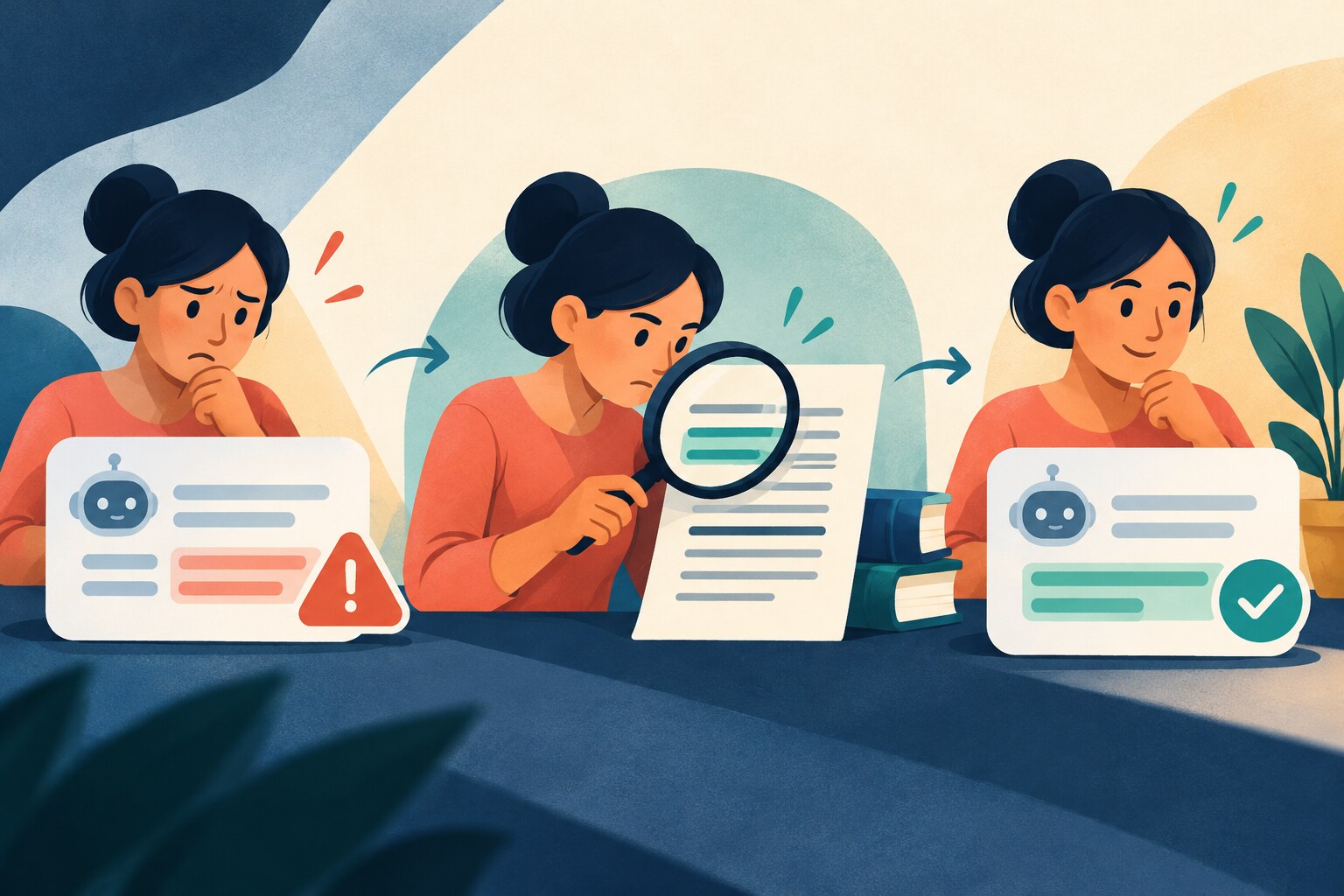
A person can doubt an AI answer, check it against a source and still make the same wrong decision. Those are not contradictory outcomes. They are three different behaviours, and each can fail on its own.
A September 2026 review in Current Opinion in Psychology separates scepticism, verification and reliance in goal-directed use of organisation-backed AI advisers. The distinction matters for workplace training. A warning may make someone cautious. A citation may prompt a click. Neither proves that the check succeeded or changed what the person did.
Measure three behaviours, not one confidence score
The review finds that most studies measure reliance, while scepticism and verification are less often measured directly. It also reports that general hallucination warnings have weak and mixed effects across the evidence reviewed. More targeted cues about where an AI system tends to fail may help, but the evidence remains limited. The practical lesson is modest: do not treat a disclaimer, a source link or a self-reported confidence score as proof of safe use.
The NCA decision test
N — Notice
Can the person recognise that the answer may be wrong, incomplete or unsuitable for this decision?
C — Check
Can they compare the material claim with an independent, current and authoritative source, rather than merely reread the AI answer?
A — Act
Does the result of the check change the draft, decision, escalation route or decision to stop using AI?
| Looks reassuring | Shows useful behaviour | |
|---|---|---|
| Notice | The user says AI can hallucinate | The user flags the exact claim that needs checking |
| Check | The user opens a citation | The user finds and reads the controlling source |
| Act | The user reports high confidence | The user corrects, escalates or rejects the answer |
| Evidence | A completion tick | A trace from claim to source to changed decision |
A successful check must be able to change the outcome
If the exercise ends after a source is opened, it measures activity. Ask what the source changed.
Worked example: an internal travel-policy adviser
Imagine an employee asks an internal AI adviser about the dinner allowance for a trip. The answer says €60 and links to the travel policy. The current policy says €45. The employee feels uncertain and opens the document, but scans the wrong section, keeps the €60 figure and submits the claim.
Reading is a start. Practice makes it stick.
Start learningRun the answer through NCA
- 1
Notice the decision point
The claim affects a reimbursable expense, so the employee marks the amount and policy version for checking.
- 2
Check the controlling source
They open the current policy, search the relevant destination and meal category, and record the paragraph used.
- 3
Explain the result
They state that the AI answer used an outdated limit and identify the correct €45 cap.
- 4
Change the action
They amend the claim, preserve the source reference and report the stale answer through the approved feedback route.
- 5
Test transfer
They repeat the method with a different policy question where the original AI answer is correct.
This example reveals four possible outcomes. A person may not notice the risk. They may notice but not check. They may attempt a check and miss the error. Or they may find the error but fail to change the action. A single score called “trust” hides those differences and gives the training team little guidance about what to practise next.
Design the review around the decision consequence
NIST’s AI Risk Management Framework calls for documented human oversight, context-aware interpretation of outputs and feedback mechanisms that can support appeal or override. The UK Government AI Playbook similarly says people remain accountable for outputs and should validate them in proportion to impact and risk. For a low-stakes internal note, NCA may take a minute. For a public, financial, legal or people-related decision, the source, reviewer and release rule should be explicit.
Evidence that a verification habit is working
- The learner identifies the exact claim or recommendation that needs checking.
- The source is independent of the generated answer and current for the task.
- The learner distinguishes opening a source from finding the relevant evidence.
- The result records whether the claim was confirmed, corrected or left unresolved.
- The final action changes when the evidence changes.
- Unresolved or high-impact cases follow a named escalation route.
The European Commission’s AI-literacy guidance also emphasises context, purpose, user knowledge and the skills needed for human oversight. That supports task-specific practice: the relevant check for a policy answer differs from the check for a calculation, a customer message or a ranking of people.
Build a ten-minute NCA exercise
- Choose a low-risk fictional decision supported by an AI answer.
- Plant one plausible error in a material claim and provide the correct source.
- Ask the learner to mark what requires verification before opening the source.
- Observe whether the learner finds the controlling passage, not just any related text.
- Require a final decision note that states what changed and why.
- Repeat with a correct answer so that checking does not become automatic rejection.
Pair the method with the “nothing found” coverage check, the UNIT number check and the evidence-versus-hypothesis sales brief. Each one gives the check stage a concrete form for a different type of work.
The aim is not permanent distrust. It is appropriate reliance. Good AI practice makes the path visible: notice the risk, check the right evidence, then let the evidence change the decision.
Practise the full behaviour
Bokili turns verification principles into short role-based missions with a task, an evidence bar and feedback. The useful proof is not that someone read a warning. It is that they made a better decision.
Sources
- Hallucinations in organization-backed AI advisors: Evidence about skepticism, verification, and reliance in goal-directed use — Current Opinion in Psychology / PubMed
- Artificial Intelligence Playbook for the UK Government — UK Government
- AI Risk Management Framework Core — NIST AI Resource Center
- AI Literacy — Questions & Answers — European Commission
- AI training for HR & L&D leaders — Bokili
Reading is a start. Practice makes it stick.
Bokili turns skills like this into ten-minute missions for your whole team, with instant feedback and progress you can see.
Start learningKeep reading

AI Training Platform for Companies: Run a Localisation Test
Test whether multilingual learning adapts language, work context and assessment while preserving one clear evidence standard.
AI Training for Employees: Check the Numbers Before You Use Them
AI training for employees should teach the UNIT check: label the unit and period, expose the base, then recompute the total.

Demo, Simulation or Live Work? Choose the Right AI Practice Format
Match AI practice to the consequence of the task: demonstrate the method, simulate the judgement, then use live work with review.